
five centuries of art between dream and reality
A warmly dressed little girl is immersed in the blissful sleep of childhood, on a church pew. This touching painting by the Englishman John Everett Millais is humorously titled My second sermon (1864). Hanging almost in front, The Violet Merchantpainted by the Parisian Fernand Pelez a few years later, powerfully captures the exhaustion of a small salesman, pale from malnutrition, suddenly seized by sleep in the corner of a door.
Confident abandonment or forgetting of sorrows, open door to dream or torment… Thanks to a careful selection of one hundred and thirty paintings, sculptures or engravings, the exhibition at the Marmottan Monet museum, in Paris, presents sleep in its ambivalences and shows the richness of a theme that spans the ages. No doubt because “the sleeping model is ideal. He does not move and, in his abandoned body, the painter can capture a little of his intimacy, of his unconscious,” summarizes Laura Bossi, the scientific curator.
A journey of five centuries
Without seeming excessive, as it is so rhythmic, the journey succeeds in this ambitious challenge of making us discover these various faces of sleep through five centuries of art history – from the end of the Middle Ages to the contemporary era, with a focus on the 19th century. The eclectic choice of works exhibited offers us a moving journey through different periods. The first rooms return to the great founding texts, a permanent source of inspiration for artists, which provided many sleep scenes – more than fifty in the Bible!
The dangerous drunkenness of Noah is thus evoked by a superb painting by Giovanni Bellini dating from 1515. An astonishing medieval sculpture of the sleeping of the Virgin, where the apostles are joyfully grouped along her bed, introduces the part devoted to the New Testament. Not far away, a Christ resurrecting Jairus’ daughter – who simply seems to wake up despite the fly on his arm – testifies, under the brush of the Austrian painter Gabriel von Max (1878), that death is only a transitory “sleep” while awaiting the Resurrection.
From mythical to dreamlike
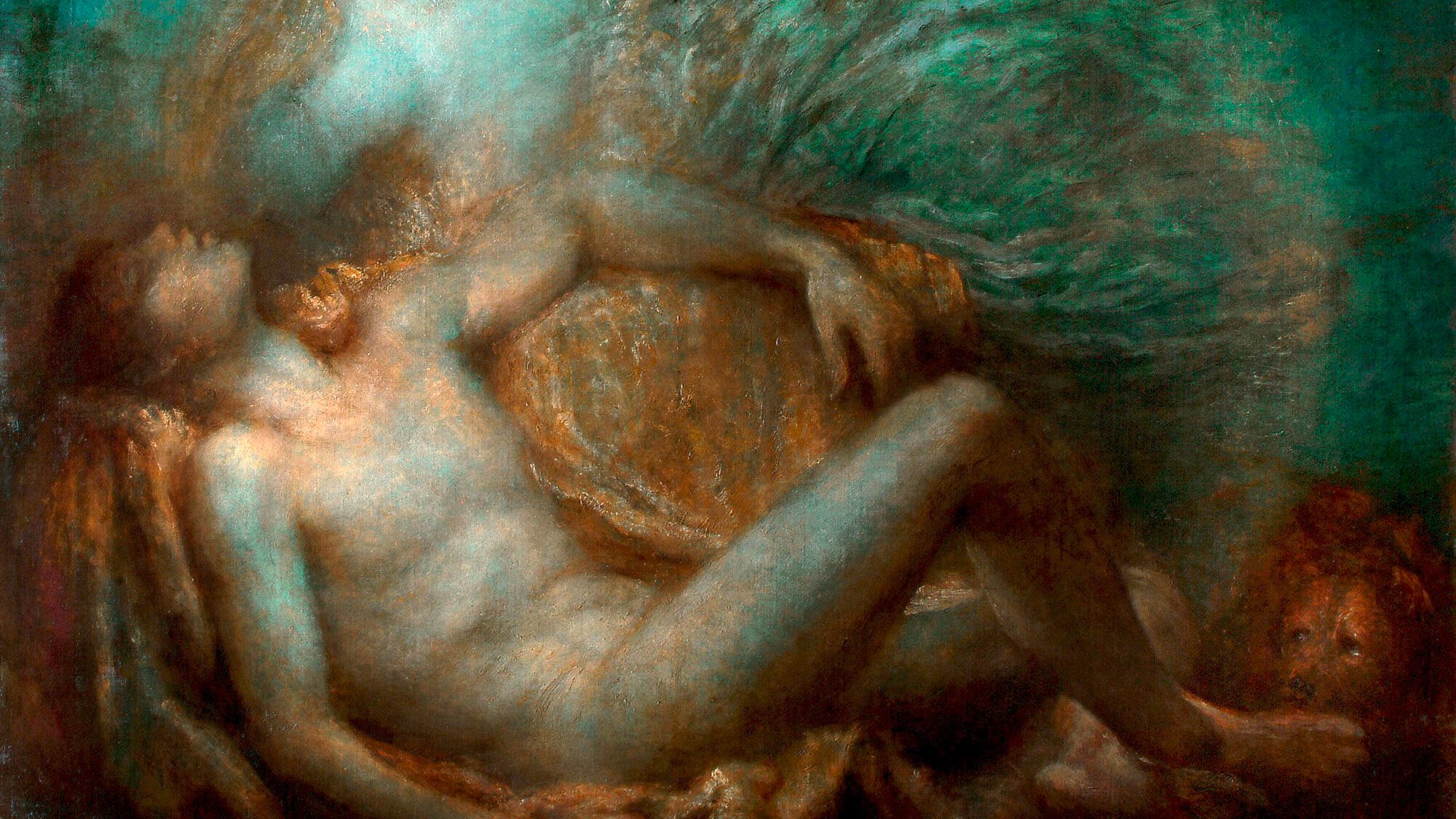
Ancient myths and fairy tales are often a pretext to reveal the erotic dimension of sleep, whether it is a dozing Venus, Sleeping Beauty, or Selene in love with Endymion whom she puts to sleep for eternity…
Then the journey branches off towards the world of dreams, hallucinations and artificial sleep… “Painters have the privilege of being able to link, in the same work, the sleeper and his dream or his nightmare,” explains Laura Bossi who is also a neurologist and historian of science. The 19th century is particularly rich on this subject, especially as we begin to interpret dreams no longer as prophecies but as windows onto the sleeper’s past and his unconscious.
Dizzying images
At this time, artists also became interested in sleep pathologies. A dramatic painting by the Czechoslovakian Maximilian Pirner, from 1878, presents the romantic figure of a disheveled young woman, with closed eyes, who advances on the cornice of a building. A cliché that defies medical reality. On the contrary, Gustave Courbet reflects, in a very realistic portrait, the intense but lost gaze of a sleepwalker (1855). Edvard Munch’s later self-portrait The night owl (1924) directly challenges the visitor with its insomniac features, “this evil which appears with modern urban life”, comments the curator.
Birth, death, rest or illness… The journey draws on all stages of the artists’ lives, such as this modest portrait, blurred by veils, of Camille Monet on her deathbed that her husband, Claude, could not help painting one final time (1879). Or the shared sleep of the wife of the Spaniard Joaquin Sorolla y Bastida (1900) with their newborn child, their heads alone emerging from the sheets in a striking shades of white. Contrary to any voyeurism, these works touch us precisely through the tender intimacy they reveal. This artistic journey then joins our human experience.