
In Roubaix, an exhibition on the timeless La Redoute
In Roubaix, the industrial history of the North can be read on the surface of red bricks and the height of chimneys. There, within the Art Deco setting of the La Piscine museum, a symbol of the past splendor of the former workers’ town, a commercial and human adventure is woven together that is worth the detour: that of La Redoute. “The city and the brand are inseparable,” immediately announces Karine Lacquemant, curator of the museum.
It all started just a stone’s throw from here in 1837, when a certain Joseph Pollet opened his first spinning mill. In 1873, his son Charles set up a second factory in the nearby rue de la Redoute, which would give his name to the company. After the Great War, he began making stockings and socks.
One day in 1922, faced with a large unsold stock of wool, management had an idea: sell the merchandise directly to individuals, who would be informed of the windfall through an article in the local daily.
Family totem
That’s the trigger: the company is overwhelmed with orders and ships the items by postal parcel. “It was Vinted or Amazon before its time,” laughs Brigitte Danhieux, exhibition guide. At the same time, La Redoute launched Pénélope, a knitting user manual combining advice, patterns and knitting techniques, which is gradually being expanded with cooking recipes and other practical information.
The first issue of the mail order catalog (VPC), published in 1928, has 16 pages and 40 articles. Very quickly, the object becomes a family totem and the brand’s best commercial asset. Its circulation will increase until the record of the 1992 edition: 1,250 pages and 8 million copies…
At the foot of the wall where the most emblematic “headlines” of this “directory” are displayed, visitors let their memories flow. Nadine, a septuagenarian who came from Île-de-France with her daughters, confides nostalgically: “In my grandmother’s kitchen, my mother peeled it religiously, pencil and notebook in hand for orders. »
I can’t help but share with Nadine the memory of my aunts, in the 1980s, in Cameroon, placing an order for curtains which would arrive by boat a few months later! I thus taught my interlocutor the international nature of this company, which she thought was confined to France.
Clothing, household linen, bedding, fabrics, raincoats for bicycles: in the 1940s, the offer diversified. And just after the war, children’s toys entered the catalog, then decorative items.
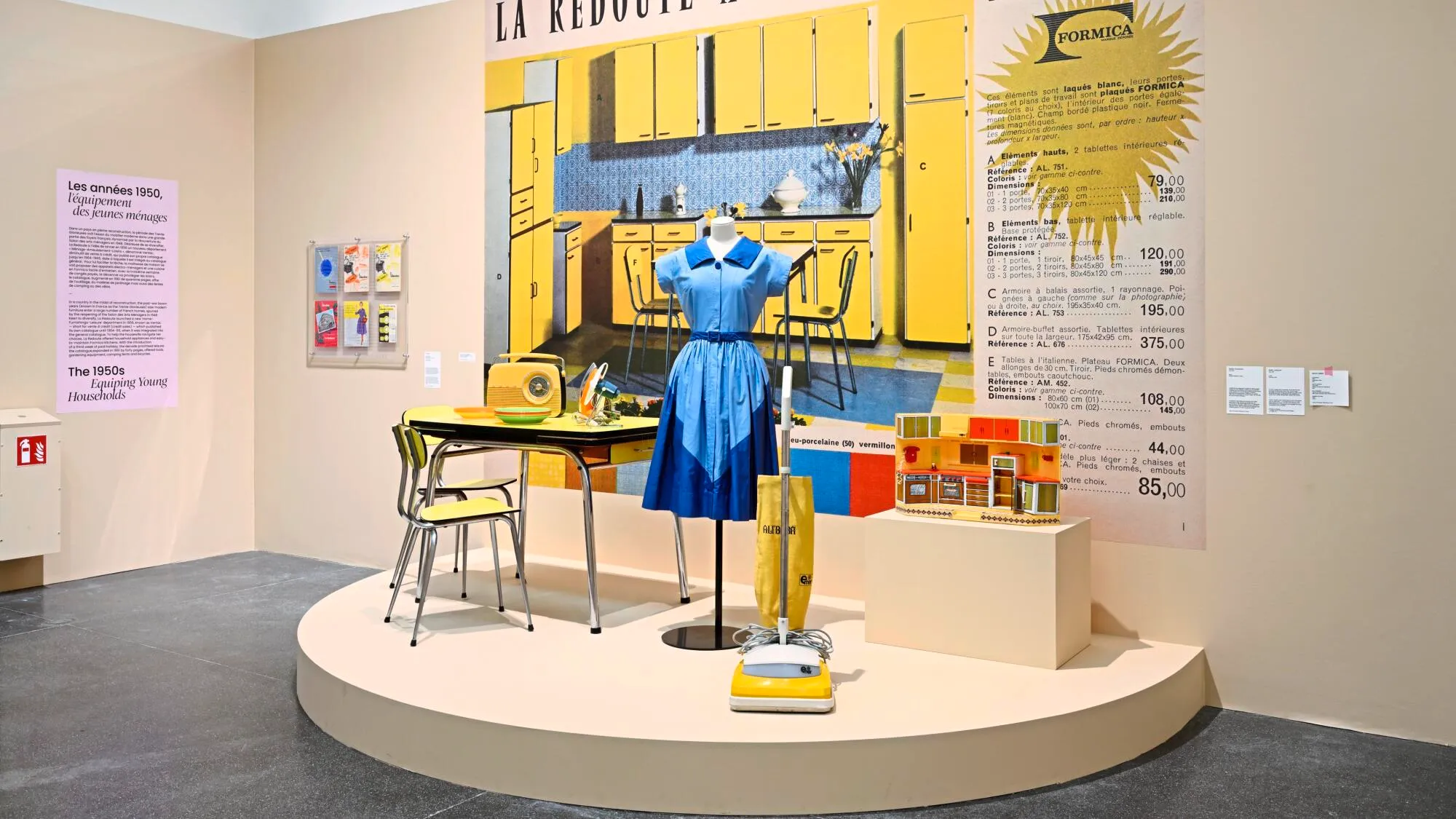
The company, gradually abandoning its productive activity in favor of mail order, adds furniture to its portfolio. Hence the eclecticism of the 300 objects on display, which bear witness to the evolution of fashions and habits: a Formica kitchen, a pink gingham Bikini, an orange stool or a scriban wall-mounted secretary.
La Redoute also supports social changes. The emancipation of women constitutes one of the central themes of the exhibition. In the workshops, 90% of the staff consisted of workers aged 12 to 25. “They left their jobs right after to avoid becoming catherinettes,” explains Brigitte Danhieux.
Outside of factories and warehouses, this revolution took place in the privacy of homes. “Have you ever bought your husband’s underwear over the phone?” » asks a poster.
Along the route, advertisements, catalogs and photographs show that wives and mothers, who dictate purchases, were clearly targeted by the slogans. This is also evidenced by the famous Kangaroo card, a free credit card reserved for women which allowed housewives to spend without asking their husband’s authorization.
Still on the communication side, La Redoute crisscrossed the entire territory with its green trucks displaying the brand logo and bearing the slogan “Quickly, we deliver”. Between 1979 and 1985, a La Redoute cycling team even participated in the Tour de France.
Vintage objects
In 1969, telephone sales were launched. In 1984, place at Minitel. The promise of delivery in 48 hours, then in 24 hours, far precedes current standards. With the rise of ready-to-wear, La Redoute relies on stars to seduce.
The visitor encounters Sheila and Sylvie Vartan, as well as clothes by designers such as Sonia Rykiel, Yves Saint Laurent, Elsa Schiaparelli, Jean Patou and Azzedine Alaïa. Over the decades, the dress gave way to pants, sportswear took over, and the leisure society invaded the pages. Today the brand is opening up to a new wave of designers. It is with their creations that the visit ends.
After the opening of the website and the online store in the mid-1990s, a turning point was taken in 2015 with the abandonment of the paper catalog. “The copies have become vintage objects that are sold in flea markets and on online platforms,” Brigitte Danhieux tells us.
Proof that La Redoute belongs to the collective imagination, transcending generations and social circles. Through changes in ownership, globalization and crises, the adaptation of the old lady continues, not without clashes, like the strike of employees at the Wattrelos site in March 2025.
But this flagship, which has spanned two centuries, continues to weave links between the industrial past, innovation and social transformations. While, under the vaults of La Piscine, his odyssey is rediscovered, thread by thread.


