
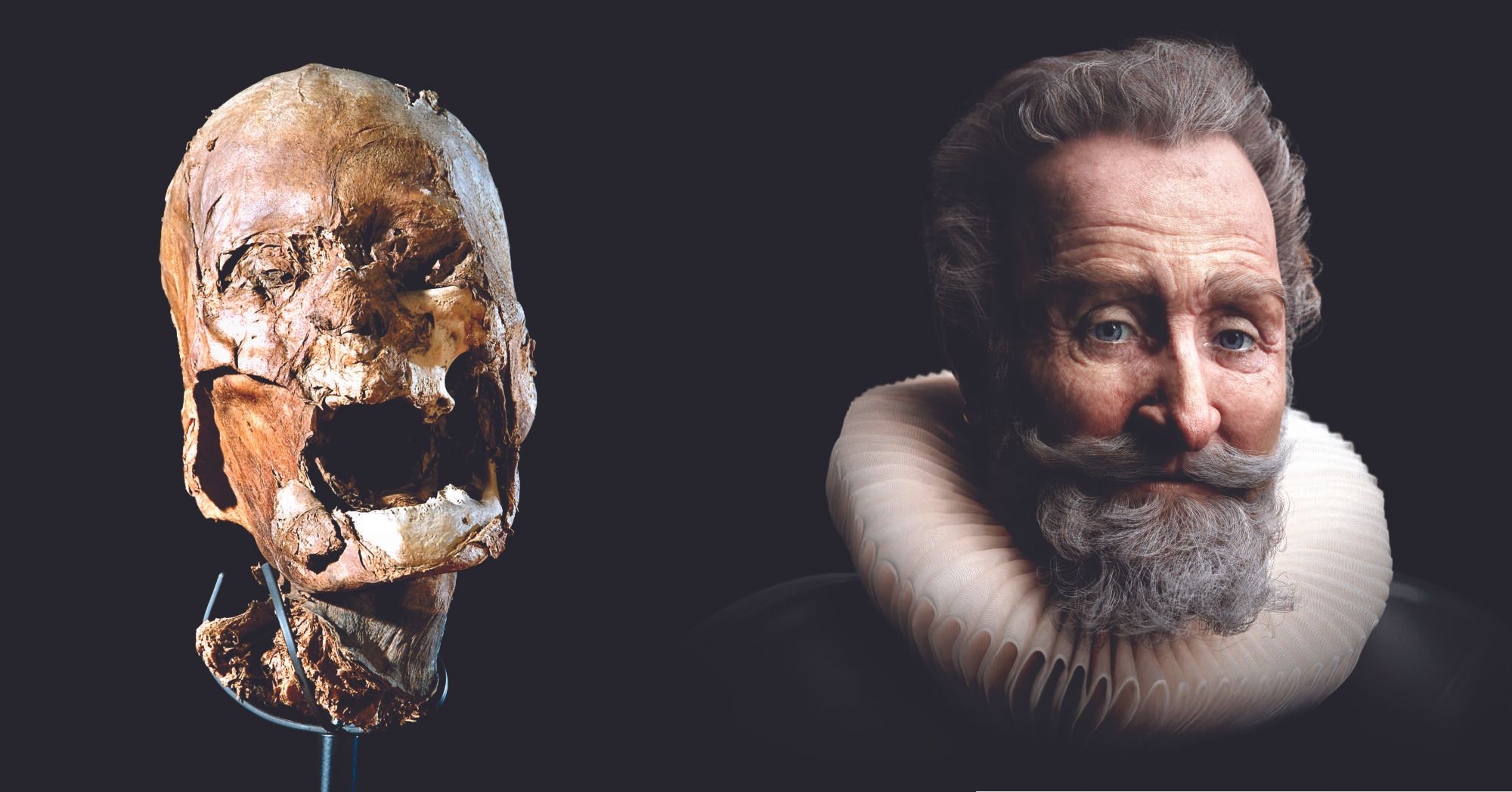
How the voice of Henry IV can help patients who have lost their speech
It was said of “good King Henry” that he had a “witty and conversation ready for jokes and witticisms (1). »
Thanks to several teams of specialists (2), whose work has just been published in the Journal of Voice, we can now listen to his voice, “mocking and mocking”, as his contemporaries of the 17th century enjoyed it. For the moment, these are only snippets: a series of phonemes (a, i, u and e), with a rather low range.
This result represents a feat. Because “the voice of Henry IV was reconstructed from anatomical realities”, underlines Dr Robin Baudouin, surgeon at the Foch hospital in Suresnes (Hauts-de-Seine), co-author of the study. In other words, it is neither a simple synthetic voice nor sounds said by an actor, but a voice produced from the remains of the sovereign.
Making a dead person speak: the feat is unprecedented. It is in fact based on the exploration of the head, neck and first cervical vertebrae of Henry IV, found mummified.
The story is incredible: the head, desecrated and decapitated during the Revolution, passed from hand to hand among collectors, then was finally authenticated.
Luckily, it is “in an exceptional state of conservation,” says Dr Philippe Charlier, forensic pathologist and archaeo-anthropologist, director of Laab, who has been carrying out research for fifteen years. Firstly because by draining him of his blood, the fatal blow delivered by his assassin Ravaillac protected the body. Then because the autopsy and embalming were of high quality.”
A medical breakthrough
His study made it possible to model the king’s larynx, sinuses and tongue in 3D. Then, it was necessary to take into account the dental prostheses and correct the position of the head, which would have distorted the voice. Finally, “we passed a volume of air through the physical modeling of the larynx, in order to vibrate the vocal cords,” explains Dr. Charlier.
This work could benefit patients with ENT cancers, those of the mouth and neck organs – 15 to 20,000 per year – whose voices have been altered by an operation. “It will allow us to better understand and individualize the changes caused by surgery,” hopes Dr. Baudouin. In the meantime, the researchers plan to hear, before the summer, the voice of the Vert-Galant reading the Edict of Nantes… With his strong Béarn accent, of course!
1) Giovanni Botero, Piedmontese author.
2) Anthropology, archaeology, biology laboratory (Laab) at the University of Versailles-Saint-Quentin-en-Yvelines; Foch hospital in Suresnes; CNRS/Sorbonne Nouvelle phonetics and phonology laboratory; imaging from the Pitié-Salpêtrière hospital.