How Thomas transformed his stuttering into strength
Saturday, February 1, 2025, in Lyon. Fluo vest, helmet screwed on his head, Thomas pedal to the Rockefeller campus of Claude-Bernard University, specializing in health professions. In front of the imposing main building, he marks a hesitation, tired after a week busy at work, a night shortened by the rehearsals of his rock metal group …
But an inner voice insists: “You are not there by chance. “It was his speech therapist who told him about the baptized competition The eloquence of stuttering. Not a competition, rather a space to tame your voice. Skeptical, he had his head. But after all, what did he have to lose? The young man holds his bike, climbs the steps, pushes the front door.
It is 8:30 am. In a room bathed in pale light, floats with coffee and pastries. Thomas tightens his goblet in his hands to give himself a capacity. Around him, young workers, a retiree, a father, a few young women … A smiling man speaks “Nothing but being here, it’s huge.” I too went through this stage. And today, I lead the Master Class! ” He presents himself: Charlie, winner of the first Lyon edition, in 2022. By his side, Kévin, former finalist: “The only limits are those that we impose on ourselves. Their voices sometimes hesitate but their interventions remain clear, fluid. Thomas understands instinctively that they embody what he came to seek: the ability to express himself without apprehension in the face of an assembly.
A stuttering that appeared brutally
“Who wants to introduce himself?” Silence. The looks are lowered. Then, in the second row, a finger rises. It’s him. Despite his apprehension, he perceived the benevolence of the room, the lack of judgment. His chair scraped the ground. “Hello … er … me, it’s Thomas. I am 30 years old … I am an IT engineer … I have been playing drums since I was 8 years old … well … I like science … Role games, that’s it … “The words spring up in jolts, the breathing is accelerating. “I came to … see if, er … if what we said was true. That it could help me … talk … in public. ” A silence. Then the applause burst, sincere. In the ranks, Juliet, young volunteer speech therapist, smiles. “He just put his first words,” she thinks. He will have to help him polish her voice so that she is less jerky, released from tensions due to stress. ” She will be her coach for the next seven weeks … at least, if the young man reaches the final, scheduled for March 15. Other hands get up: Gilles, Bastourou, Maxime, Hinda, Taha… and Raphaël, 28, engineer like him. They will finally be twelve to compete, four having withdrawn.
By listening to them, Thomas suddenly becomes aware of not being the only one “to live this”: to live this frustration felt when one tries to formulate a sentence, but that the words remain blocked, suspended in a silence which seems to last an eternity; When, opposite, the interlocutor, often distraught, reveals his desire to breathe them. His stuttering appeared suddenly, when he was 8 years old, like a pressure in his throat, a breathless breath, tightening of the face, eye blinks. His mother, Annie, believed the consequence of school harassment. Thomas connects this disorder to a specific memory, one day that he argued with her and told her that he was sad. When she replied, without wickedness, that it did not bother her, the little boy felt a strong feeling of abandonment. Distraught, her parents consulted a child psychiatrist … A rebouteux, even. But nothing has unlocked.
Thomas still learned to get around the corner that were cornering, punctuating his sentences with “Uh … well … so …” So many crutches, support to relaunch his breathing. His speech therapist taught him the visualization of words before letting go of a single breath. A method that works … up to a certain point. To defuse the embarrassment, he pretended to be nothing, despite the mockery, rare but hurtful. And to preserve himself, he invents a character from Intello Matheux, a little away but cool, funny, not too serious. Its shelters are drums, video games, role -playing games.
Twice a week, Thomas seeks to understand the mechanisms of eloquence as we dismantle an engine.
Recognition of his quality as a disabled worker
It took years of silence, failures, detours, so that the young man agrees to recognize himself stamped. For a long time, he avoided this word too heavy, too stigmatizing. Why define himself thus, he who has always been a good student, at the Lycée in Roanne (Loire), before joining the National Institute of Applied Sciences in Lyon? He preferred to speak of “blockages”, “passing tensions”. However, to go in university exchange in Australia, he had to accept that his English teacher wrote a letter stating that he was stammered. A shock to see the word written black on white. On the way back, new cold shower. A graduate and motivated, Thomas thinks of finding a job easily.
But during a videoconferencing interview, he felt the discomfort of the recruiter from the first minutes. And the more he forces himself to speak well, the more it blocks: “I know what I want to say, I just want her to give me time to express myself! He enraged internally. A few days later, she clearly admits to Thomas that her stuttering poses a problem for her integration. He cashes. He must face the facts: he must undertake a request for recognition of his quality as a disabled worker (RQTH) – an approach difficult to assume. But paying: last fall, Thomas won an engineer position. And the company has accepted some developments such as using a table to facilitate exchanges in meetings with its colleagues.
Tame your voice as a technical tool
At the Rockefeller Health Campus, every Thursday evening and every Saturday, Thomas finds the other candidates of the competition. In the large room, he takes notes, gets involved in each workshop: posture, breath, intonation, sophrology … He seeks to understand the mechanisms of eloquence as we dismantle an engine. He learns to put the microphone under his chin, to stand straight behind the desk, to tame his voice as a technical tool. Little by little, the young man feels more comfortable. He often settles alongside Raphaël who, he fights with each sentence to get out of the recalcitrant syllables.
Almost the same age, they both discover themselves passionate about mathematics. During a workshop dedicated to the art of argumentation, they choose the same subject that challenges them: “Will artificial intelligence eventually go beyond human intelligence?” “How do you plan to do it?” questions Thomas. “With a touch of humor,” replied Raphaël, well aware that his difficulties in articulating the “R” and the “Ch” will not simplify his life. “You will have to do it with it anyway.” “I will explore AI as a parallel universe,” says Thomas. After each speaking, they exchange in a low voice impressions and encouragement. In this duo, everyone finds real support.
He does not say his text, he lives it
February 22. For the first playoffs, Thomas chooses an apparently light, almost provocative subject: “Can we be a good royalist by being stuck?” A theme nourished by his love of role -playing games, populated by fantastic creatures and multiple voice to embody. He annotates his text punctuated by highlighted passages and codes on the fringes: here a break, there a whisper, elsewhere a votes. His own stage language. But the test remains formidable: seven minutes to put his voice, master his gestures, captivate the audience. It applies the three pillars of eloquence: body, argumentation, expressiveness. “How dare you, miserable deadly, desecrates this sacred place!” he launches, inhabited. He does not say his text, he lives it. The public adheres. At the end, Pierre-Alain, folk singer and volunteer speaker, congratulates him: “You have gained in clarity. You can go further.” The other candidates confirm that he is launched for the next round.
March 1st. For the semi-final, the subject is imposed: “Is curiosity an ugly defect?” Thomas seizes it with method. Several work evenings have prepared it. Concentrated, inhabited look, it advances towards the microphone. For him, curiosity is not a defect but a vital impulse: the one who pushes to explore, understand, move forward. He illustrates his demonstration by citing scientific advances. And it works. He captures attention, convinces, holds the scene with confidence. At the end of the event, his name resonates: Thomas will be among the six finalists in the competition. By his side, Raphaël, of course, and Hinda, a chemistry student who, still recently, collapsed after talking for three minutes. Next step: the final, at the Palais de la Mutualité in Lyon.
His speech becomes performance
Saturday March 15. New issue, with a majestic scene and more than 300 spectators for decor. In the room, Annie and Daniel, discreet retirees from Roanne to listen to their son defending the “no”, the position imposed on him by drawing to the question: “Are the appearances misleading?” In the audience too, Michaël and Loubna, two close friends, who have already seen Thomas behind the scenes in black jacket, cap screwed on the head, metal t-shirt, skull rings. He is the last to pass in front of a jury which has figures in the world of disability, associative, cultural and a champion of eloquence.
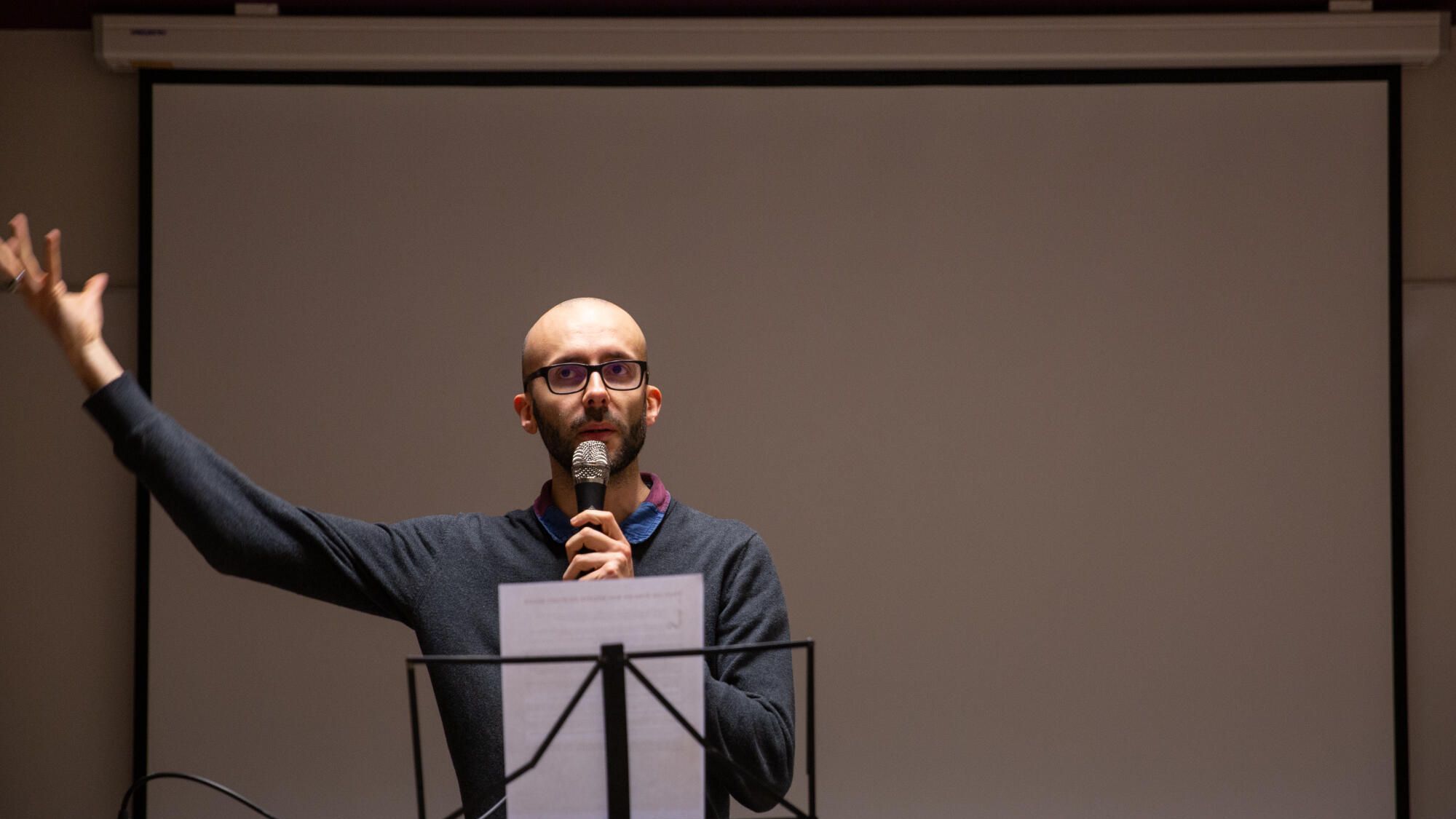
Before his visit, Juliette, his coach, went on stage: “He knows by heart the first 151 Pokémon, embodies dozens of characters in play … He will bluff you! Here is Thomas. ” Drum rolling, before appearing, in a halo of light, the young man. Calm, it adjusts the microphone, puts its notes on the easel. Then, his voice rises: “Frustration, helplessness, disarray … Emotions scroll, the face freezes: a motionless storm caused by words. Yes, I stutter. And that’s how. Appearances are not misleading. The discussion will be laborious. “
Throughout his speech, he engaged, modestly evoking a pretty saxophonist met at the Conservatoire who declined her invitation. And here he is who takes off his cap, reveals his skull and confides: “No doubt, I lose my hair.” Laughs in the room. His speech becomes performance, up to a conclusion in the form of a call: “I have known rejection and helplessness. Today, I say to the Bègues: “Speak. This competition can change your life.” “
“Today, I say to the Bègues: speak. This competition can change your life ”
Thomas
Daring to be himself
While the jury deliberates, Michaël and Loubna observe him who radiates and seems soothed. His parents now see a confident man in front of them. Their son receives the prize for the pen, his text having been hailed for his sincerity. Very moved, he expresses his deep gratitude to other candidates and the coaches: “Their look, their patience, their listening … have never failed.”
Among the other winners, Raphaël won the prize for humor, while Hinda won the Grand Prix thanks to a remarkable fluidity service, which, a few weeks earlier, still came up against each sentence. His diploma in hand, Thomas suddenly becomes aware that it was this strength of the collective that allowed such shared success, without a spirit of competition. And if he was involved in the next edition of The eloquence of stuttering, But this time as a coach? In the meantime, he savor this afternoon, his greatest victory: to have finally dared to be himself.
Benchmarks
- 19 editions From the competition, the eloquence of stuttering have been organized since 2019, benefiting 352 participants and sensitizing more than 8,450 spectators.
- Over 600,000 people carry this disorder in France, either 1 % of the population. Begament generally appears in childhood, affecting 5 % of young people according to a girl ratio for three boys. In three quarters of the cases, he disappears around 5 or 6 years old, provided he is spotted and taken care of early.
- October 22. For twenty-eight years, it is the International Day for Boat Awareness. Source: Ministry of Health.