
In Puy-de-Dôme, artisanal paper comes back to life
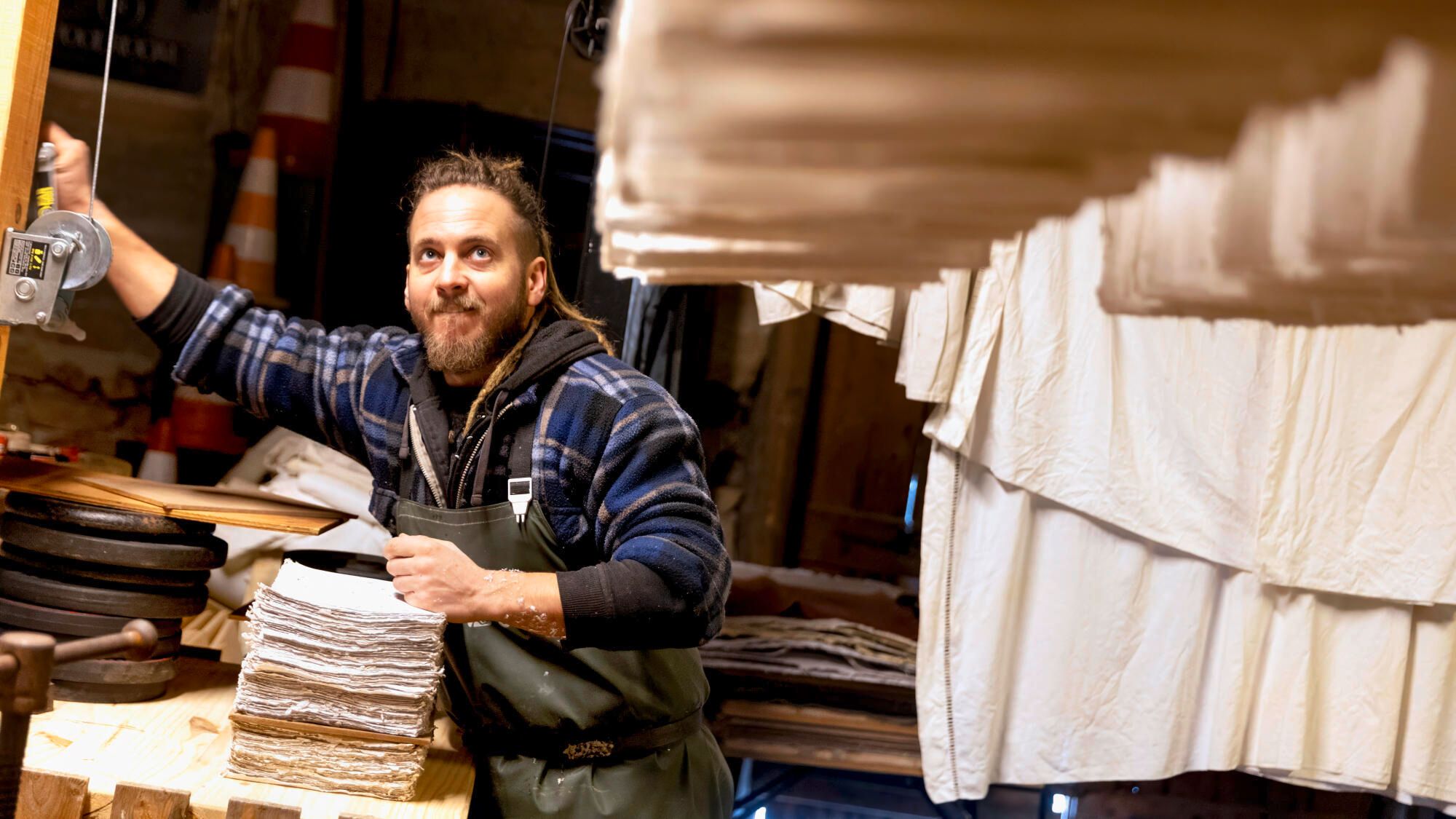
A brief bark, then frank yips, before pointing its nose forward to identify the new arrival. Ringo presents himself as the guardian of the singular universe of Étienne Gouttefarde. In Marsac-en-Livradois (Puy-de-Dôme), his workshop is nestled on the edge of the woods, in the barns of “one of the largest farmhouses in the village, bought by my parents before I was born”, specifies the thirty-year-old. Checked shirt with sleeves rolled up to the elbows, large waterproof green apron marked by water and paste, rubber boots ready to face splashes: the outfit says everything about the gestures and physical efforts involved in his job as a paper craftsman.
However, nothing destined him for this path: scientific baccalaureate in Ambert, master Staps in Clermont-Ferrand, followed by four years of travel in Australia, Asia and South America. “And then I wanted to come back and turn to a manual profession,” he says. By delving into local history, he discovered that Livradois was a large paper-making basin, punctuated from the 14th century by the mallets of water mills. A forgotten past that he chooses to revive following an experience in a tourist paper mill in the region. An activity that has become a passion that he is nourishing by creating his own workshop, Les papiers de la grange*, in 2024. “At the beginning, I only had a tank in a corner… Since then, I haven’t stopped. I annexed all the space, I now have three workplaces,” he says with a laugh.
From rag to leaf
The first accommodates the recycling of shredded paper that Étienne transforms into sheets. “It’s a recovery of waste and an ideal support for integrating plants: ferns, cornflowers, lichens, carrot tops, hazelnut skins, fir needles… The possibilities are unlimited,” he enthuses.
The plants and vegetables come from the surrounding gardens and woods, when they are not unsold chrysanthemums from a florist.
In a second space, Étienne works on plates of fibers from textile residues, particularly cotton, using a Dutch pile, a machine for creating paper pulp, passed down by a Belgian colleague who had taken him under his wing. But his favorite workshop remains that of “real rag paper”, a space called Didier-Faure, in homage to the papermaker who gave him a Dutch stack designed by his hands. There are only old linen, hemp or cotton sheets here, from all over France. “The best thing is that they have never known modern detergents. Softeners damage the fiber,” he insists.
Manufacturing begins at the scrapyard to cut the sheets into strips, before putting them in the Dutch pile. Five to seven kilos of rags will bathe in the water of the well for six hours and be crushed. He collects a paper pulp to which he adds a glue based on pine resin and kaolin, as well as a touch of alumina sulfate to adjust the pH.
To stir, he hijacked a redable, a cheesemaker’s tool used for Fourme d’Ambert, “perfect for stirring the dough”. At Étienne, there are no manufacturing secrets. “My philosophy is transparency. Show, explain, transmit. » On Instagram, known by the humorous alias “le_dur_de_la_feuille”, he shares everything: the dump board in action, the pile, the tank, the press, the drying rack. His videos, silent but rich in technical gestures, have gone viral.
Award-winning know-how
Today, Étienne’s papers are found among watercolorists, engravers, designers, decorators, and even on the tables of starred chefs. His productions include invitations for individuals, supports for gourmet menus, lampshades, etc. In 2025, he received the Aurhalpine heritage prize in the know-how category. But success has a price: “I would need forty-eight hour days!” » he confides. Because, between communication, logistics, online store and points of sale, everything still relies on him.
His partner, Coline, is preparing to join him in the adventure to help him, a condition for “continuing to create, welcome, explain, without exhausting ourselves”, he admits. And to warn: “Everyone is welcome, but please make an appointment by email. Above all, don’t come unexpectedly! » The price of success…
* lespapiersdelagrange.com
Recipes for success
- Social networks: Étienne relies on his 232,000 subscribers on Instagram, 54,000 on Facebook, 24,000 on TikTok, and soon a YouTube channel.
- Recovery: Unable to invest but also because certain tools no longer exist, the craftsman relies on second hand: sieves, Dutch batteries, etc.
- The valuation: By offering courses and visits, it promotes its craftsmanship, while offering the opportunity to discover a territory nestled in the heart of the Livradois-Forez regional park.


