
in the shadow of the Combalou cellars, exceptional craftsmanship
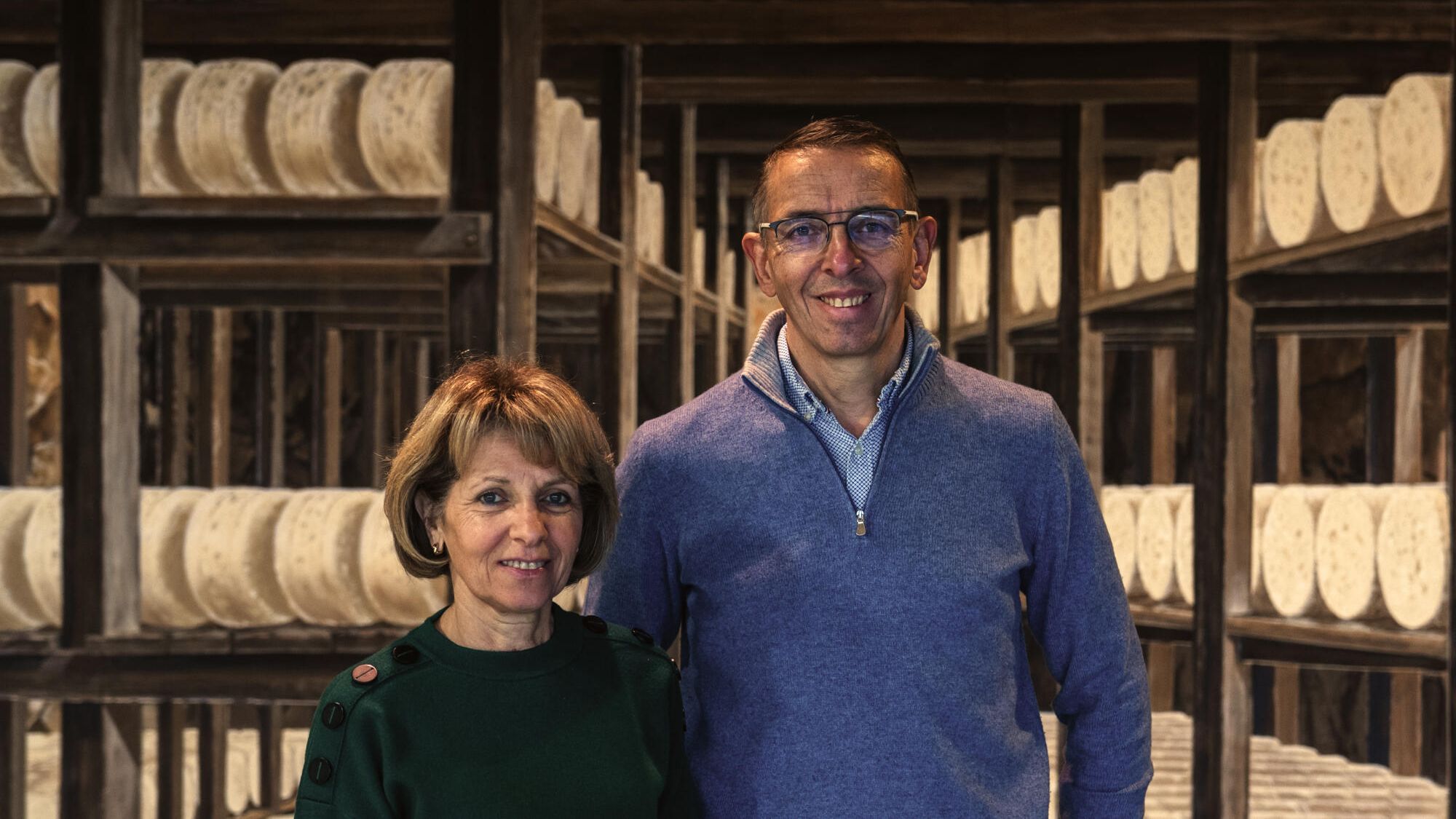
Head to the south of Aveyron, facing the Larzac plateau. In Roquefort-sur-Soulzon, the wind rushes through the faults of the Combalou mountain, caresses the cellars and gives birth to a miracle: Roquefort. In this village clinging to the limestone rock, Vincent and Marie-Laure Combes watch over this treasure with infinite patience.
Founded in 1923, their house is today the smallest of the seven AOP Roquefort producers: less than 1% of the total tonnage, or around 5,000 cheeses per season. A fully accepted choice. “We prefer quality over quantity. Everything is done by hand, it’s our identity,” says Marie-Laure.
A cheese that tells a story
Before joining Vincent, Marie-Laure lived in a completely different world. “Originally, I have a social worker degree. Even though I am from the south of Aveyron, I was far from cellars and sheep, until the day I met Vincent. I then discovered a fascinating world.” A world that she chose to tell in 2009, by creating an exhibition space adjoining the store, open all year round to visitors.
“People are unaware of everything that is hidden behind a slice of Roquefort: the fleurine, the cellar, the manual work, the traditions… I want to share this magic.” From then on, Marie-Laure orchestrates communication, welcomes, explains, transmits. At Les Combes, tradition is not preserved: it is lived and told.
“It’s a work of patience, adaptation to the elements and love”
Vincent Combes
Master refiner, a profession of sensations
Vincent was born in the cellars. As the third generation, he learned the trade over the seasons, guided by his father. “Master refiner, you can’t learn that from books. It’s a question of experience, of observation. And every year is different: the temperature, the milk, the ventilation… You have to constantly adapt.”
For him, Roquefort is a living product, never frozen. “What I like is seeing the cheese evolve. Just by looking at it, I know if it will be creamy or firmer. It’s a matter of the senses: sight, touch, taste.” His pride is deep, always tempered by humility: “We cannot control everything. Nature decides. We accompany.”
The cellars, a sanctuary
In the basement of the Combes house, a 120-meter tunnel connects the maturing cellars, spread over four floors. They are nourished by fleurine, this natural fault created millennia ago by the landslide of part of Combalou, and without which the magic of Roquefort could not operate. It blows or sucks air depending on the outside temperature. On contact with the rock, the air becomes humid: 8 to 10°C, 95 to 98% humidity. “She’s the one who makes the cheese bloom,” slips Marie-Laure mischievously.
After ten days in this cool, humidity-saturated atmosphere, the Penicillium roqueforti little by little draws its gray-blue veins in the white paste, under the attentive eye of Vincent. The master ripener regularly probes the cheeses to assess the progress of the fungus, before performing another ritual: wrapping each loaf in tin foil to slow down the ripening. “It’s a work of patience, adaptation to the elements, and love. With us, everything is done by hand,” he insists.
This philosophy has earned the Combes house a rare distinction: it is the only one, among the seven Roquefort producers, to hold the Living Heritage Company label, recognition of artisanal know-how passed down from generation to generation.
And this is how, in the darkness of the cellars, the silence is inhabited. The humid air slides over the oak bays where the Roquefort loaves rest. Here, time is not measured in hours, but in precise gestures, repeated day after day. In this discreet breath of Combalou, Vincent and Marie-Laure Combes continue their work as artisans, faithful to a simple and demanding idea: giving the cheese time to fully express what nature has given it.


