In Togo, Sister Marie Stella saved more than 5,000 orphans from AIDS
In just a few years, you have saved several thousand children. How is this possible?
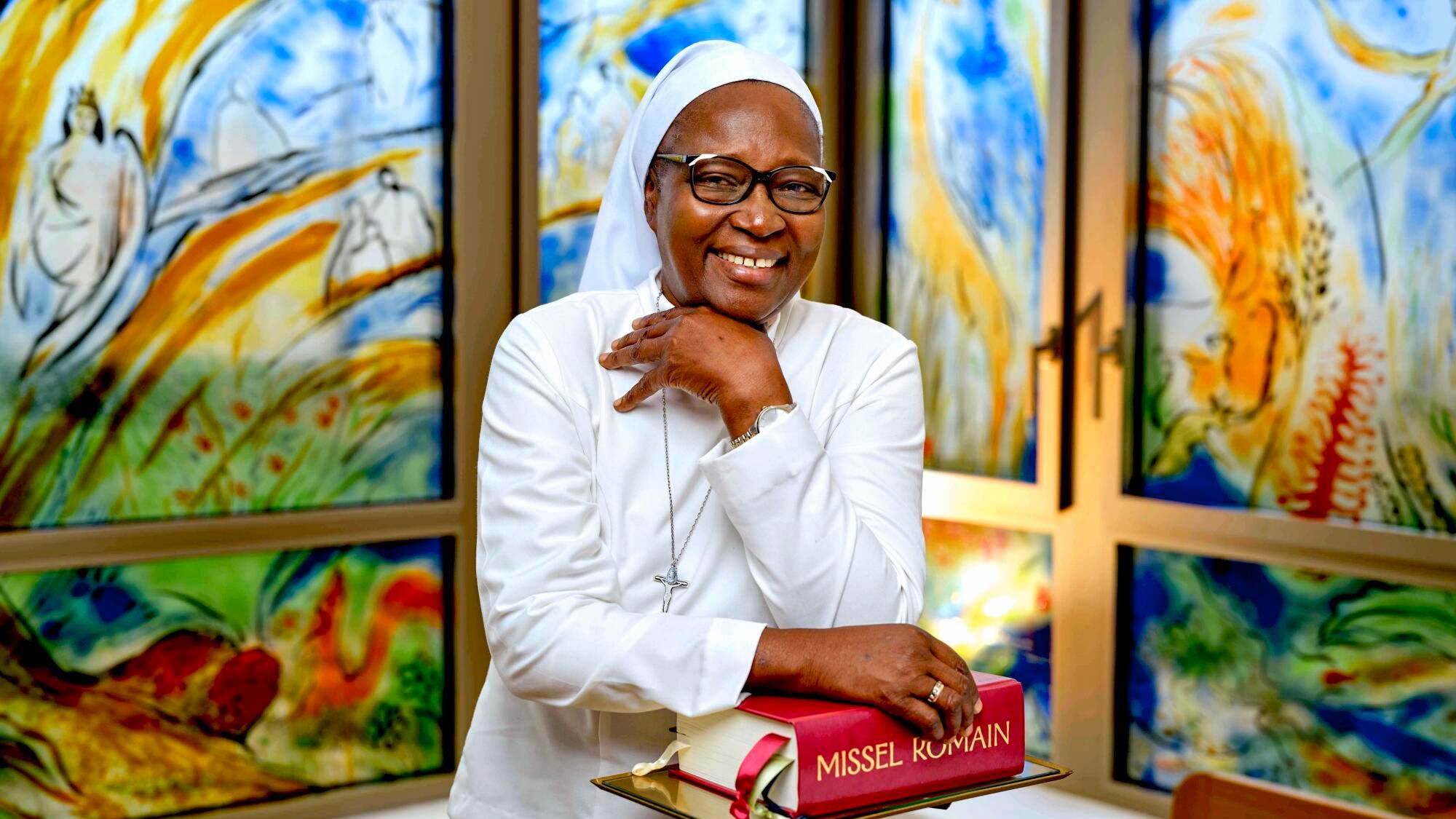
In 1999, I was a young nun, a nurse at the children’s hospital run by my congregation in Dapaong, my hometown in northern Togo. More and more, malnourished children were brought to us who we were unable to cure. These children were born with HIV, to an infected mother, most often by her husband. So I founded a small association, Living in Hope, with a few volunteers who thought, like me, that we needed to act.
I began to travel through the villages on a moped: I brought supplies to wash the sick, give them porridge… I buried many parents who left children behind. Coming from a large family, I myself had been raised with an uncle. I thought these orphans could be welcomed, as I had been. Unfortunately, discrimination against AIDS patients had broken this community solidarity, which is the wealth of Africa.
Were people afraid?
Yes. HIV-positive people were often locked in their huts where they were left to die of hunger and thirst.
Or they were chased out of the village, deemed useless because they were too weak to work, and above all dangerous. We thought they would infect others. And when in a family, one of the children was infected, we considered that all the others were also infected: I had to collect entire siblings.
How did you manage to change mentalities?
It was necessary to make people understand that an HIV patient was neither dangerous nor witchcraft. Bad luck in Africa still stirs people’s minds. However, AIDS is only a disease linked to poverty.
We arrived with a new message: each person is a gift from God and can make their family proud. We took action: washing the children, sharing a meal with them, holding them… Little by little, those around us asked themselves: “If a stranger can approach them like this, why not us? »
While waiting for this message to take hold, we created two family homes, in 2004 then in 2010, thanks to the help of French associations and readers of the Pilgrim that your newspaper had requested. Of the 1,600 children currently in care, more than 1,200 are being raised within their families. It’s a double success. Firstly because experience shows us that it is essential for an orphan to maintain links with his extended family. And this also means that, in our Savanes region, our awareness message is really understood. This allows us to support patients beyond just treating AIDS.
You are referring to the hospital that you created…
Indeed, the small dispensary where we discreetly received the first patients has become the Maguy hospital, in which we offer numerous services: general medicine, maternity, analysis laboratory, pharmacy, cardiology, etc.
The entire population can consult and everyone pays according to their income. So, everyone gets involved and the hospital manages to balance its accounts. From the start, we divided the children into different schools so as not to create a ghetto. However, among our orphans, those with HIV were sometimes ostracized. And the tiring treatments prevented them from following classes well. We therefore built our own school group also open to local children.
At the same time, we built a farm. It brings together a fish farming pond, livestock and seasonal crops, and allows us to feed the children. We sell surplus to generate income. We employ a psychologist, facilitators, accountants… More than 120 people now work for the association.
“These children are mine: their joy makes my joy, their doubts feed mine, their suffering becomes mine. »
Spontaneously, we see a heroine in you. But what does “save” mean to you?
It is seeing the face of Jesus behind each person, even in the heart of misery and illness. If this person, however fragile, is Christ, then I am his servant and I offer him a place in my heart.
As a nun’s first name, I chose Marie Stella de l’Incarnation. The Gospel of the Incarnation is foundational in my vocation and carries me daily. God could have sent his Son in the form of a man. But He chose to incarnate as a vulnerable infant. This littleness of Jesus came to save the world! And Mary, when the angel appeared to her, was upset, shaken too, but she chose to trust. She was not an intellectual and simply lived by her faith. I find myself in her.
Taking on the role of “savior”, isn’t that difficult sometimes?
Yes, it’s hard. Some people envy our success: the happiness of the children, the sick people saved, the volunteers who get involved… They don’t see all that this implies in the shadows: the teenager who runs away, the caregivers struggling with certain cases, the sleepless nights… These children are mine: their joy makes my joy, their doubts feed mine, their suffering becomes mine. I wear them like a mother. And I live with the fear of not being able to educate and care for them well. My team knows it, and so does God. This is the most important.
You also say that you learned from these trials…
When Mary said “yes”, she had no idea how hard Jesus would make her life! There is never complete joy in life: there are always crosses that make us grow.
Some young people rebel and sometimes leave home. At first, I took this behavior very badly. I know today that a mother’s heart must remain available. When a child leaves, I tell him: “The door of the house will always be open to you; I simply ask you not to damage your life by allowing yourself to be contaminated, by becoming a delinquent… because then I would be powerless to support you. » Since then, some have returned. And among the adults we have raised, many in turn help their “brothers and sisters”.
Living in Hope means deciding every day not to let joy fade away.
As the Jubilee of Hope comes to an end, what does this word mean to you?
Living in Hope means always keeping your flame burning, this little flame of faith and trust. It also means setting off into the unknown without knowing what awaits us, and deciding every day not to let the joy die out.
Sometimes overcome with weariness, I sit down and pray: “Lord, today I am so poor. Fill my hand with your grace so that this mission can continue. » Systematically, he sends me a godfather who agrees to take charge of the education of an orphan brought to us; a donor who offers to build the maternity ward; young Togolese doctors, happy to come and do shifts with us… There is never any chance in my life, only Providence.
Christmas is coming. How do you prepare for this party?
Family homes take on a different look, with small decorations prepared by the children. The apprentice seamstresses that we train are busy preparing an outfit for everyone. Exceptionally, children choose their meals. And they often confide in little Jesus in front of the nativity scene. It is a day of light and joy.