
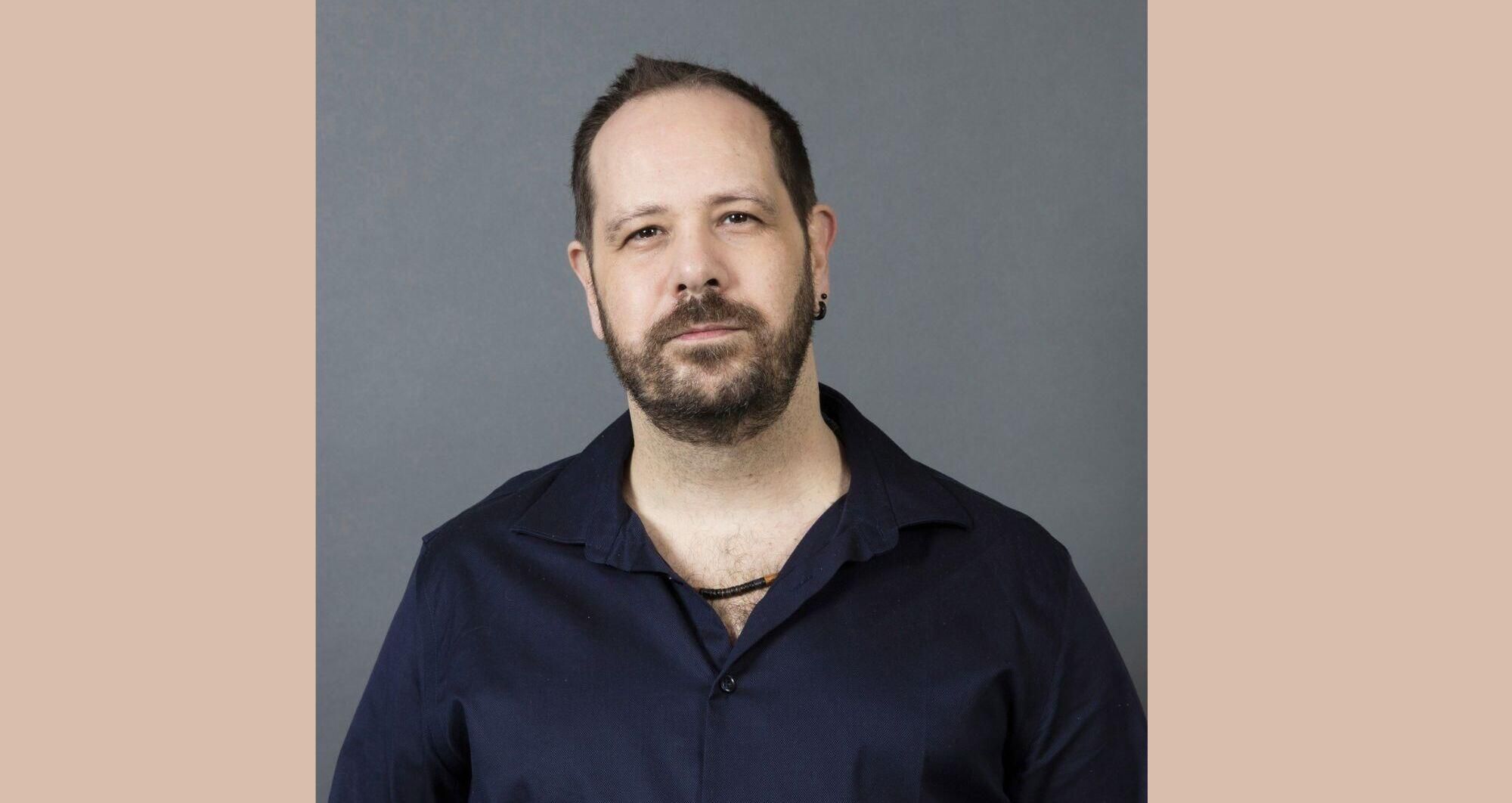
“Mickey belongs to the world heritage of the imagination”
When did you become interested in Mickey?
Like many children, I read Mickey Pocket And Scrooge Magazine. But I really immersed myself again in the Disney universe when I began my graphic arts studies at the Gobelins school in Paris in 1991.
Your route then takes you to the Disney studios. How does this dream become a job?
Les Gobelins is the school of high standards: we learn rigor, movement, volume, precision of gaze. After an internship at the Disney animation studios in Montreuil (Seine-Saint-Denis), I was hired in 1993. I stayed for almost ten years. I worked on feature films Tarzan, Kuzco, Atlantis, Lilo & Stitch…Extraordinary training! We learn to draw accurately, to think of the body in movement, to be precise while remaining simple.
Is it on this occasion that you drew Mickey for the first time?
Yes, on the short film Runaway Brain (Mickey is losing his mind, directed by Chris Bailey, released in 1995, editor’s note). There were a lot of us working on this project, so it wasn’t an intimate meeting, but a total immersion. We immerse ourselves in the character, his codes, his graphic grammar. Mickey almost becomes a language.
What makes Mickey’s graphic strength?
It’s a graphic miracle. Three circles: a large one for the face and two smaller, colored ones for the ears. Such simplicity makes Mickey universal. Minnie follows the same principle: just add three eyelashes, a bow between the ears, a little red on the lips…
Why did you leave the world of animation?
I loved working for Disney studios, but animation is a collective art, very hierarchical. After a while, I needed autonomy. Comics have always been my first love. I needed to find a more intimate freedom as a comic book artist.
At Glénat, I had the opportunity to meet Mickey again with Mickey’s Craziest Adventure (2016), Donald with Donald’s Happiest Adventures (2018), and finally Picsou with Scrooge and the Bit-coincoins (2025). But, this time, I truly brought an author’s perspective.
Disney characters, including Mickey of course, must remain alive, and not frozen in nostalgia.
Nicolas Keramidas
Disney imposes a strict framework for drawing its characters. Do you experience it as a constraint?
No. Disney lends me its toys: it’s up to me not to break them. In Mickey’s adventures, there are no cigarettes, no sex, no war, no death. This requires you to be clever, inventive, subtle.
You also seek to anchor these characters in the contemporary world…
Yes, otherwise they become museum pieces. In my last album, Scrooge and the Bit-coincoinswe are talking about dematerialized money, social networks, smartphones. If children no longer recognize the objects we draw, we lose their attention. Disney characters, including Mickey of course, must remain alive, and not frozen in nostalgia.
For the exhibition “Mickey. It all started with a mouse”, you have created an original postcard. Why this choice?
I wanted this card to be a direct nod to Grenoble. I represented Mickey in the “eggs” of the Bastille cable car, an emblematic infrastructure of the city. Four circles for the cabins, three for Mickey: graphically, it was obvious. I also liked the postcard format because it is a popular item that circulates. This expands the exhibition beyond the walls and reminds us that Mickey is a character who travels, who shares things.
This exhibition also has a heritage dimension…
Yes, it is essential. Mickey is part of the world heritage of the imagination. He is not just a commercial figure: he is a cultural, transgenerational character. The Glénat Fund also plays an important role in linking contemporary creation, collective memory and transmission.
You are also a collector…
Yes, I have “collectionitis”. I try to find objects from my childhood. For Mickey, I got started late, so I buy when I like, like the box of Lego Steamboat Williewhich takes up the first cartoon from 1928. For the exhibition, I notably lent my Disney studio badge: it’s not a fetish, but a trace. Physical proof of a journey.


