
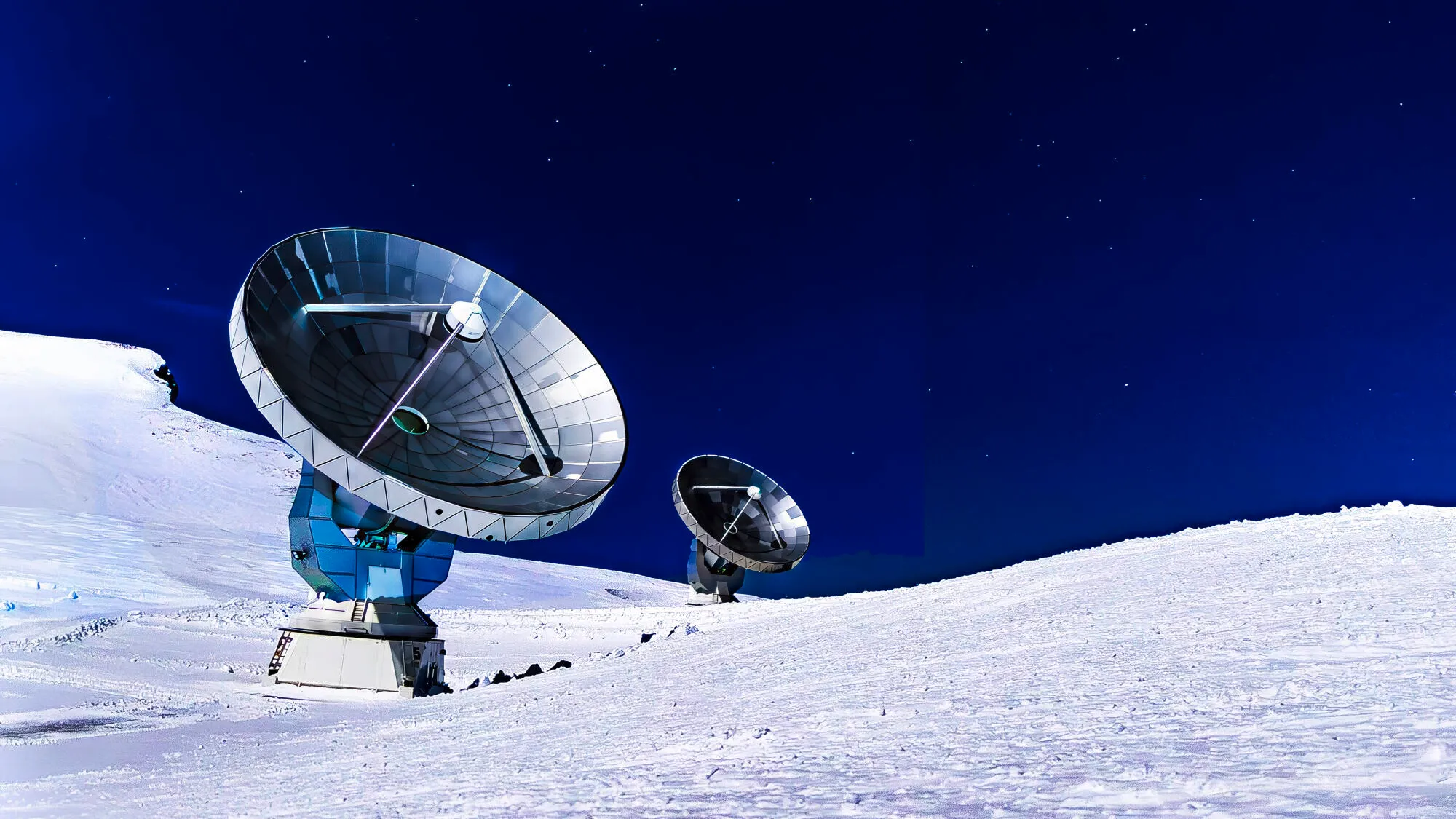
Noema tracks the birth of stars
“There are undoubtedly habitable planets, perhaps in our galaxy, but one day communicating with other life remains uncertain…” The scientific rigor of Jan Orkisz, the astronomer from Iram (Institute for Millimetric Radio Astronomy), tempers the dreams of lovers of science fiction stories. His “office” would make more than one fantasize. He officiates in the lunar setting of the Noema observatory (NORthern Extended Millimeter Array) at an altitude of 2,550 m, on the Bure plateau, in the Hautes-Alpes. He goes up there by cable car, a means of transport reserved for the Institute, with a multidisciplinary team (astronomer, operator, engineer, mechanic, cook, electrical technician, etc.) who take turns every week and form a real community.
For his colleague Olivier Gentaz, a telecommunications engineer, “it was the love of the mountains and the desire to unlock the secrets of the waves” that led him to join Iram twenty-five years ago. Noema relies on interferometry: the signals collected by its twelve 15 m antennas are combined to produce sky maps of exceptional precision, showing the distribution of gas, dust or molecules. Transported by optical fiber to Grenoble in the offices of Iram – an institute financed by a European consortium – these data are then verified and calibrated before feeding the work of astrophysicists around the world.