
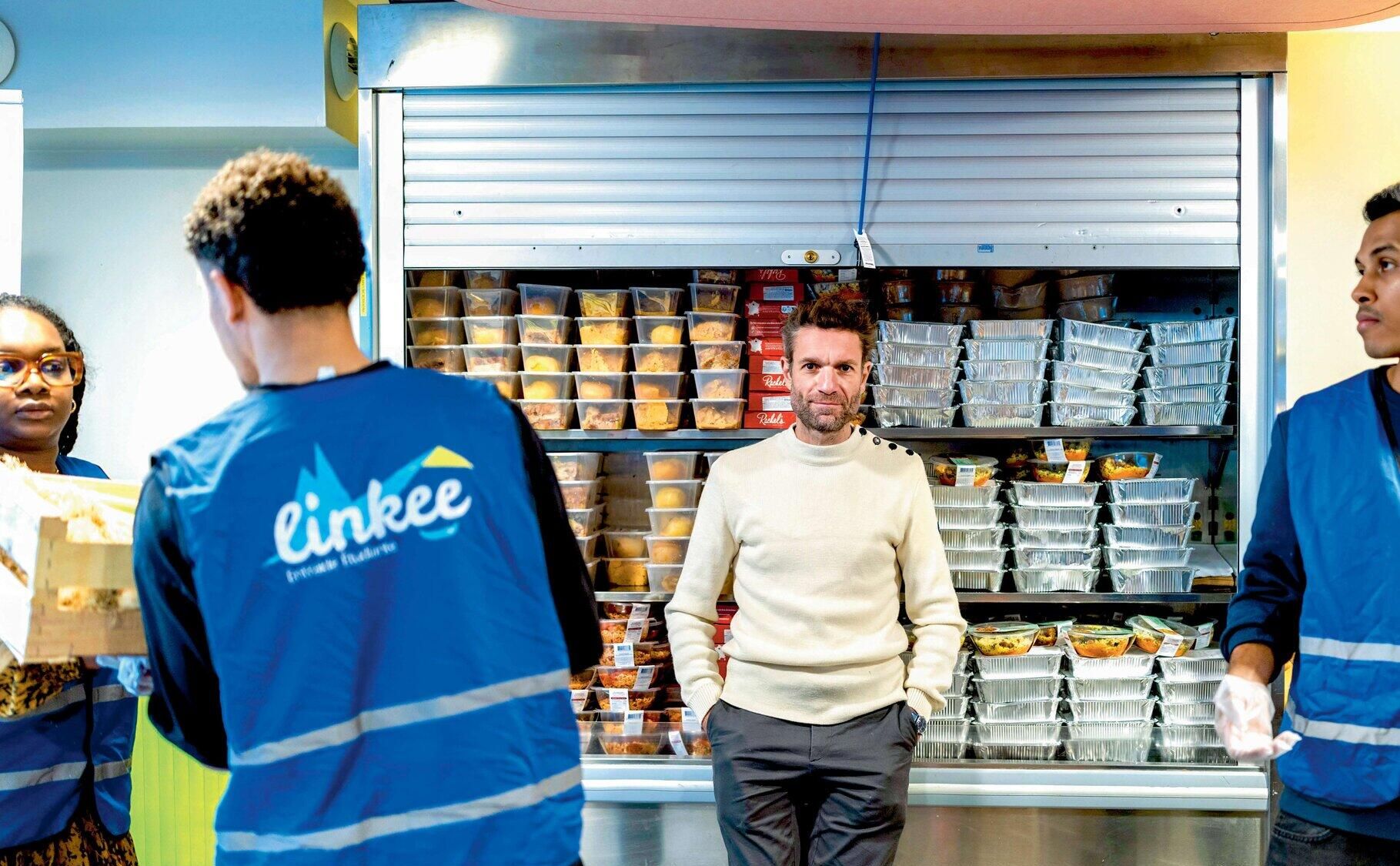
“One in three students does not have enough to eat”
Your book is devoted to student precariousness. How big is it?
Measuring the phenomenon is one of the contemporary challenges. Today, we know the number of scholarship holders but not exactly the number of precarious workers, who remain invisible. Aid associations estimate that 30% of students are food insecure, or 1 million people. All major cities are affected, private schools and universities, all sectors and all age groups, from first year to doctorate.
The study “Being 20 in 2025”, conducted by the Federation of Solidarity Actors and Linkee, highlights two specificities. This poverty primarily affects students who have left their parental home and have not yet rebuilt their social network. Secondly, it particularly hits young women, hence the need to include hygiene kits including menstrual protection in food packages.
How is it translated?
Once the rent and fixed charges have been paid, eight out of ten precarious students have only 100 euros per month left to live on, which ranks them among the poorest in France. They sacrifice everything. Food: 75% skip several meals per week, and many go without meat, fruits and vegetables. They draw a line under their health, transport, clothing, outings and vacations…
Everyone tends to minimize their misery: they imagine it as temporary in order to be able to bear it psychologically.
Does this fragility increase in winter?
Added to all the difficulties cited is energy poverty, because these young people often live in poorly insulated rooms or studios which are expensive for heating. That said, at Linkee, we record peaks in attendance at our distributions between May and September. As the regional centers for university and school works (Crous), which manage housing, scholarships and catering, are partially or completely closed in the summer, the most disadvantaged find themselves deprived of their main recourse. The internal associative fabric of each faculty, which provides them with small packages, is also absent during this period.
How is this precariousness explained?
When it exists, the aid is insufficient because it is not indexed to the cost of living. Above all, due to threshold effects, they are only allocated to a fraction of those who need them. It should be remembered that, from 1955, under the leadership of the left-wing union that is the National Union of Students of France, the Crous were set up to allow the less fortunate to complete their course.
But, in the 1960s, the university remained a world of heirs: there were only 300,000 students. Today, there are three million, ten times more! A massification of higher education, more than a democratization, since many of those enrolled have not benefited from the means necessary for their journey.
Since the 1980s, the term precariousness has been hammered home by student unions without any structural reform being carried out. It is urgent to establish the obsolescence of the aid system in order to make it evolve.
Did the Covid pandemic precipitate the explosion of the system?
It was the spark that ignited the powder. In 2020, because of confinement, young people lose, overnight, their economic balance which was based on 150 euros and which was based on odd jobs, such as babysitter, salesman or bartender. They are also deprived of financial support from their parents or aunts and uncles, who are also affected by the crisis.
Their presence in the endless queues for food distributions is creating a buzz in the media and on social networks, harkening back to three dark periods in our history: the queues in front of soup kitchens during the Great Depression of the 1930s, during the rationing of the Second World War, and at Restos du coeur in 1985.
Public opinion then becomes aware that the expression “student hardship” refers to a much more brutal reality: that of unacceptable poverty in a country which represents the seventh world power.
What was the response from your Linkee association?
At the time of confinement, Linkee, which was already collecting unsold food for the most deprived, implemented its logistics to recover the mounds of food from the Rungis market, wholesalers and restaurateurs, destined for the trash, since everything was closed. In September 2020, we organized in a Parisian bar the first mass distribution made by and for students of packages of fresh products: bread, dairy products, meat, fish, fruit, vegetables, etc.
We welcomed 200 people the first evening, 400 the second, 700 the third, and we ended up opening 19 distribution locations in Île-de-France in six months. From the start, we wanted to put even the most hesitant at ease by opting for friendly spaces and recruiting volunteers who were students themselves.
The Restos du coeur, designed as emergency aid, have just celebrated their 40th anniversary. Is Linkee also intended to last?
When we launched the student distributions, we were confident that six months later the effects of the pandemic would have worn off and they would no longer be necessary.
However, five years later, we understand that it is the opposite. We now deliver four million meals per year in all major cities in France: Paris, Lille, Lyon, Nantes, Bordeaux, Toulouse, Montpellier and, since October, Marseille.
An action that only the mobilization of our 11,000 volunteers makes possible. But associations, however determined they are to change the order of things, are not able to resolve the entire equation. We need a reform of public policies targeting students.
What would be the levers for improving the system?
To deal with the problem, we should already be able to circumscribe it. It is urgent to create a statistical tool to precisely quantify the precariousness of students in France.
Then, we must tackle the question of rent, which constitutes the main item of expenditure in their budget: 528 euros per month, on average. However, only 35,000 student accommodations should be built by 2027, whereas 600,000 are needed!
Finally, it is time to put the structure of social assistance designed in the 1950s back on the table. The Crous only take care of a small part of those who need it, and they do it badly. Meals for one euro are insufficient since the queues are getting longer at the associations’ food distributions.
As for scholarships, they are disconnected from the real cost of living, as revealed by Maëlle, a student at Sciences Po Paris. His moving testimony on TikTok in 2022 led to a surge of solidarity and the creation of a prize pool amounting to 14,000 euros.
Ultimately, is it the future of our youth that is at stake?
Yes, the student question reflects the choice of a societal model. Do we favor a family-oriented approach, where parents in difficulty benefit from tax advantages to be able to support their children? Or, taking inspiration from Nordic states, such as Denmark, do we pay students directly an allowance to offer them financial autonomy and the best possible training, considering that they are the lifeblood of our country?
How did your own commitment come about?
It is rooted in childhood. My father, a reporter, and my mother, a professor, both had an acute political conscience and passed on their commitment to me. I remember a strong moment when I was in CM2, in Paris. In 1985, television news broadcast terrible images of the famine in Ethiopia. With my classmates, we met at my parents’ house and decided to start a collection in the neighborhood for SOS Enfants sans frontières. After sending the prize pool, we received a thank you note from the president of the association, Jacqueline Bonheur. We were proud of this initiative. Subsequently, I mobilized for several causes. As a law student at Assas, in Paris, I was part of a collective which defended freedom of expression against the far-right activists of the GUD (Union defense group, dissolved in 2024, editor’s note) very violent, which led to me being attacked on several occasions.
You first worked within the administration. What brought you to the voluntary sector?
I have held several positions of responsibility in the public sphere. Until in 2015, as chief of staff of the Minister of Justice, Christiane Taubira, I helped deal with the tragic consequences of the November 13 attacks. At the end of this experience which had a profound impact on me, I told myself that I only had one life and that I had to put all my strength into this crucial battle: transforming food waste into help for the most deprived. With this in mind, I had already founded an association called The Missing Link. So I decided to create a structure capable of operating on a larger scale. And Linkee was born.
The biography of Julien Meimon
- November 21, 1974. Birth in Paris.
- 2005. Obtained his doctorate in political science at Ceri-Sciences Po.
- 2012-2014. Chief of staff to the deputy mayor of Paris, responsible for the social and solidarity economy.
- 2014. Founded the association Le Chaînon Missing, which fights against food waste.
- 2015-2016. Chief of staff of the Minister of Justice.
- 2016. Create Linkee.


