
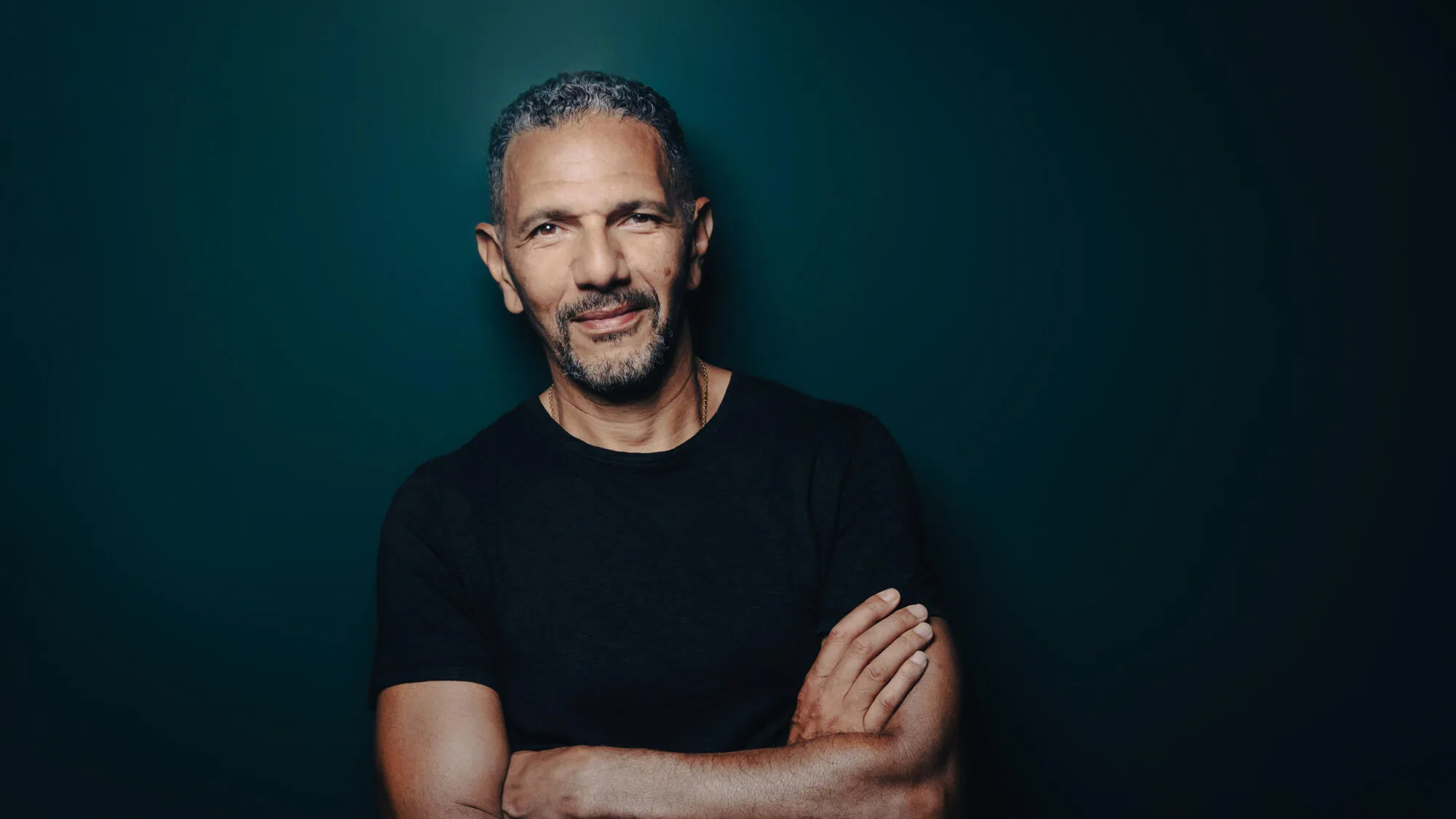
Roschdy Zem speaks before the release of “Billie Melody”
Once again, filmmaker Christine Paillard has written a father role for you. What would you portray of Tony, your character in Billie Melody, which hits theaters on September 9, 2026?
He is a loving father who experienced many personal disappointments and had to give up his dreams as a musician. A character for whom we can fear the worst. I notice that the role of the father is preponderant in the scenarios that I am currently being offered. Perhaps because certain representations are changing.
Traditionally, the father had to be a strong man, keeping his cool in all circumstances. Our fathers hid to cry. This is no longer the case today.
We are far from your first roles in the cinema at the age of 25…
I became an actor in the early 1990s, at a time when certain filmmakers were looking for actors from working-class neighborhoods. At the time, they could not find them either at the Conservatory or at the Cours Florent (French theater school created in 1967, editor’s note). Spotting was done in the street. I then worked in the second-hand clothing store at the Clignancourt flea market, north of Paris. That’s where André Téchiné’s assistant came to offer me the chance to play in I don’t kiss (1991). Then, the filming continued under the direction of Xavier Beauvois, Patrice Chéreau, Pierre Jolivet. I had no idea my career would be so long.
Of the eighty films in which you have acted, many are directed by women. Is it a coincidence?
Absolutely not. I was very quickly looking for roles that would take me away from somewhat harsh and stereotypical characters. Fortunately, the codes of masculinity have changed a lot in thirty-five years. The roles evolved from assertive virility to a form of acceptance of fragility and I enjoyed participating in this movement.
Certain female filmmakers like Lætitia Masson, Yolande Zauberman or Rebecca Zlotowski offered me characters expressing a degree of vulnerability. Michel Piccoli, Jean-Louis Trintignant and Marcello Mastroianni opened the way for us. These actors, who are my models, were able to assume a part of sensitivity, and sometimes femininity, in their acting.
Have these changes in representation also influenced your way of being a father?
Like many parents, I learned to adapt to the times thanks to my two children, Chad and Nina. I educated them with their mother, a wonderful woman, a psychologist specializing in adolescence. I tried to pass on to them the family values that built me, such as merit through work, respect for others, generosity in listening and the ability to question oneself. Because nothing is ever acquired.
In a society where failure is perceived in a very negative way, I wanted to show my children that we should not be afraid of failing. It is by eliminating possible options that we move forward, step by step.
“When faced with a person convicted of a crime, I wonder what could have happened in their life. »
Roschdy Zem Humanist actor and director
Your parents also dared to try their luck…
Yes, when they arrived from Morocco in the early 1960s, they lived in a shantytown in Nanterre. My father, Jilali, was a construction worker and worked hard all his life. It was at this time, when I was barely 18 months old, that my parents agreed to place me in a foster family in Belgium, with very practicing Flemish Catholics.
Long after my departure, almost until I came of age, I maintained a very close relationship with this family who welcomed me with love and gentleness until around the age of 6.
What did these practicing Catholics transmit to you?
I went to mass with them every Sunday even though, in my memory as a little boy, no one ever explained to me who Jesus was. Every evening, my Flemish grandmother signed me, then kissed my forehead. I felt protected by this gesture which helped me fall asleep. This feeling of being safe in a family cocoon, I found again once I returned to my family of origin, in Drancy (Seine-Saint-Denis).
Your parents were of Muslim tradition…
Yes and they were also quite religious. But in no case, in these two families, did I feel crushed or suffocated by religion. Above all, I had the feeling that these practices united the people around me.
This experience with a host family has left you with good memories…
You know, right before she died, my mother asked me to forgive her for leaving me in foster care. “Have no regrets,” I replied, “you have no idea how much it has enriched me.” It built the man I am. I thank you for your decision, even if we lost moments that we could have spent together. » And then, this experience made me stand out within my family. This is probably why I dared to try a career as an actor. A form of philosophy allowed me to adapt and say to myself: “Try it, there’s no risk!” »
What place does spirituality occupy in your life?
I believe in the existence of God, but my approach is more cultural than religious. I like traditions. Christmas, Ramadan or Shabbat: these holidays bring us together and that seems essential to me. And then, the three monotheistic religions set frameworks in relation to the notions of good and evil.
Paying attention to those around me and particularly to those who have less than me is my way of getting closer to good. I wouldn’t say that I’m a “good man”, but rather that I do everything to be one, to behave well. It’s a constant quest.
In Roubaix, a light, Commissioner Daoud, a role for which you received the César for best actor in 2020, is a man who believes in kindness. This film is analyzed during certain cinema retreats. Does this surprise you?
I didn’t know that, but it makes sense! The director, Arnaud Desplechin, asked me to find a Christ-like dimension in my interpretation. I tried to express a quality of listening, forgiveness and non-judgment close to confession. My son recently pointed out to me the biblical dimension of this character whose name is Yacoub, the Arabic name for Jacob.
This role of humanist commissioner resonates with me. When faced with a convicted person, I wonder what could have happened in their life to cause them to commit a crime. I have a lot of compassion for the guilty parties.
This theme of guilt ties in with the subject of the seventh film that you are about to make…
Yes, I am preparing the adaptation of the novel The decisionby Karine Tuil. The book tells the daily life of an anti-terrorism judge faced with the return of a jihadist to France. I wanted to understand what could have led nearly 2,000 kids from the Republic to leave for Syria to join the Daesh caliphate. With this film, I do not want to provoke any controversy, nor provide any ready-made answers, but above all to stimulate reflection.
After consulting reports and testimonies from converts, I was able to see that some of these radicalized young people were facing abysmal forms of despair. How much responsibility do we bear towards them? What have we collectively missed?
In Drancy, where you spent your youth, did community tensions already exist in the 1970s?
No way. In our building, Christians, Jews and Muslims lived together without problem. My parents’ closest friends were Jewish. Humor, gastronomy, the art of living… there are so many similarities between Jews and Muslims from Morocco and Tunisia!
In Drancy, as in other suburbs, middle-income families lived in HLM. Social diversity was a reality. Everything changed in the mid-1980s, with the arrival of drugs, AIDS, unemployment, the departure of the middle classes to suburban areas, followed by community withdrawal.
In 2006, with Pascal Elbé, we explored the question of religious prejudices by producing Bad faitha light comedy about a Jewish-Muslim couple. Twenty years later, I no longer feel able to laugh at these tensions which have only gotten worse.
Do your directorial projects respond to a desire for commitment?
I’m 60 years old and one day I will be too old to act. Directing fascinates me and actually gives me the opportunity to get involved through my films. “Open schools, you will close prisons,” said Victor Hugo. Faced with social problems, education is the solution, the essential thing is there. I would like us to return to more social political decisions. Like everyone else, I value my own comfort, but I can’t enjoy it knowing that others have nothing.
The biography of Roschdy Zem
- September 28, 1965. Born in Gennevilliers (Hauts-de-Seine).
- 1995. First major roles in To have it or not by Lætitia Masson, and Don’t forget that you are going to die by Xavier Beauvois.
- 2006. Play in Natives by Rachid Bouchareb, collective male performance prize at the Cannes Film Festival.
- 2016. Chocolate his 4th film as director.
- 2019. Roubaix, a light by Arnaud Desplechin.
- 2022. Mine its 6e movie. He is also featured in The innocentby Louis Garrel.


