
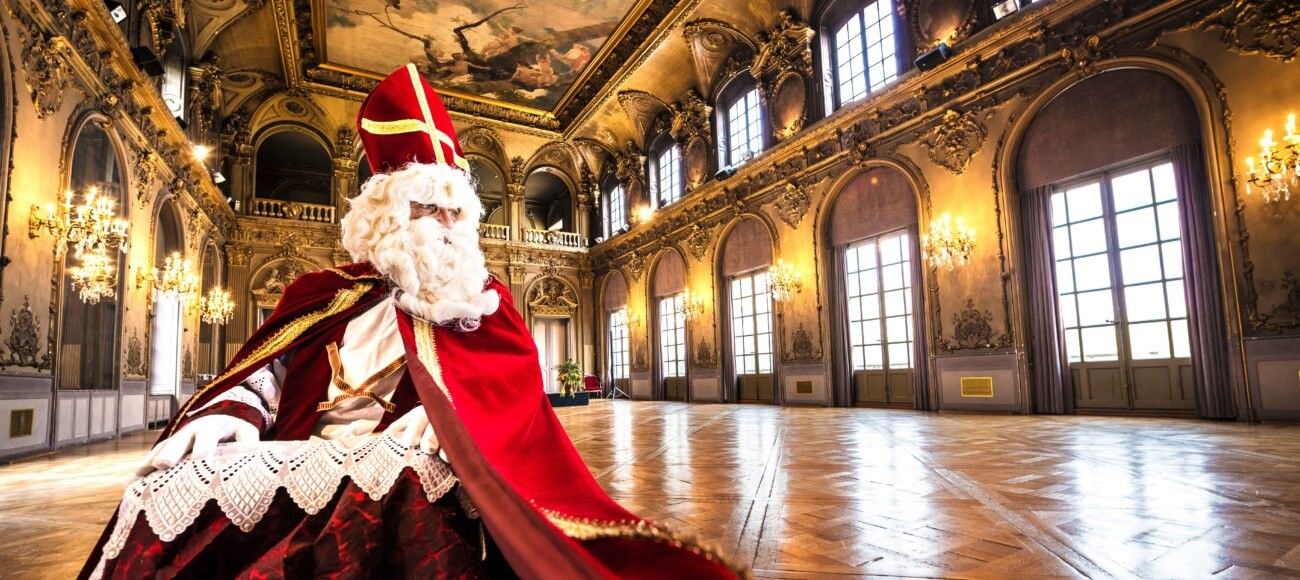
Saint Nicholas, Father Christmas of Lorraine
The seamstresses of the Nancy opera retouch Saint Nicholas’ cape. This new costume represents around a hundred hours of work.
An anonymous person disguises himself before going to meet the children. To preserve their credulity, he refuses to show his true face. Photographing his transformation, on the other hand, does not bother him… as long as he remains incognito.
The day before St. Nicholas Day, families place carrots in the bottom of their shoes. This stratagem is supposed to deceive the children who are waiting for the arrival of the bishop loaded with gifts: the carrots are intended to feed the donkey who accompanies him. The next day, they have of course disappeared, and the children discover their toys. In Lorraine, over the last two centuries, Saint-Nicolas held a more important place than Christmas.
From November 22, the city of Nancy offers free shows and attractions. As a highlight, the Saint-Nicolas parade offers 1.7 km of light and sound enchantments until the finish at Place Stanislas. Several professional companies and volunteers from Greater Nancy parade in joy. The cold and the rain do not frighten the onlookers who enjoy the spectacle.
Some 2.5 tonnes of candy are distributed to the 100,000 people who attend the parade.
As the saint passes, the children become ecstatic.
An enigmatic character in a brown cape, Father Fouettard worries all the children. Faithful sidekick of Saint Nicholas, he is there to frighten those who have not been good during the year.
Its legend dates back to 1552, when the Messins besieged by Charles V were looking for entertainment. On the morning of December 6, tradition has it that he beats the kids with a whip, which is rare, because they are forgiven if they repent.
Every year, more than 100,000 people come to watch the Saint-Nicolas parade. On Place Stanislas, the crowd waits in front of Nancy’s town hall, where the mayor symbolically hands over “the keys to the city” to Saint Nicolas, patron saint of the people of Lorraine.
These festivities are included in the French inventory of intangible cultural heritage, a gateway to UNESCO.
In Lorraine, each commune organizes or participates in a Nicolaïan parade. This tradition is linked to the presence in the region of a relic of Nicholas of Myra. Stolen in 1098 from the Italians, the phalanx bone was placed in the town of Saint-Nicolas-de-Port, sparking a major pilgrimage which continues today.
Every year, on the Saturday closest to December 6, a torchlight procession takes place in the basilica of Saint-Nicolas-de-Port. Compact, the crowd sings in a fraternal and collected atmosphere.
That evening, there were an estimated 3,000 participants, some of whom had to wait for others to exit before entering. This procession pays homage to a miracle. That of the Lord of Réchicourt who, during his captivity in the East, implored the intercession of Saint Nicholas. After being mysteriously released and repatriated to the church square in 1244, he ordered that a procession take place there every year.
Director of the Nancy Museum of Fine Arts, Charles Villeneuve de Janti presents two plates by Jochen Gerner, an author from Nancy. This comic book story in 54 plates, published in 2004, is titled The Patron Saint. It illustrates the history of Lorraine through contemporary characters embodying Saint Nicholas in turn.
Director of the Nancy municipal archives, Daniel Peter observes a print illustrating Saint Nicholas. It comes from the collection of Jean-Varcollier, an advertising designer from the 1960s. For a millennium, Lorraine artists have been inspired by Nicolas de Myre and his legends.


