
The extraordinary investigation to reconstruct the great carpet of Louis XIV
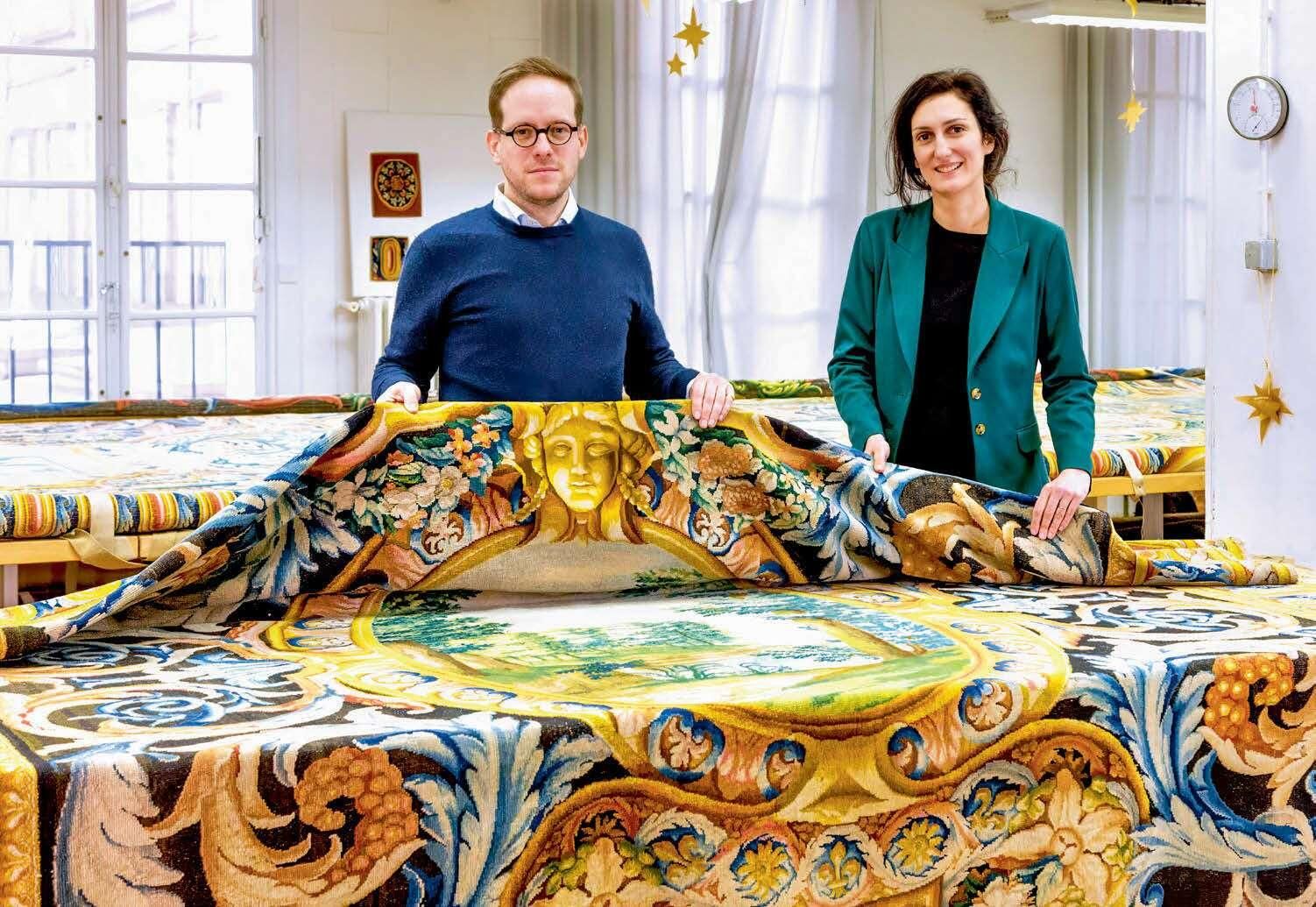
“It’s a crazy but exhilarating project,” enthuses Emmanuelle Federspiel. “We are like kids when we discover a new fragment of carpet,” adds his colleague, Antonin Macé de Lépinay. Inspectors of the Mobilier national collections, the two researchers have embarked on a dense and in-depth investigation since 2020: reconstituting the “grand carpet”, composed of 92 pieces, commissioned by Louis XIV from 1668 to cover the floor of the Grande Galerie du Louvre in Paris, i.e. 440 m long.
At 42 years old each, these enthusiasts of the decorative arts share the conviction that, under the reign of the Sun King, carpets, tapestries, silver dishes… participated in the architecture of the palace which became “a total work of art” under the direction of Charles Le Brun, the king’s first painter. The boxes that the latter had designed as models for the weavers are studied by Emmanuelle. Thirty-three surviving carpets were restored and stored at the Mobilier national, under the supervision of Antonin. From this collection, they track and list the elements scattered, sold and fragmented over the centuries.
A grandiose journey
On the wall of Emmanuelle’s office, 92 stickers pasted show the order of the rugs and show the state of their work: in the photo, the entire rugs; on a white background, the fragments; on colored adhesive, missing parts. “We found traces of 70% of the whole,” estimates Antonin. “Our great discovery,” rejoices Emmanuelle, “is to have understood how everything was ordered in the Grand Gallery, around an immense central work, and that this grandiose path was to lead the king’s visitors to the throne room, at the end of the Louvre, in the Flore pavilion. Intimidating!” The set was never installed, because in the meantime… Louis XIV had moved to Versailles.
So, to evoke it today, Emmanuelle, Antonin and Wolf Burchard from the Metropolitan Museum of Art in New York, created a partial presentation in the nave of the Grand Palais, in Paris. “We need the public to renew our outlook,” they explain, “and to make known this story which also tells of the reign of young Louis XIV and the birth of French manufactures.” You never know, other fragments sleeping in attics could reappear! Being an art historian does not prevent you from dreaming, quite the contrary.