
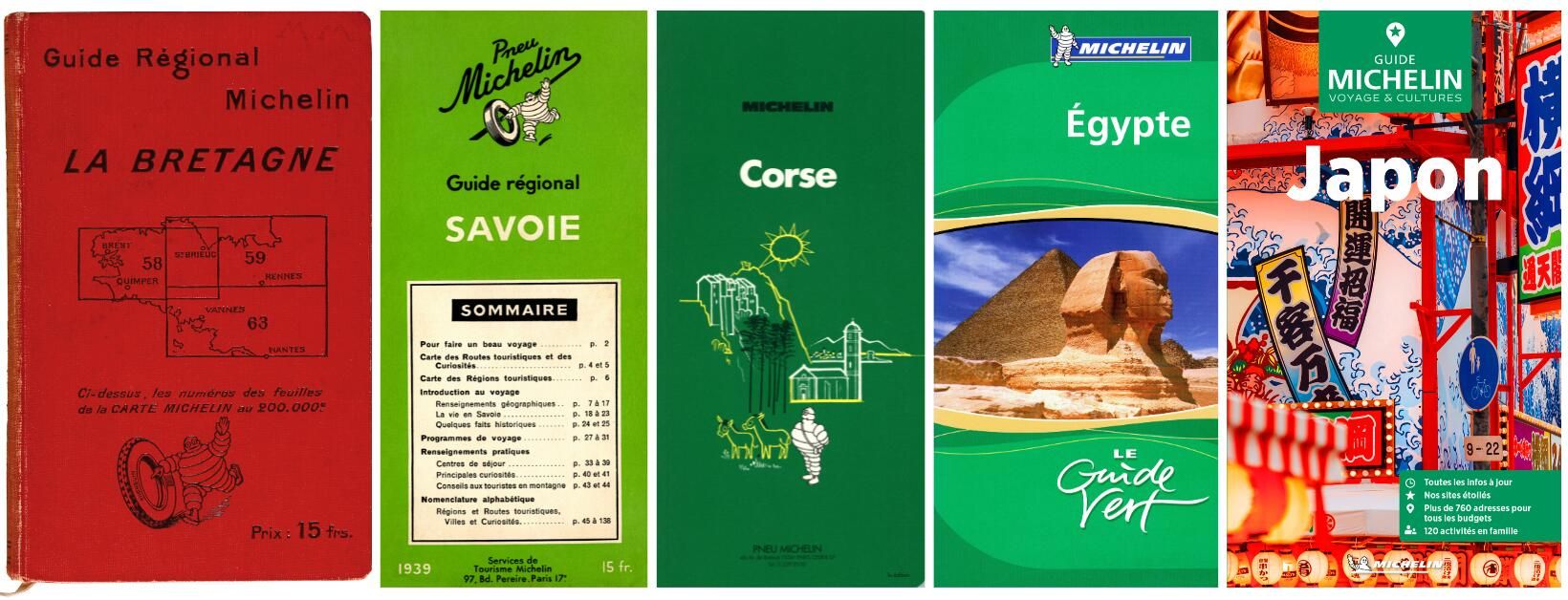
The Michelin Green Guide celebrates its 100th anniversary
It’s the story of two brothers who don’t have both feet in the same shoe. In 1889, André and Édouard Michelin inherited the small family rubber business in Clermont-Ferrand (Puy-de-Dôme). Two years later, they invented the modern bicycle with its removable tires. Then came the automobile tire (in 1895), the Bréguet airplane (in 1914), the Micheline (train on wheels) at the beginning of the 1930s.
Factories open, thousands of jobs are created. “Their leitmotif was mobility,” explains Philippe Orain, director of the Green Guides, in front of the Bréguet 14 plane suspended in the entrance to L’Aventure Michelin, a museum space linked to the firm. “Ingenious, pioneering and reactive, they have created new vehicles and new uses. »
Accompany travelers
But it was necessary to support the first drivers. In 1900, André and Édouard distributed a small red guide free of charge, indicating fuel depots, garages, hotels and restaurants for each region.
Then, even though there were no signs or route numbers, they created their first map in 1910 and founded a Routes Office in Paris: employees answered the telephone and typed letters to all motorists, with many details on the natural and heritage environment. In 1925, 120 employees sent 155,000 itineraries to travelers.
These are among the precious Michelin archives, housed in the basement of the museum in Clermont-Ferrand, as are the Battlefield Guides (Verdun, Lisieux, etc.) that the brothers designed during the First World War, so that the French could go on pilgrimage to the martyred sites.
The first tourist guide was printed in 1926, for Brittany. “This is where the greatest number of calls from the itinerary office came from,” explains Marie-Claire Demain-Frackowiak, head of historical collections at the Michelin group. Followed by those on the Alps, the castles of the Loire, Auvergne, the Tarn gorges, the Côte d’Azur… and little by little all of France. This growth was driven by the first two weeks of paid leave, in 1936, which launched the French on the holiday roads. Soon, everyone has a guide in their glove compartment! It will become green in 1939, to differentiate itself from the red gastronomic guide.
Embodied territories
Outdated in the age of the Internet? “Not at all,” replies Philippe Orain. It is reliable, because it is revised at least every two years. And more embodied: the very descriptive content of the early days has given way to more warmth. Today, there are nearly 300 guides, compared to 60 in 2000. Between 120 and 130 titles are created or updated each year. »
Above all, the Green Guides have become international and available: itineraries to discover a region by bike, van, motorbike, map guides of “fabulous itineraries” through gourmet, secret, historic France… Against overtourism, an “off” guide to alternative places has even been designed. And this year, the Green Guides called on novelists to each write a story in a new collection “The great tours in the footsteps of…” First destination, Italy with, among others, Pierre Adrian.
Trend-wise, no surprise if travel booms in the East (Japan, South Korea, Vietnam, Thailand) and collapses in the United States. “Quebec and Brazil are resisting,” underlines Philippe Orain. And we are leaving Egypt, China, Bulgaria and Tunisia in 2026. » The French being tireless travelers, the French market for guides is the second largest in the world (behind Germany), with five million guides sold, including one million of the famous Green Guide. No doubt, this one holds up!


