
“Treating the forgotten on the street makes me happy”
Does your job be part of a family vocation?
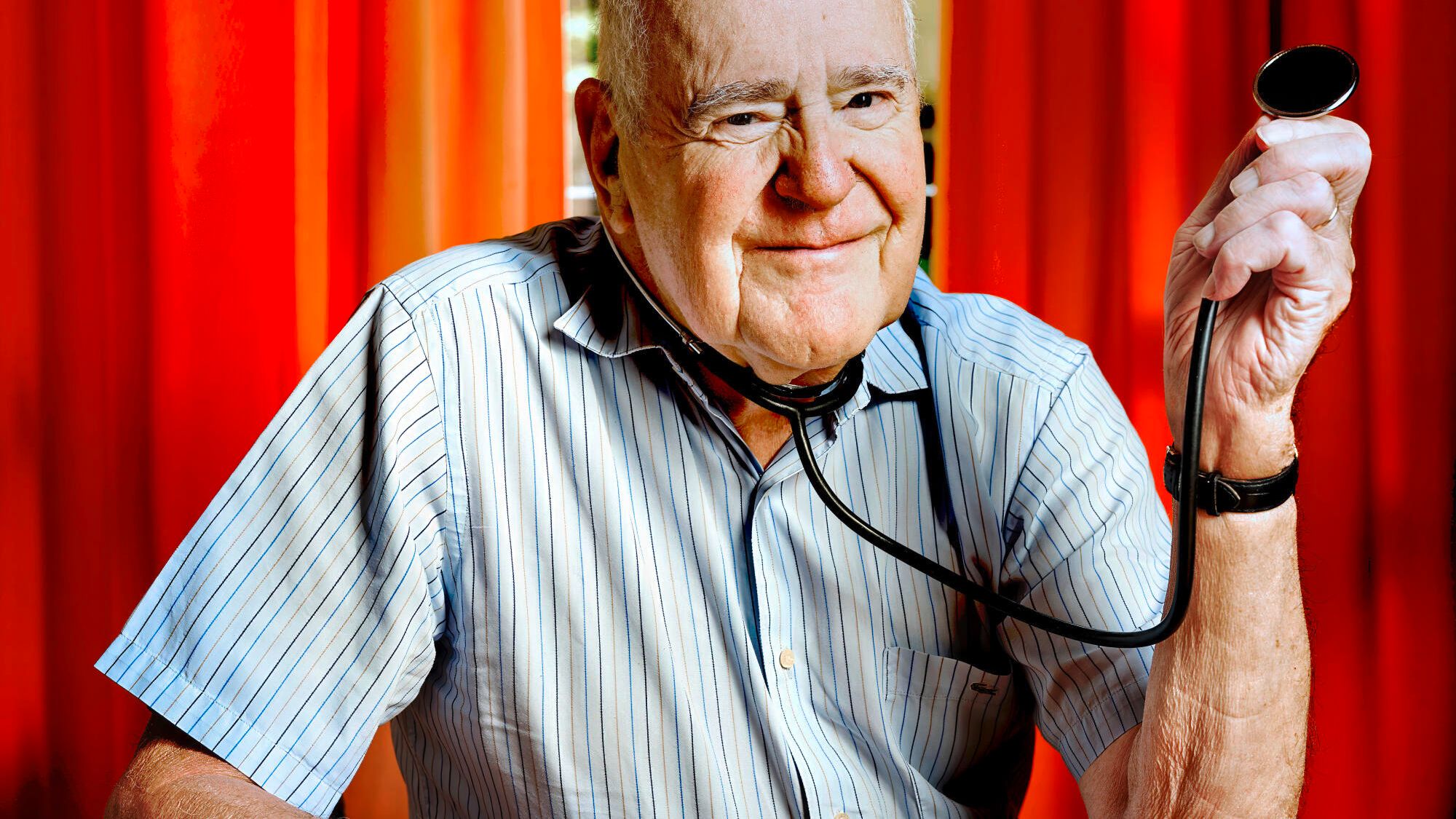
Yes. And as far as I remember, I have always wanted to exercise this profession. The one who marked me was my grandfather. Coming back from the 14-18 war, he had to abandon the project to become a doctor and turned to the veterinary field. His joy was to have later had a grandson who was able to study medicine. He was very happy with it. When I entered the third or fourth year of medicine, he offered me his first stethoscope, a significant memory.
You yourself, what was your desire, becoming a doctor?
Take care of others! This is why I chose to be a generalist. I remember that one of my teachers at the time, in the late 1960s, said to me: “Lassieux, you are right. Soon there will be no more priest to listen to people in confession. They will come to you and it will be up to you to listen to them. »»
And is that what you did?
I tried. In fifty-six years of career, I saw patients pass. I have always tried to take the time to listen to them. My young colleagues often only have a few minutes to devote to everyone today.
Such a commitment requires sacrifices …
Yes, that of very full days. From 7 a.m. to 10 a.m., with only the lunch with family. At the time, I also spent half-days to visit patients at home.
And, every other day, the consultations were done without appointment. Try to find this today! For me, it is the very meaning of the Hippocratic oath that is pronounced: healing everyone, without distinction. Did it also go through availability at night … my record? Four emergency calls in the same night.
Not easy when you have a family life …
It is indeed one of my regrets. Do not have enough time with my wife and my five children. Since then, I have caught up with the grandchildren. Among them, two are medical students and one is a nurse, like her grandmother. I offered them a stethoscope in my turn.
It was your wife who opened a new horizon for you. Tell us …
It was in February 1998. I exposed my wife that I had to ensure the CCAS (Communal Center for Social Action) in Boulogne-Billancourt (Hauts-de-Seine) a vaccination campaign against flu. “I hope you will also vaccinate the tramps that are on the street!” she launched me as a challenge. She was right: something had to be done. At the time, a small association was being formed in the city, around a doctor and a nurse, to take care of the homeless. I joined them. Then, with the help of the Order of Malta, I launched the first medical maraud of Hauts-de-Seine and France. The discovery of this street world has thrilled me and I never left it.
However, the Samu Social is already doing a lot of work with these people …
Yes, with many other associations. But their action is above all to distribute food or clothes. And sometimes ensure accommodation. But never to ensure real medical follow -up.
Where is the problem then?
When you’re on the street, you often lose your basic rights. No more vital card, no social security coverage, no access to drugs … a disaster. I therefore asked for the authorization of the Council of the Order to practice directly in the street.
Why should we ask for this authorization?
In our language, we speak of “funny medicine”, that which is practiced outside the classic health framework. In France, it is prohibited. But when a person is too alcoholic to get into the fitted ambulance that we have at our disposal, we must be able to act directly on the sidewalk. I was able to have this authorization of the officials of the Council of the Order, “in the name of the oath of Hippocrates”. And today there are about fifteen medical marauds of this kind!
Who do you meet in the street?
About twenty years ago, it was mainly clochardized people, in her fifty years. Chess or a violent family setting had pushed them to the street, and they had often fallen into alcoholism to survive. In recent years, we realize that this population has evolved. She rejuvenates and consumes no longer wine but beer, strong alcohols or drugs. There are also women there with children. And foreign populations, Eastern Europe or Africa. There, it is also the barrier of the language that makes things complicated. But the “doctor” badge that I wear facilitates many things.
You are 83 years old today and you continue to make marauds. Where do you draw your energy?
As long as my health and the Lord allow me, I will continue. A few years ago, I was seriously ill. I realized how much contact with the street people I was missing. By force, we make friends. And, unlike my ordinary patients, in this world, we know how to take ourselves in our arms to say thank you.
Has the COVIR’s recent experience marked a turning point?
Yes, and it was very hard. First, because doctors over 70, like me, had prohibited from exercising during this period. As soon as the vaccine arrived, I was among the first to be vaccinated to return to work. And then, during this period, many homeless people were sent far from Paris, as during the 2024 Olympic Games, by the way. We have also lost contact with people wandering in the undergrounds in the La Défense district that we were going to visit once a month with the Red Cross. Work to be resumed urgently.
What are the most common care you practice?
Besides recurring problems – cardiac, digestive, ENT, etc. -, what is striking is the recurrence of psychiatric problems, that alcohol and drugs aggravate. A colleague often says to me: “The street is suffering. And permanent suffering drives you crazy. »»
And then, there are all dermatological pathologies due to poorly treated wounds, lack of hygiene, violence … We see the scabs come back for example. To treat it, it would not only be necessary to take a medication but also to find a form of daily hygiene. In other words, leave the street.
Do some get there?
Their number is estimated at around 10 %. But we are sorely lacking in adapted homes to allow these independent people to be welcomed as they are. I think of this gentleman who, having a leg fracture, refused hospitalization to continue to take care of his cats. They were his “children” after all.
Do your children and grandchildren accept the time you devote to these maraudes late at night?
Last Wednesday, I returned at 2 am. I feel that my body is starting to suffer from it, that’s for sure. But many of my children sometimes accompany me. My grandchildren too, especially those who prepare a career in the medical. It helps them take the measure of human reality, which can be hard. And the happiness that the fact of taking care of those who await us. For me, it also changed my way of praying.
Explain to us …
For a long time, I have prayed for and with my deceased wife, who is always with me, and for my family. But street people have also entered my heart. They extended my prayer. I guarantee you that when, with my friends of the order of Malta, I find myself on all fours on a sidewalk to wash the feet of a man in poor condition, it really has the impression of living the gospel.
The biography of Doctor Guy Lessieux
- May 13, 1942. Birth in Neuilly-sur-Seine (Hauts-de-Seine).
- April 10, 1969. Wife Christiane, nurse.
- July 3, 1970. Supports his medicine thesis in Paris, on neurological affections.
- February 6, 1998. First medical maraud.
- July 14, 2025. Appointed knight of the Legion of Honor.


