
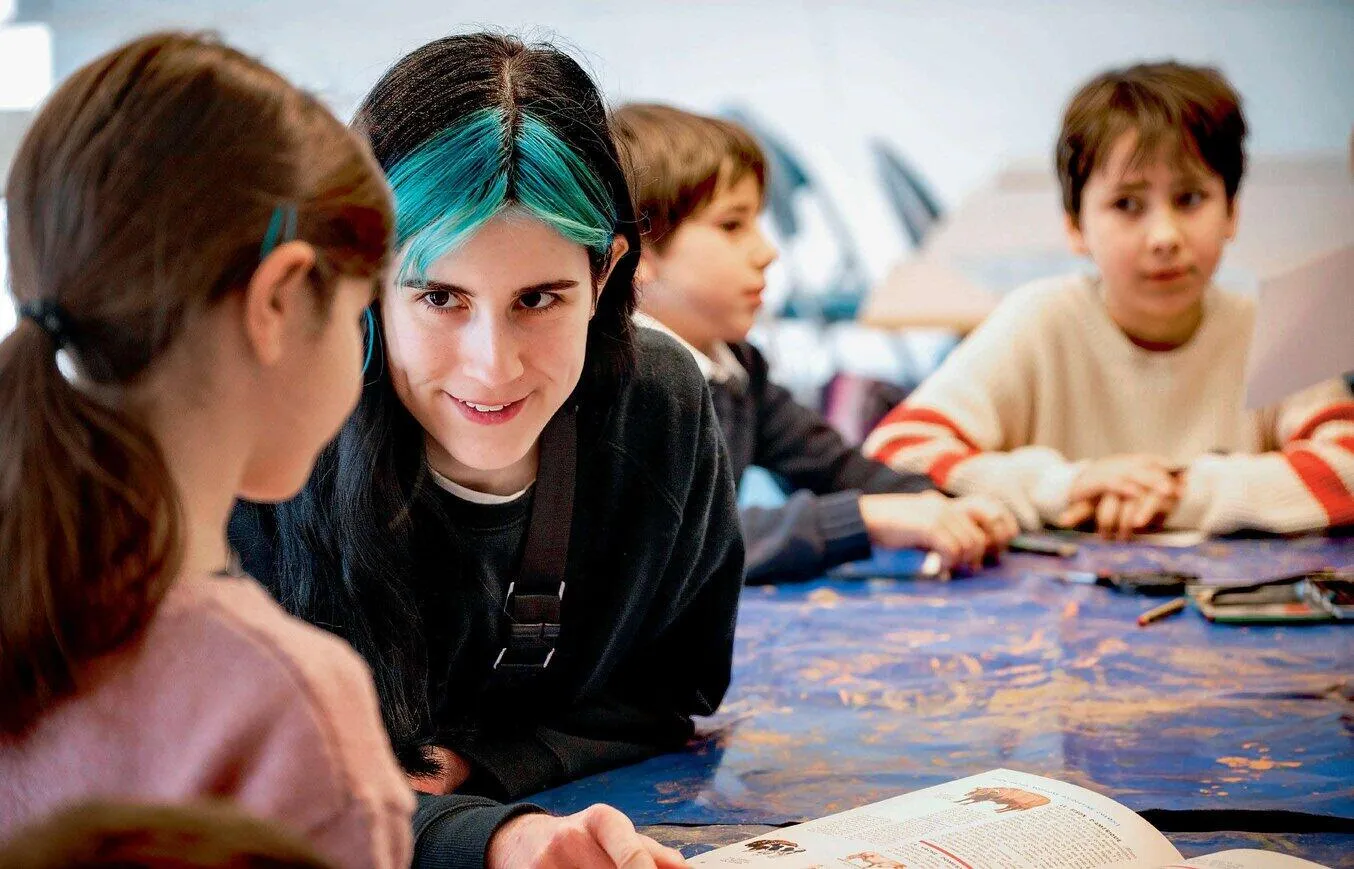
Youth centers bring popular education to life
“As a child, I went to hip-hop workshops. Then I sang, and now I participate in a music group. This year, I am organizing the first dance gala. This is my second home! » Caroline, 19 years old with blue hair, fan of K-pop (Korean pop music, see our article on South Korea) , carries out his civic service within the ALC, Home leisure culture of Chevreuse (Yvelines), in a gentle valley southwest of Paris.
“Setting up a stage, managing programming, communication… This joint learning constitutes the whole point of popular education,” explains Vincent Frerebeau, the president.
The association, which has one employee, 25 speakers, 30 volunteers and 300 members, offers many dance and theater workshops, organizes the Chevreuse Valley film festival, and is involved in a new project: The Valley Archipelago.
“With an association for autistic people and another for equine therapy, we acquired a superb estate including a house, a barn and land in order to make it an associative third place, open to all,” explains Vincent Frerebeau. We want people to meet and work together on projects. For example, movie screenings in the renovated barn, a garden area, a games library adapted for autistic people… »
Citizenship education
The ALC is an MJC, a House of Youth and Culture. These links in popular education are the heirs of a long tradition which has put them shoulder to shoulder with different Catholic movements.
“The challenge is to do with people and not in their place,” underlines Carole Barret, director of the MJC of Sartrouville (Yvelines), in the western suburbs of Paris, where several neighborhoods are classified as priority districts of city policy.
The team of 27 employees and 80 volunteers are getting their bearings in their new premises located on the Plateau, far from the affluent city center. “The priority,” says Carole Barret, “is to educate about citizenship, secularism, otherness and also to empower young people. We are proposing a system other than the ultra-competitive one of National Education and society as a whole. We want to make people understand that failure is not serious, that we can start again differently. »
“You have to love people,” adds Fatou, pillar of this antenna, long located in the heart of the city of India, currently undergoing rehabilitation. Fatou takes care of the reception, she who was the initiator of a network of reciprocal exchange of knowledge in India before joining the MJC.
“There is no future without education. » Rosa Parks (1913-2005)
On this Wednesday afternoon, the art workshop ends and a flock of schoolchildren arrive for tutoring, throwing themselves into the arms of the adults. Children, parents looking for information, teenagers… everyone scrolls through the session.
“It’s our whole life, the city of India,” intervenes a 25-year-old volunteer, who is setting up a collection of donations for the poor. “Can we organize our outdoor cinema there? » he asks Carole. “It was great last time, hundreds of people came! »
Numbering 1,000, MJCs also exist in the countryside, where cultural and friendly offerings are often lacking. Forty-five minutes by car from Poitiers, in the east of Vienne, in the middle of the fields, the MJC La Vigne aux Moines, in Saint-Germain, is also happily acclimatizing to brand new premises, which president Stéphanie Perochon negotiated for a year.
The MJC welcomes children from neighboring towns for leisure activities, discovery trips, artistic and sports workshops. “It was set up in 2013, at the request of public authorities, to “channel” young people,” she relates. Today, we have 9 employees, 10 facilitators and 60 volunteers. And we promote emancipation, critical thinking, the search for meaning. »
“A few years ago, I didn’t do much, apart from smoking and drinking,” confides Florian, 21 years old. Stéphanie came to pick us up. » One thing led to another, he became a volunteer, did his civic service, organized table football tournaments to finance trips, and he now helps out while waiting to get his heavy goods vehicle license.
He will tend the bar for the next tavern requested by the seniors. “We don’t have much time, so I’ll make a playlist,” continues Thomas, 24, also a volunteer. But, for the next one, I will look for an orchestra. »
Project funding under threat
The MJC adapts to the variety of the public as well as to demographic change. “The retirees come every Wednesday,” points out Enora, 18, on civic service. It would be great if we started a seniors club! » Already, trips have allowed some to take the train for the first time.
It’s 5:30 p.m. this Friday, and as we chat, the sewing club begins. The dean sits comfortably in a black and red armchair gamer (video game player) – the teen room with the computers is right next door… Chachou, 31, watches over the sewing workshop, she is known to all the young people, who saw her arrive with her energy and her short pants at their school.
In the cities and countryside, there is no shortage of projects. But now is the time for concern. Costs are increasing (electricity, bus rental, etc.) If most municipalities and the CAFs (Family Allowance Funds) support the MJCs, the State, regions and departments are tightening the purse strings.
“Some of our most emblematic projects are no longer funded, such as learning colonies or assistance for rural mobility,” regrets Stéphanie Perochon. Many actions are financed on file. And with the return of military service, will there still be civic service, which allows these associations to benefit from a serious helping hand and young people to take responsibility?
Handover
“Association life is, at the moment, very hard hit in our country,” assures Jean-Yves Macé, president of MJC de France. We are facing a low-noise social plan. And the MJCs are not immune to this unease.
It is not a question of political side, but of vision between those responsible who understood that culture was a means of living together, and those who only see it as an object of consumption. » Fortunately, young bottle-borns with an “educ pop” spirit are taking over. “This is our greatest reward,” assures Carole Barret, of the MJC of Sartrouville.
Where does popular education come from?
The term appeared at the end of the 19th century, in social Catholicism and secular republican movements. The project, beyond differences, is to educate people, to create citizens. During the interwar period, the workers’ movement got involved – it gave rise to the JOC (Young Christian Workers).
This is also when scouting was born. If Catholics and secularists evolved in parallel, the Resistance united them and gave the start, at the end of the war, to the Youth and Culture Centers which irrigated the entire territory. With the ambition to allow everyone to appropriate culture.