2026 World Cup: how Curaçao is experiencing its first World Cup
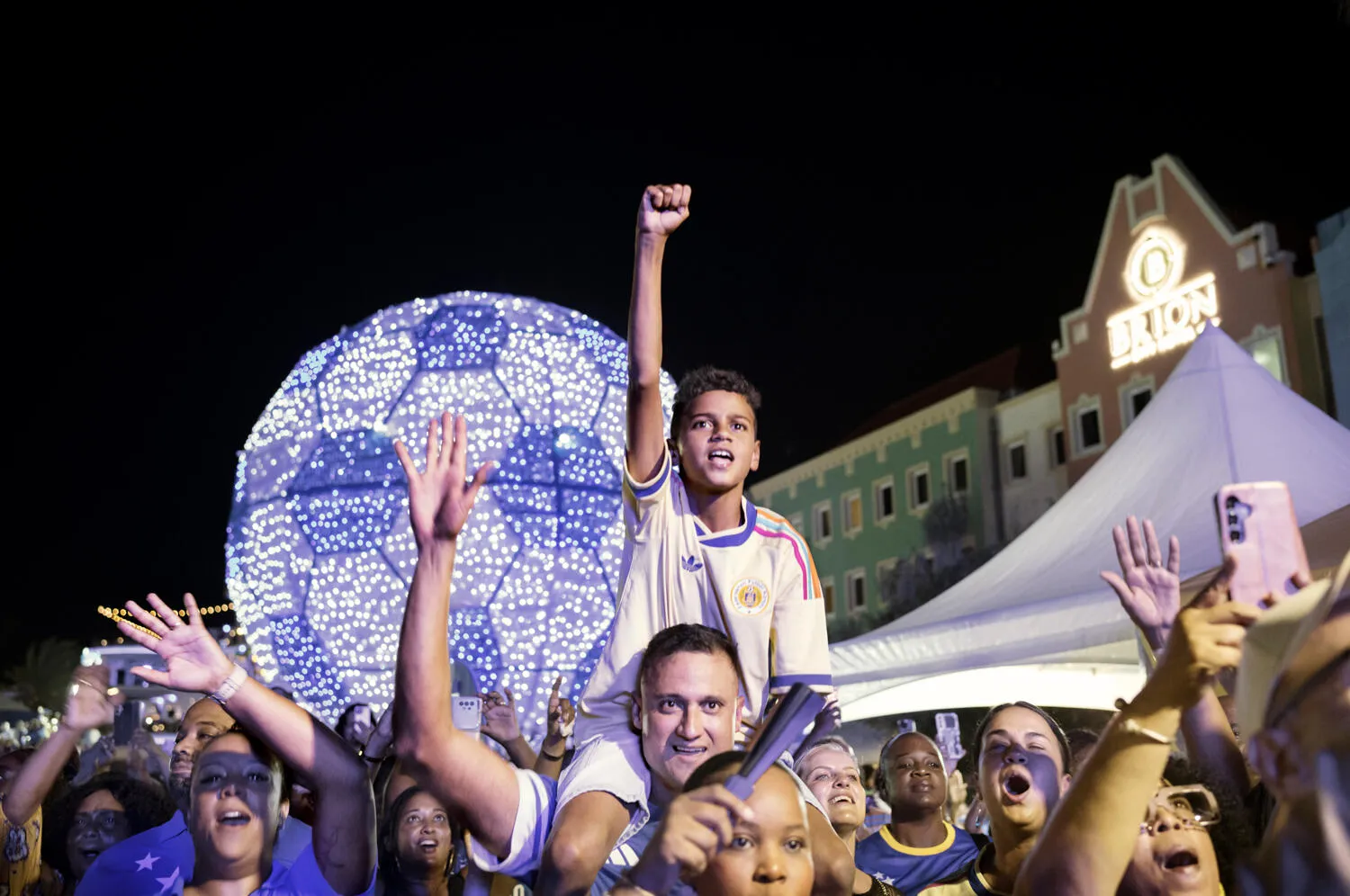
The day ends, the sun sets. The first fireworks candles ignite in the sky over Willemstad, capital of Curaçao, in the Caribbean. The final bouquet is approaching, and the jets of light exceed the Queen Juliana Bridge. The children hold out their arms to try to catch the colors. Soon, they will climb off their father’s shoulders and frolic on the sidewalks. A few steps away, their mothers are dancing. Caribbean sounds escape from the speakers. At the end of spring, Curaçao is celebrating. A happy interlude that the island fully savors.
Juliano knows that he is experiencing a happiness that he will perhaps never experience again. His heart is beating faster than usual. He talks about this damn habit of going to fish out his island’s swimsuit from the dirty laundry bin, to the great despair of his mother who gets annoyed at seeing him always put on the same outfit. “Everyone does the same anyway,” he justifies with a mischievous air.
In the streets, the crowds dressed in blue. Flags are hung on cars. The horns sound. Juliano blends into the surging tide. A few days before the World Cup, which takes place from June 11 to July 19, 2026, Curacians are celebrating the unthinkable: this 444 km island2populated by 158,000 inhabitants, qualified for the first time in its history.
It was November 18, 2025, in neighboring Jamaica. The twenty-six players of the national team heroically snatched their tickets for the United States, Canada and Mexico, the three host countries of the World Cup. “It was unbreathable,” Mya remembers. The young woman, whose teeth are covered with braces, is overcome by popular fever. Until a few weeks ago, she knew nothing about the rules of the game. In fact, she would never have been able to recognize the faces of the players displayed on the soda cans. From now on, she dreams that her “future son”, whose kicks can already be felt through his round belly, “will become captain of Curaçao”.
The Dutch imprint
Football offers a new collective dream: defending the colors of the island. With its 211 member federations, Fifa, organizer of the World Cup, has the distinction of recognizing more member states than the United Nations. Among them, Palestine, Taiwan, Hong Kong, or Curaçao… They all find a theater in which to express themselves. “Usually, in all other sports, our champions play for the Netherlands,” explains Mya. For the first time, we have our own team, our colors, our flag flying around the world. »
Technically, Curaçao is not really a country. Discovered by the Conquistadors at the end of the 15th centurye century, the strip of land was attached to the Dutch colonial empire in 1634. Today, it enjoys a unique status. An autonomous territory since 2010, the island has a parliament, a government and its own currency, but remains under Dutch protectorate, which finances its defense and whose metropolitan residents flock in droves to tan in the sun.
An island of stability
On the beaches of Jan-Thiel and Marie-Pampoen, brand new holiday homes are popping up everywhere. For the Dutch upper middle class, the coast has become an ideal retirement location or the idyllic setting for family vacations, accessible by direct flight. In supermarkets, the shelves are designed for Dutch customers. Gouda, smoked herring and Amsterdam beers… These products are imported from the Old Continent and demonstrate how the local economy remains dependent on the Dutch presence.
Curaçao is among the richest countries in the region. With a GDP per capita above 20,000 euros, the island even displays a level of wealth comparable to European countries such as Bulgaria or Romania. But to support its economy, the territory needs labor and welcomes workers mainly from neighboring islands.
In the heart of the Caribbean, Curaçao embodies a promise. That of a territory where unemployment rarely exceeds 10% and where life goes on as it goes. “Here, we’re not going to complain. There’s work to be done,” comments Justin, his arms swollen with effort. All day long, under the blazing sun, he stacks concrete blocks and insulates walls. Difficult, grueling projects that he shares with two Ecuadorian colleges who crossed South America, guided by the hope of a better life.
Unlike its neighbors, Curaçao is spared from internal crises and geopolitical upheavals. In Cuba, many are fleeing poverty and the nationalized economy. In Puerto Rico, a territory under American sovereignty, the population is suffering from the toughening of the migration policy of the Trump administration. And recently, it is the Venezuelans who have been flocking. Migration waves are intensifying, particularly since January 2026, and the capture of Nicolas Maduro, the Venezuelan head of state, by an American special forces commando.
The memory of this coup remains vivid. Firstly because the takeover of the oil sector by the Americans did not allow the reopening of the main refinery of Curaçao, long a pillar of the local economy and formerly operated by the Venezuelan public oil giant. Above all, the reaction of the Dutch godfather left a lasting impression: the day after the “Yankee” demonstration, the government dispatched a national navy patrol boat off the coast of the island. The Minister of Defense explained that he wanted to “monitor the security situation”. “We felt protected, judge Justin, and in this context, that feels good. »
A slow erosion of faith
In these uncertain times, the World Cup therefore acts as a powerful vector of unity. The selection matches are an opportunity to unite, to create cohesion. Remko Bicentini has long been at the forefront of this unifying dynamic. After an honorable football career in the Netherlands, he became coach of the Curacian national team in 2016 and will remain until 2020, then from 2022 to 2023.
Under his leadership, the island has multiplied its exploits. Players set out to beat teams from all over the world. From Qatar to India, via Honduras or Bolivia. With each victory, he saw “a growing euphoria”. The streets were filling up. Enthusiasm spread across the island and the players gradually became “idols and examples” for young people.
In reality, football also filled a void. Since 1842 and the creation of the Apostolic Vicariate of Curaçao, Catholicism has deeply permeated the country. The schools remain largely Catholic and, according to a 2023 census, 68% of the population claims to be from Rome.
Inside the Santa Famia Church, in the Otrobanda district, the faithful take their places on the benches. Indian, American and Curacian families mingle in this place of worship, open to the four winds. Father Jose Luis Dominguez Sandoval goes through the services and switches from one language to another with great ease. At 9 a.m., he celebrates mass in Papiamento, the local Creole; at 11 a.m., he starts again in English. The atmosphere is warm. Parishioners kiss each other and exchange gifts for the youngest’s birthday.
An ordinary parish life, in short. However, the country is experiencing a slow erosion of religious practice, particularly among young people. “For many, the Church is seen as boring, austere,” regrets the priest who observes a shift towards evangelical churches and charismatic communities and, whose celebrations, more musical and participatory, resonate more with Caribbean culture. Readings, songs, prayer intentions… to retain his faithful, the father relies on their involvement in the liturgy. “It’s thanks to this that my parish lives well,” he slips.
A “blue wave”
Now, a few days before its entry into contention against Germany, on June 14, 2026, Curaçao is already planning beyond the competition. The World Cup must leave a lasting legacy, starting with tourism. Football has become the new standard of the island. The authorities even adopted a slogan, Blue Wave (“the blue wave”), now omnipresent to the point of appearing on the letterhead of visas.
A “strategic exploitation”, as underlined by the Minister of Economic Development, Roderick Middelhof, whose services are already pleased with a 13% increase in tourist numbers since January 2026.
“It’s the miracle of the World Cup,” laughs Reagan. This affable and warm man – always a stray strand among his impeccably combed hair – drives his taxi truck with worn seats and tired engine, for hours on end. Between the airport and the hotels on the coast, he shuttles with jazz playing in the background.
Just a few months ago, the days sometimes dragged on. The wait could last hours in the airport parking lot. So he would grab his guitar and play a few choruses, with the window open, for the pleasure of his colleagues. Today, the instrument sleeps at the bottom of the trunk. The races continue. “For that alone, I now love football. »
But the World Cup will not be able to solve all social problems. In the poorest neighborhoods, living conditions remain precarious. Between abandoned houses and stray cats scratching the trash cans, the most modest live in wooden or sheet metal sheds that threaten to collapse. Plastic waste litters gardens.
Rayone lives in this setting of misery. Sitting on a plastic chair placed on a piece of sidewalk, he kills boredom as best he can. At 44, he suffered from heart problems. The doctor declared him “unfit for duty”. He can no longer work, and lives with his brother, a professor, in the house inherited from their mother. It is held together thanks to state aid, paid every 15th of the month. Feverishly, he “counts the days”.
Curaçao remains a very unequal country. “Life is not always easy,” Rayone euphemizes. From his seat facing the ocean, he watches the boats and the birds, and is no longer surprised to speak out loud. He has this almost poetic habit of repeating the same sentence tirelessly. This time, he chose to reinvent the ending: “Here, life is not always easy… but it is always beautiful. »
2026 Football World Cup: when to watch Curaçao (Paris time)?
- June 14, 2026 at 7 p.m.: Germany – Curaçao
- June 21, 2026 at 2 a.m.: Ecuador – Curaçao
- June 25, 2026 at 10 p.m.: Curaçao – Ivory Coast