
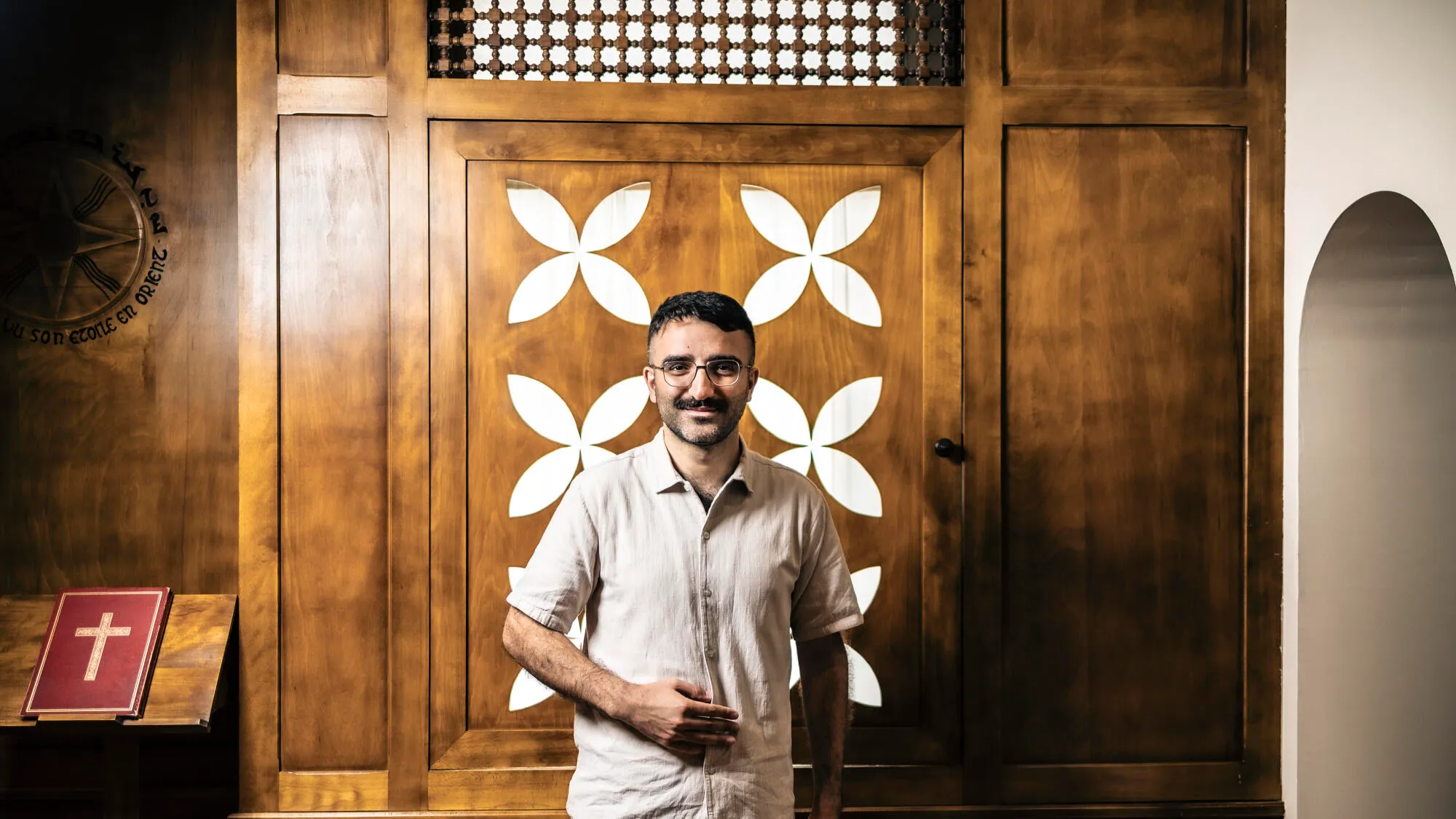
Dilan Adamat, the Franco-Iraqi returned to Iraq
You were one year old when you left Iraq with your parents in 1991. Why did they leave?
I was born a month after the Saddam Hussein regime invaded Kuwait. The opening of a new conflict was a blow to the morale of the population, which had just emerged from eight years of war against Iran. My father had participated and wanted another future for his children. We left behind us rains of bombs, but also our families… And we arrived in Nantes (Loire-Atlantique), where I grew up.
What links have you kept with your loved ones who remained in Iraq?
Our exchanges were limited to phone calls made from a bad phone booth. There was no internet back then, let alone video calls. Sometimes we recorded news on an audio cassette and gave it to someone returning home. For years, I didn’t see my grandmothers’ faces, except in a few old photos…
Until your first return, as a teenager. Tell us…
We are in 2003, a few weeks after the overthrow of the regime by the United States. That summer, we went on vacation for the first time to Ankawa, where my parents were born. It is a Christian town on the outskirts of Erbil, in the Kurdistan region of Iraq. Uncles, aunts, cousins… Everyone is waiting for us, especially my two grandmothers, who have been widowed for a long time. I was just an infant when they last saw me. We hug each other. It’s very strong!
Were you able to make up for lost time?
No, because my grandmothers were already very old and died a few years later. Ultimately, I only spent two stays with them. One day, at a wedding, my maternal grandmother asked if I was indeed the son of my mother, Majda. It was a bit sad.
With my paternal grandmother, I experienced some beautiful moments of complicity. I see us again one afternoon sitting on a swing in the garden. I make her do mental arithmetic and we laugh a lot because she gets it wrong half the time. When my cousins recount all their memories, I listen without being able to participate in the conversation. I wasn’t there.
Is this a regret?
Of course, even if I understand my parents’ choice. I don’t want to live far from my loved ones, as is still the case for many Iraqis: siblings separated between the United States, Iraq and Australia for example, who only see each other once every ten years. And again, without being complete. A phone call never replaces physical contact, a real moment together. Today I want to live close to my family.
“I often say that in Iraq, life is a stroll. I like this spontaneity. »
Dilan Adamat
Is that what made you want to settle in Iraq?
This is the main reason. But there was also a deep desire in me, which dated from my first vacation in Ankawa: that of the simple joy that I had tasted, far from the Western way of life that I found too consumerist and materialist.
You take the plunge at the threshold of your 30 years…
Yes, in 2019. In Iraq, two years after the fall of Daesh, the situation was improving. For my part, I was at a pivotal moment in my life. I had been working for several years in a Parisian law firm, where a promising career was emerging.
I was at an age where you think about getting married, taking out a mortgage… Commitments that would have kept me in France for a long time. But deep down, that wasn’t what I wanted. I wanted to move to Iraq and live there for good.
What was the reaction of those close to you?
Everyone thought I was crazy! No one supported me, not even my parents. And even less my family in Iraq: “What the hell is wrong with you? In Paris, you have a good life! »
“My Franco-Iraqi friends are still living through the trauma of their parents. »
Dilan Adamat
How did your installation go?
Alright ! I left my bags in the small house my parents built in Ankawa, and I immediately acclimatized. I often say that in Iraq, life is a stroll. We don’t necessarily go from one place to another, planning everything, like in France. If I’m going out and, on the way, I want to ring a cousin’s house to see him over tea, I’ll go. I like this spontaneity.
It seems simple and yet your approach is completely against the grain…
In twenty-five years, more than 90% of Christians have fled the country, because of wars and Daesh. There were 1.5 million Christians in the early 2000s, and now there are 130,000 according to the Shlama Foundation. If we wait without doing anything, the disappearance will become irreversible. However, without Christians, Iraq will no longer be Iraq.
For what ?
Because the Christian presence is extremely old here. It dates from the very beginning of the Church, in the Ier century. That is to say long before the arrival of the Kurds, the Arabs and Islam. Among Christians, several rites coexist. My family and I are Assyro-Chaldean, attached to the Catholic Church. We pray in Aramaic, a language very close to that spoken by Jesus. In the church I go to, in Ankawa, there is the tombstone of a priest who died in 927. That’s where my parents, grandparents, great-grandparents were baptized. Iraq must remain multi-ethnic and multi-faith.
“I received my cross during my communion from an aunt who lives in Germany. Since then, I have worn it all the time. Except for this photo, it had been several years since I took it off. Before moving to Iraq, I had another pendant with my cross: the map of Iraq. The day I moved in, I took it down. »
Dilan Adamat
How can we encourage exiles to return?
I founded The Return, an NGO that supports those we call “returners”. We assist around fifty people per year, who return from everywhere, with their administrative and legal procedures. Like this Iraqi-American who speaks no local language, whom we helped find rental accommodation.
Others need moral support, to feel that they are integrated into a community. There are many young people like me, who grew up in a perfectly westernized world, far from wars and dictatorship, and who come back out of conviction. They do the country a lot of good, like a breath of fresh air. We must encourage them. This project is close to my heart.
And your parents?
They joined me last year, in 2025! After having definitively returned the keys to their apartment in Nantes, the one where I grew up.
Finally, are all Christians following you?
Not yet ! I have met many in the diaspora who would like to return – even for a temporary visit – but who do not dare. They think they’ve been gone too long.
I think, for example, of Pierre, my childhood friend. In 2003, when we returned to Iraq for the first time, his parents thought it was premature and preferred to wait to see how the situation developed. Two decades later, they still haven’t set foot in the country again… That’s how it is.
The most complicated thing is to convince my loved ones, to preach for my parish (he smiles). My French-Iraqi friends are still living through the trauma of their parents. For them, Iraq remains a dangerous country.
It may seem difficult to prove them wrong. The country is classified as a “red zone” by the French authorities…
We must understand that this region of the world will never be completely stable. For more than fourteen hundred years, there have been latent tensions, particularly between Shiite and Sunni Muslims. I also feel that the Iraqis are tired of sectarian wars. But on a daily basis, life is peaceful. Hospitality and generosity are great, and there are never any thefts.
“My passports symbolize the two nationalities that make me up, like two parallel identities. French remains my natural language, the one in which I write best. France represents my youth. Iraq, I am building my life there. »
Dilan Aramat
There is also the war between Iran, Israel and the United States, which is shaking the entire Middle East. What is the impact on your daily life?
We see drones passing through the sky every day. Especially in Ankawa, which is located near an American military base, targeted by the Iranians. The sound of explosions and anti-aircraft defenses can be deafening. But it had no real impact on our lives and there were almost no casualties in Iraq.
This is why most of the “ghosts” stayed, contrary to what many skeptics thought, predicting that we would leave at the first tremors. Recently, a cousin even said to me: “You stayed during wartime… Now you are really Iraqi. »
On June 22, 2026, Iraq and France will face each other in the 2026 FIFA World Cup. Which jersey will you wear?
Since my childhood, I have been asked who I would support in the event of a France-Iraq match. I always managed to kick in: no need to respond, since that would never happen (laughs) ! I wasn’t born in 1986, the only time Iraq played in a World Cup, in Mexico.
But now this edition marks its big return. And I even have a cousin, Rebin Sulaka, who is a defender in the selection. On June 22, I will surely go to the big screen near my home. My heart will lean more towards Iraq but I wish both teams to go as far as possible. As I often say, I am 100% French and 100% Iraqi!
The biography of Dilan Adamat
- 1990. Born in Erbil (Iraq).
- Summer 2003. First return to Iraq with his parents.
- 2007. Obtains the baccalaureate.
- 2009. Begins law studies.
- 2015. Hired in a law firm in Paris.
- 2019. Moves to Iraq.
- 2023. Founded the NGO The Return.