
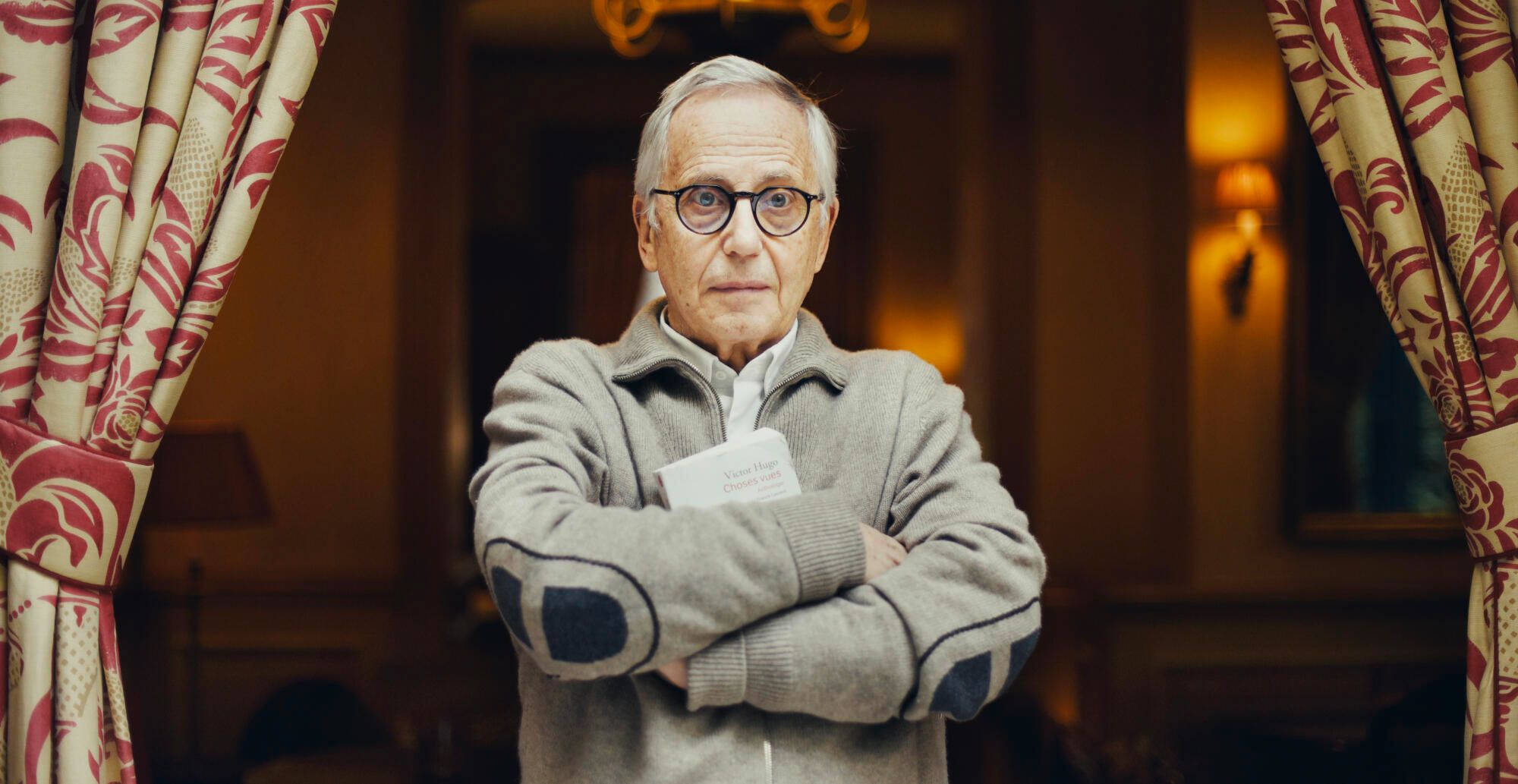
“Great texts have the art of uniting”
In your new film, you play an artist inhabited by the city and the stage by the poetry of Victor Hugo. Tell us about this role…
Director Sophie Fillières had this unique idea of writing a scenario around an actor who is completely exalted, nourished and passionate by the genius of Hugo, but who, in his private life, has overlooked his relationship with his daughter. Certain sequences of the film include extracts from my show on Victor Hugo, created in 2023 at the Théâtre de la Porte-Saint-Martin, in Paris.
In this fiction, you are therefore both a theater actor and a film actor…
I learned this need to alternate between the two exercises by reading Louis Jouvet (1887-1951), my absolute master. This great actor proposes an overcoming of the ego and demands that we annihilate ourselves in order to make people love the texts. If you’re just an actor, you’re in appearance all the time. However, it is the responsibility of the actor to also know how to disappear in order to serve the words of an author.
One of the most touching shots in the film is the one where we see your audience head-on, from the theater stage. An audience with very diverse faces and ages…
In such a distressing time, where politicians bombard us with their “living together”, this is called unifying. There, at the theater, the public has the certainty of forming a human community around great texts. There we find something of the order of Christian spirituality. And I’m not saying that because I’m talking to Pilgrim !
The theatrical performance is sometimes similar to a religious ceremony. There is a priest – the actor – who is an intermediary. There is a verb – here that of Hugo, who was very concerned about God, but who, strangely, did not want to belong to either Catholicism or Protestantism. And there is a community. In the evening, when the show is on, we are in suspension.
In the film, your character seeks to build a bond with his daughter, a young adult. When meeting her face to face, he can’t help but quote Victor Hugo…
Robert Zucchini cannot do without the beauty of Hugo’s language, even in the presence of his daughter whom he has not seen for twenty years. And she, with the harshness that young people can have, asks him to stop immediately with his quotes. It is not always possible to convey what we want to our loved ones.
“I was a better son than father,” said the filmmaker Claude Berri. For my part, I went to see my mother at lunchtime almost every day, until I was 60 years old. But when my daughter Emma was born, I wasn’t there at all. Very invested in my career, I was not coping well with my fatherhood. Fortunately, I made up for it around the time she was 14 and I now have an exceptional relationship with her.
A poem by Hugo runs through the entire film, it is Booz asleep. What does it mean to you?
It was Charles Péguy (1873-1914) that all this was born. This writer devoted a book to this poem. According to him, from high school, and then each time we reread these verses which relate an episode from the Book of Ruth in the Bible, we are struck! We feel that it is much more than a text. A work of “biblical, patriarchal, nocturnal peace”, in the words of Péguy, who considered it one of the major events in the history of Western poetry. Say, Péguy, as a Christian, there is nothing more extraordinary!
Quoting the last three lines of this poem, your character, Robert Zucchini says: “It’s Hugo’s phrase that makes you mystical, even if you are an atheist. »
“What god, what harvester of eternal summer,/ Had, on leaving, carelessly thrown/ This golden sickle into the field of stars. » Yes, Hugo is overcome by grace when he writes these verses, it is obvious. It goes beyond mechanical versification. Hugo is a rooted, inspired poetry. According to Péguy, Booz asleepit’s almost a pagan prophecy. Hugo speaks here of spirituality, even if he is not baptized. Moreover, this totally fascinates the priests who come to my show.
“In the theater, we find something of the order of Christian spirituality. There is community. »
Fabrice Luchini
The day Victor Hugo wrote this poem, he would have felt that he was going to deliver something unique…
On stage, I say this poem for ten minutes for the first time. Then I say it a second time, clarifying it with comments. “Ruth was thinking and Boaz was sleeping; the grass was black; /The bells of the herds palpitated vaguely; / An immense goodness fell from the firmament. » Every evening at the theater, at that moment, I witness a suspension. Something seizes the spectators, while I was convinced that the era would no longer include this type of text. It’s very complicated to phrase, almost impossible.
Should we try to sing Victor Hugo?
First of all, you should never sing to anyone, even Rimbaud. Saying poetry requires asceticism, transparency. Because whatever you do, you betray! As soon as you voice your voice, you betray! But then Hugo, if you give each word the heaviness of an intention, you are wrong! Not singing the verse does not mean that we should not restore its lyrical breadth. It exists intrinsically and you try to simply serve this arrangement of words. In short, it’s a job…
So, when you read a text, it’s not music?
There is immense music, lyricism, genius. But it is not your responsibility, it is that of the author. It’s not up to the actor to create his little music. “Ruth thought and Boaz slept” is so sublime that there is no need to add more. If your diction and breathing are correct and you are old enough to not want to show off, something is coming up. This is Jouvet’s wonderful sentence: “They bloat the sentence, they throw it at the public like people throw food at the animals at the Vincennes zoo.” And they bloat the sentence so much with their personal intentions that they destroy the innocence of the reply. »
You fill the theaters with Hugo and new show dates have been scheduled for fall 2026. What do the public find when they come to listen to you at the theater?
We can ask my partner! (He turns to her.) “Emmanuelle, what does the public find? – Easy access to great literature » (she replies.) And literature, of course, is the French spirit! Whether we studied or not… “It seemed to me that everything was just a horrible dream,/ That she couldn’t have left me like that,/ That I heard her laughing in the next room,/ That it was finally impossible that she was dead,/ And that I was going to see her enter through that door! », wrote Victor Hugo following the tragic death of his daughter Léopoldine. That’s genius! Everyone who has lost a child says that this sentence is extraordinary. You don’t need to be an intellectual to be amazed by this poem, that’s Hugo’s great talent!
So many spectators come to watch your readings, listen to you on the radio and on social networks. Would you be a sort of universal teacher?
I, the bad student, who was so unhappy at school that I left it at the age of 13 and a half, accept the compliment with emotion. At 13 years and ten months, I entered a hairdressing salon on Avenue Montaigne, in Paris, where I did the hair of very rich, very arrogant bourgeois women. Neither the modest nor the rich should be mythologized…
It was when I found myself face to face with my theater teacher, the immense Jean-Laurent Cochet, that he created a miracle. Later, I also met the actor Michel Bouquet and the filmmaker Éric Rohmer who had been a literature teacher.
“Saying poetry requires asceticism, transparency. »
Fabrice Luchini
Your passion for great texts was therefore not born at school…
No, but you have to tell your readers that it’s a privilege to love school a little. The autodidact is deprived of a broad reading of reality, of a general culture. The school is extraordinary! My luck is that my dissonance found an outlet in my profession, my passion. Otherwise it wouldn’t have been easy. Perhaps I could have made a living by opening a restaurant or selling fruits and vegetables, like my father. But it’s not free to be a misfit at school. If you start to be dissonant with school, it will make you dissonant in society.
Transmitting great texts, is this a duty for you?
No not at all. I don’t do things out of love for others. Everything actually comes from my personal interest: I like to work because I have always been anxious. I’m not going to say that I’m a hero; I’m not a hero at all. And if one day I became a Christian, I would be a Jansenist (spiritual movement born in the 17th century giving a rigorous reading of Saint Augustine, editor’s note)like Blaise Pascal, the philosopher (1623-1662)! I like this radical side.
Reading passages from the Old or New Testament on stage, is this possible?
Maybe… starting with the Gospel of John… I just bought a new translation of the Gospels and it’s not uninteresting… But then, if I tackle that, I have work for twenty years!
News from Fabrice Luchini
The biography of Fabrice Luchini
- 1951. Born in Paris.
- 1970. Claire’s kneeby Eric Rohmer.
- 1985. Reading on stage of Journey to the end of the night, by Louis-Ferdinand Céline, at the Rond-Point theater in Paris.
- 1990. The discreetby Christian Vincent.
- 1994. César for best supporting role in All that… for that!by Claude Lelouch.
- 2011. The women of the sixth floorby Philippe Le Guay.
- 2022-2023. The Fountain and confinementdirected by Emmanuelle Garassino, at the Montparnasse theater in Paris.


