
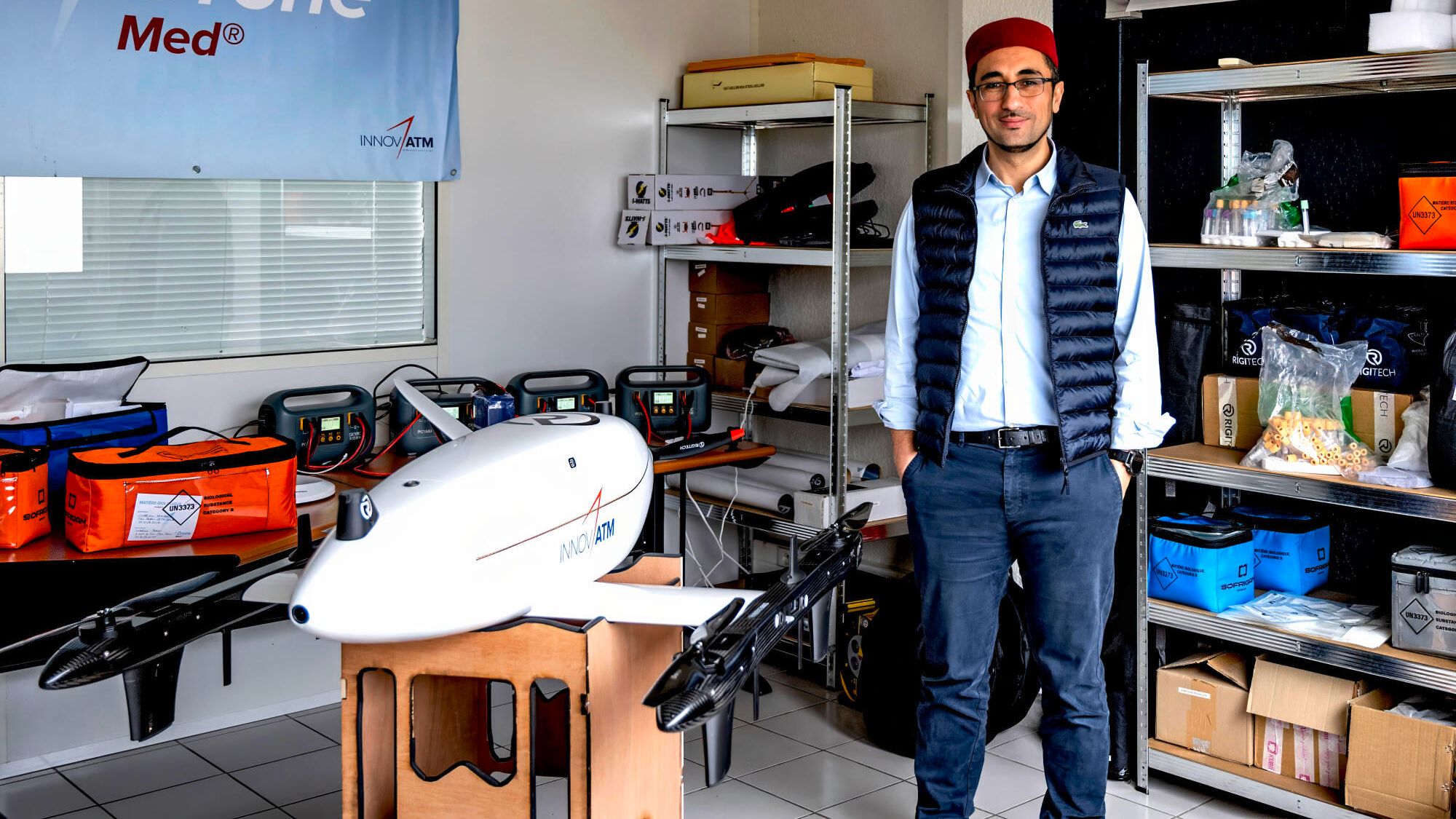
medical drones to save lives
You have to see it in place on the vertiport (takeoff platform) of Pamiers, in Ariège. With its 2.68 m wingspan, blue wings and trunk that can hold up to 3 kg of blood tubes in a cooler, the Eiger drone is a revolutionary mode of transport for the medical world.
For six months, in the testing phase, he has been shuttling between the Cerballiance analysis laboratory in Saverdun and the department’s medical-technical platform (place where the samples are analyzed) in Pamiers. No traffic jams or CO2 emissions. From May 2026, it will officially operate in medical analysis laboratories, hospitals and clinics in Ariège, with six flights per day.
The DroneMed service was created by the company Innov’ATM in 2024, in Cugnaux (Haute-Garonne), near Toulouse. Amine Karray, co-founder and manager of the company with Stéphane Bascobert, explains how the project was born: “We specialize in air traffic management solutions. For example, we have equipped airports with tools to keep drones at bay. »
In 2025, Innov’ATM became the only French company (and one of the few in Europe) authorized to fly in secure air corridors above sensitive environments such as hospitals. “We have understood our usefulness since the State grouped the medical-technical platforms in each department,” continues Amine Karray. The idea also came after professional experience in Rwanda between 2023 and 2024, where Zipline, an American company, provides 400 drone flights per day to the country’s hospitals. »
In January 2025, Innov’ATM tested a first multicopter drone (equipped with several propellers). “But the device was limited to 15 km of autonomy and small loads,” explains Philippe Hassan, operations manager. So we acquired the Eiger, a hybrid drone designed by Rigitech, in Lausanne, Switzerland. This multicopter has a fixed wing and a push – rear propellers – which allow it to fly 80 km, between 80 m and 120 m above the ground.
The drone is still subject to constraints. It cannot fly when the wind exceeds 54 km/h and the rain exceeds 5 mm per hour. It also does not operate below -7°C and above 40°C. The journeys are not made in a straight line because we can only fly over areas with a maximum density of 500 inhabitants per square kilometer. We must also avoid sensitive sites like prisons, transformers, courts, nuclear power plants, stadiums and schools. »
New line in the East
The drone is managed by a supervisor at the Innov’ATM premises in Cugnaux. Remote pilot Justine Veirier d’Aiguebonne, responsible for flight regulations and safety, works with three control screens: one for the weather, one for air traffic and another for airspace.
“We check time, distance and battery charge. The drone has a programmed trajectory, but if there is a problem we can regain control of the aircraft, pause it or return it to the starting point. It is equipped with a safety parachute in case of emergency landing. »
In November 2025, Innov’ATM raised funds of five million euros in order to industrialize its model and expand its operations nationally. The company is due to open a new line in the Grand Est in 2026, connecting the Nancy-Brabois hospital center to that of Pont-à-Mousson, in Meurthe-et-Moselle.
“Enough to eliminate twelve daily road trips, or 444 km. We are also studying the opening of other lines between Bagnols-sur-Cèze and Pont-Saint-Esprit, in Gard, and in Toulouse. And soon beyond borders,” rejoices Amine Karray.
Towards organ transport
On the Pamiers vertiport, Philippe Hassan confides: “Our project is to transport other medical products such as organs. We provide the cooler, ice packs and temperature probes. The samples are protected by specific triple packaging guaranteeing the maintenance of the temperature and the absence of vibrations likely to alter their quality. » A service which, due to its effectiveness, has every chance of becoming widespread in the years to come to treat and save more lives, particularly in isolated rural areas.
DroneMed’s recipes for success
- Speed. The Eiger drone flies on average at 110 km/h. It avoids the hazards of road traffic and shortens analysis times.
- Cost reduction. This solution saves driver salaries and vehicle maintenance. The cost reduction was estimated at at least 30% in Ariège.
- Ecological transport. The elimination of thermal vehicles considerably reduces the carbon footprint of journeys.


