Clotilde Gilbert: “An hour of speaking can change a life”
You were a prison chaplain and you founded a reintegration association. Why this interest in the prison world?
People often ask me how I ended up in prison. At 28, I met a former soldier involved in reintegration. While listening to him, I had an intuition: one day, I will go to prison. This came true ten years later. A monk I knew, a chaplain in a remand center, asked me to come and sing there to bring a little joy. So I went to Nanterre prison to participate in a mass with inmates. I joined the chaplaincy team and, little by little, I discovered what the inside of the prison was like. The chaplains have the particularity of having the keys to the cells, and therefore of entering into the privacy of the prisoners. This is where I felt at home.
What was your mission?
Above all, I was trying to be a presence. Some detainees adopted a facade attitude, others showed their wounds straight away. They all had the same need, which everyone shares: that of being loved. When you simply introduce yourself and say, “I’m here to hang out with you and meet you,” anything becomes possible. Some have confided to me moving life stories, sometimes very violent. I particularly remember a man who was the age of my father and who was being prosecuted for acts of incest against his children, including a girl who was my age. I accompanied him before his trial, then until the moment of judgment.
Why did it despite such a crime?
It wasn’t always easy. Receiving this type of confidence requires real work on yourself. Sometimes what we hear is extremely difficult to bear. So I was accompanied by a psychologist myself. I needed to deposit what I received. As a chaplain, my mission was to be present to all those who asked me to be. Each inmate has the right to receive spiritual accompaniment, not to minimize the seriousness of his actions but to help him face them.
“Many people are not aware of the beautiful, good and good things they wear. »
What do you say to those who think we are more interested in the perpetrators than the victims?
The best way to respect the tragedy of the victims is to do everything so that there are no more. This involves preventing the attackers from doing it again. To do this, we must help them become aware of their actions and give them the means not to repeat them. For me, the function of prison is not to avenge the victims.
Then, you moved from chaplaincy to reintegration…
Many people are not aware of who they are. Nor of what is beautiful, good and good in them. These three words come up often for me because they say something profound about every human being. This is what led me to create Wake up Café. We wanted to build a place where the ex-inmate is never reduced to his actions but supported to rebuild his life.
How do we ensure that a person is no longer reduced to their past?
We must first reconcile her with herself. Allow her to discover that she carries within herself all the potential necessary to have a better life, to be happy and regain her dignity. This path begins with an understanding of one’s own value, but also with the opening of perspectives. You have to create desire by showing an achievable horizon. In our programs, we involve partner companies so that prisoners see that there are companies who are interested in them, who are ready to trust them and who offer them a much wider range of possibilities than they imagined. Reintegration is not just an idea or a speech: it is concrete. It is by providing the means to understand that everyone has their place in society from detention that we obtain results. Then, externally, by providing the means to achieve it.
So reintegration is not just a question of work?
Simply supporting people towards employment is not enough. To achieve sustainable reintegration, all aspects of each person’s life must be taken into account. It takes time. Joining Wake up Café is a demanding choice for those leaving prison. There is a framework, rules. We work on self-presentation, dress, how to be with others. It is not a question of judging, but of giving the codes which will then make it easier to evolve in society. It is through this progressive, demanding but caring learning that everyone can find their place and build a stable life outside of prison. Our houses, for example, are located in the city center and have a garden, which is part of this reconstruction. Most of those we support grew up in cities or working-class neighborhoods. We often welcome them to pleasant places, sometimes in beautiful neighborhoods, because we want to tell them that they are worth it.
Society, for its part, does not necessarily want to reconcile with an ex-inmate…
We live in a society where two worlds evolve in parallel, without really meeting. On the one hand, there is that of the detained people, with their anger and their often legitimate feeling of injustice. Being locked up, having no prospects, having no visible alternative to leaving, sometimes living four people in nine square meters, in overcrowded establishments… All this feeds frustration and despair.
“Through demanding but caring learning, ex-inmates can find a stable life. »
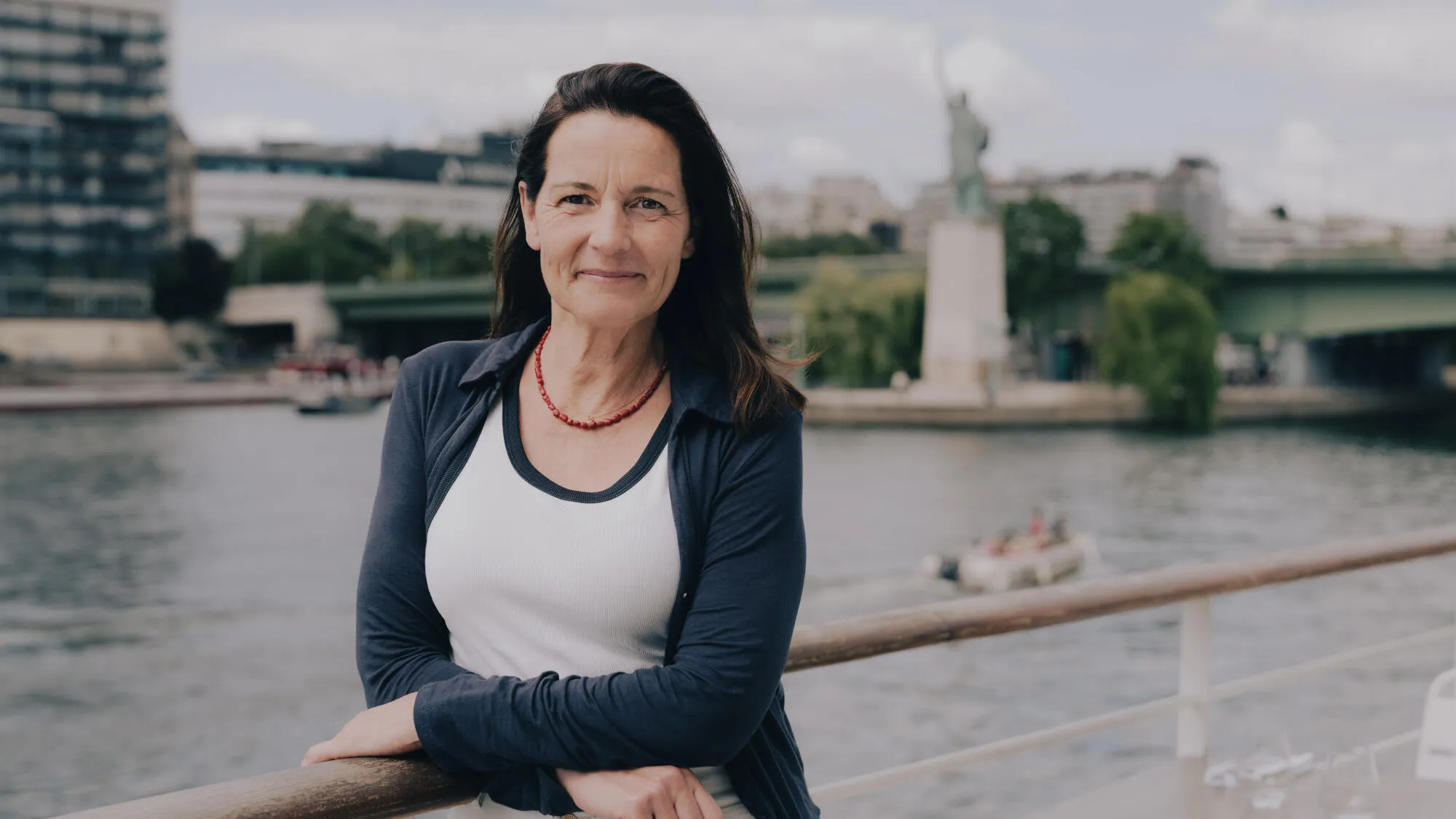
Clotilde Gilbert Former prison chaplain and founder of Wake up Café
But on the other hand, society notes that burglaries, assaults and rapes continue. There is also anger and a feeling of legitimate injustice…
The only possible path consists of reconciling these two worlds, without angelism. Yes, it is normal for society to expect strong and effective justice. But if we do not support a real change in trajectory, then we remain in an endless circle. How to transform this? How can we put an end to this cycle of entries and exits which serve no purpose and are extremely costly to the community? By enlightening consciences a little. This work concerns the whole of society. Wanting the State to be alone in managing these problems is, in a certain way, disengaging from our collective responsibility to build a society in which life is good.
Even if the results of Wake up Café are very positive, there are cases of recurrence…
It happens. Teams are often affected and disappointed when they have invested in someone, when there was a lot of hope, when the person seemed to be doing well, but they reoffend despite everything. At Wake up Café, we train teams in an adult-to-adult posture. The idea is simple: “I am at your side, I move forward with you in the choice you make to integrate into society. I do my part, you do yours. » We are not responsible for what everyone ultimately decides to do. We provide our know-how, our teaching, our support tools. Then, what the person chooses to do with it is up to them: everyone remains an actor in their own story. I also believe that what we sow does not always produce its effects immediately. Sometimes I tell myself that a simple one-hour visit in detention can transform a life, but not necessarily right away. Some seeds simply take longer than others to germinate.
His universe
A game of cards
I have six children and five grandchildren who are my greatest pride, my greatest joy. In my family, playing – especially tarot – is almost an obligation. Playing brings happiness and joy to life.
The biography of Clotilde Gilbert
- 1970. Born in Tassin-la-Demi-Lune (Rhône).
- 2008. Chaplain at the Nanterre-Hauts-de-Seine prison center.
- 2020. Creation of Quai Liberté, in Paris, the first barge-restaurant employing people released from prison.
- 2022. First agreement with the prison administration (renewed in 2025).