Fires in Gironde: “We would be ready to die for our trees”
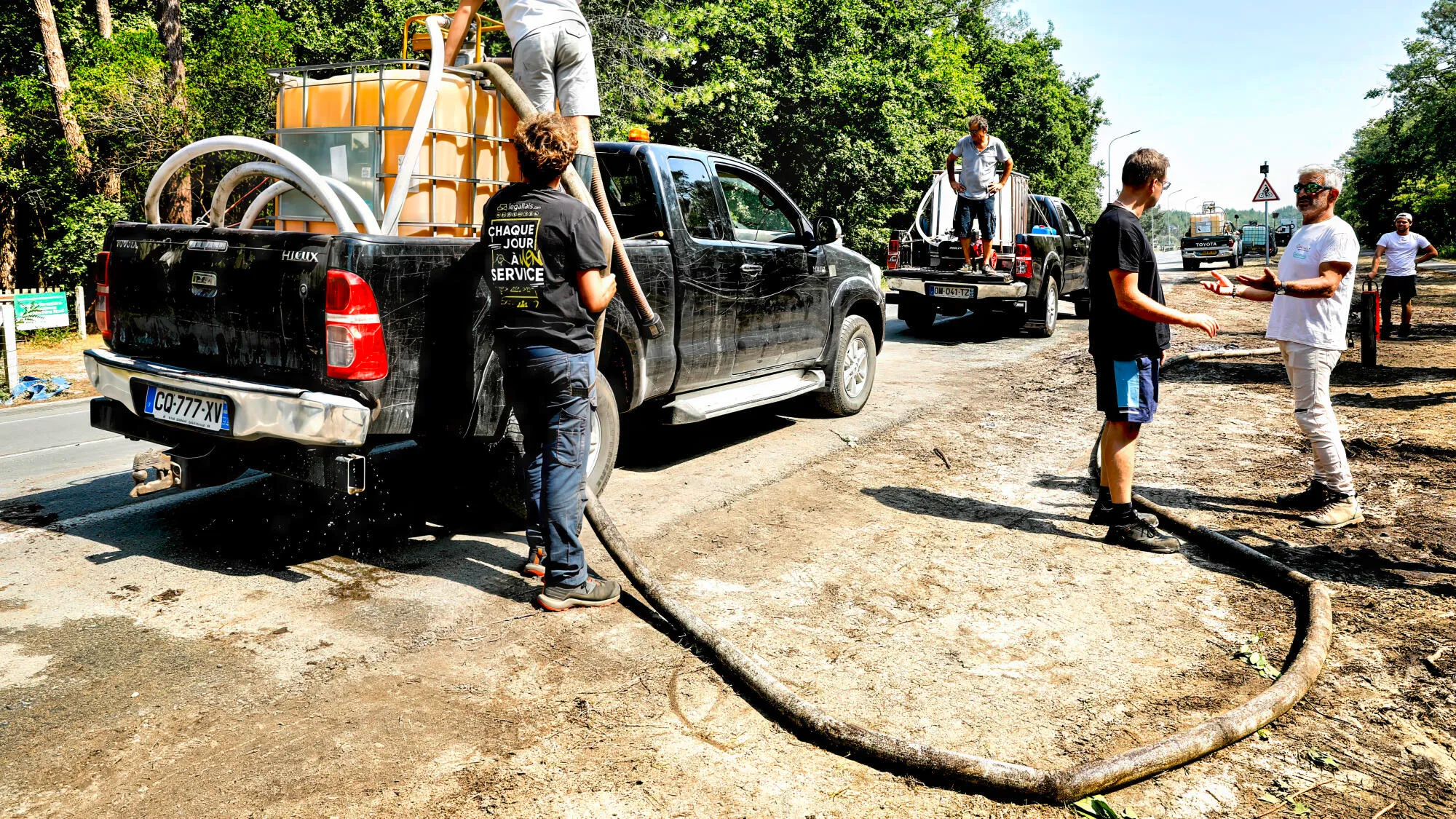
A cry, and the order is given. The vans loaded with vats and cans of water park at the edge of the forest. Above the pines, under the thick cloud of smoke rising from the Landes de Gascogne, the bombers are preparing to drop their cargo of water on the fire. The road was cut. Thomas, Maxence and the others are stamping their feet in the parking lot of the resin worker’s cabin. Leaning against their pick-up trucks, FFP2 masks on their faces, their arms blackened with ash, they watch the flames gain ground, their eyes almost moist.
The megafire has been burning the Grironde pines for almost a week. “We love them, our trees. It’s a little corner of paradise,” Thomas image. Shaved head, tight t-shirt on an athletic build, this surf instructor, who grew up on the Cap-Ferret peninsula, says without hesitation: “We would be ready to die for them. »
As soon as the fire started in the town of Saumos (Gironde) on July 22, hunters, forest owners, pruners, but also real estate agents and plumbers spontaneously mobilized. The farmers attached 1,000 liter tanks to their pick-ups, capable of traveling on forest tracks. The oyster farmers attached their motor pumps, usually used in oyster beds, to fill the tanks more quickly. Improvised convoys which took turns without interruption to resupply the fire trucks. “We organized ourselves on WhatsApp loops. With the experience of the fires of 2022, we knew how to be useful,” says Maxence, whose cap from his high-end real estate agency in the Arcachon basin lost its chic, stained with mud after several days of effort. With each rotation, the same scene repeats itself. The firefighters greet them with a wave: “Thank you guys. Don’t let go. We need you. »
Essential volunteers
As the days went by, these volunteers became indispensable. As the firefighters managed to control the flames, the nature of the battle changed. In the plots already burned, fires threaten at any time… “The ground is so dry…”, laments Commander Matthieu Jomain. In this context, firefighters need less water than active forces capable of detecting fumaroles, these releases of smoke which betray a still smoldering fire, likely to start again at the slightest gust of wind.
As soon as the traffic ban was lifted, Thomas, Maxence and the whole gang of diehards resumed their position. When a red truck stops next to them. The thirty-somethings straighten up immediately. “Hello, Colonel. » The officer responds without wasting time: “We have to watch the shooting range. It can go from there. We already have a truck engaged in the massif. » Armand, plumber-heating engineer, unrolls his sixty meters of pipe. Its unblocker, diverted from its usual use, allows water to be projected with more power. Familiar with the operation of his machine, he coordinates efforts. At his side, Thomas turns the earth with a shovel to smother the still hot embers. The others water the smoking stumps.
A darkened future
But this spontaneous, poorly regulated impulse is also capable of disrupting the chain of command. Especially when the Chicanos, as some groups of volunteers called themselves, tried to fight the fire on their own, without equipment or methods. An inconsiderate risk which forces the firefighters to come to their aid and slows down operations, while the doctrine set by the prefecture remains unchanged: “Preserve human lives. »
“ It’s not just burning wood. These are trees planted by our fathers, our landscape, our identity. It’s a legacy. »
“But we’re going because we have no other choice,” retorts Thomas. These are jobs, pensions that are going up in smoke…” Here, forestry supports an entire sector, from wood to paper, and the pines shape both the identity and the tourist economy of the region. Self-employed, Thomas already knows that he will not work in August. In front of him, the charred pines stretch as far as the eye can see. It’s difficult for him not to imagine the months to come with anxiety. “Will the tourists come back? Will the economy recover? I no longer know how to project myself. It’s as if the future is getting darker. »
So Thomas clings to a promise he made to himself: to become a volunteer firefighter, like his grandfather. In September, he will take the competitive exams. A way, he says, of defending what can still be defended. “It’s not just burning wood. These are trees planted by our fathers, our landscape, our identity. It’s a legacy. It’s up to us to do everything we can to prevent the world from burning. »