
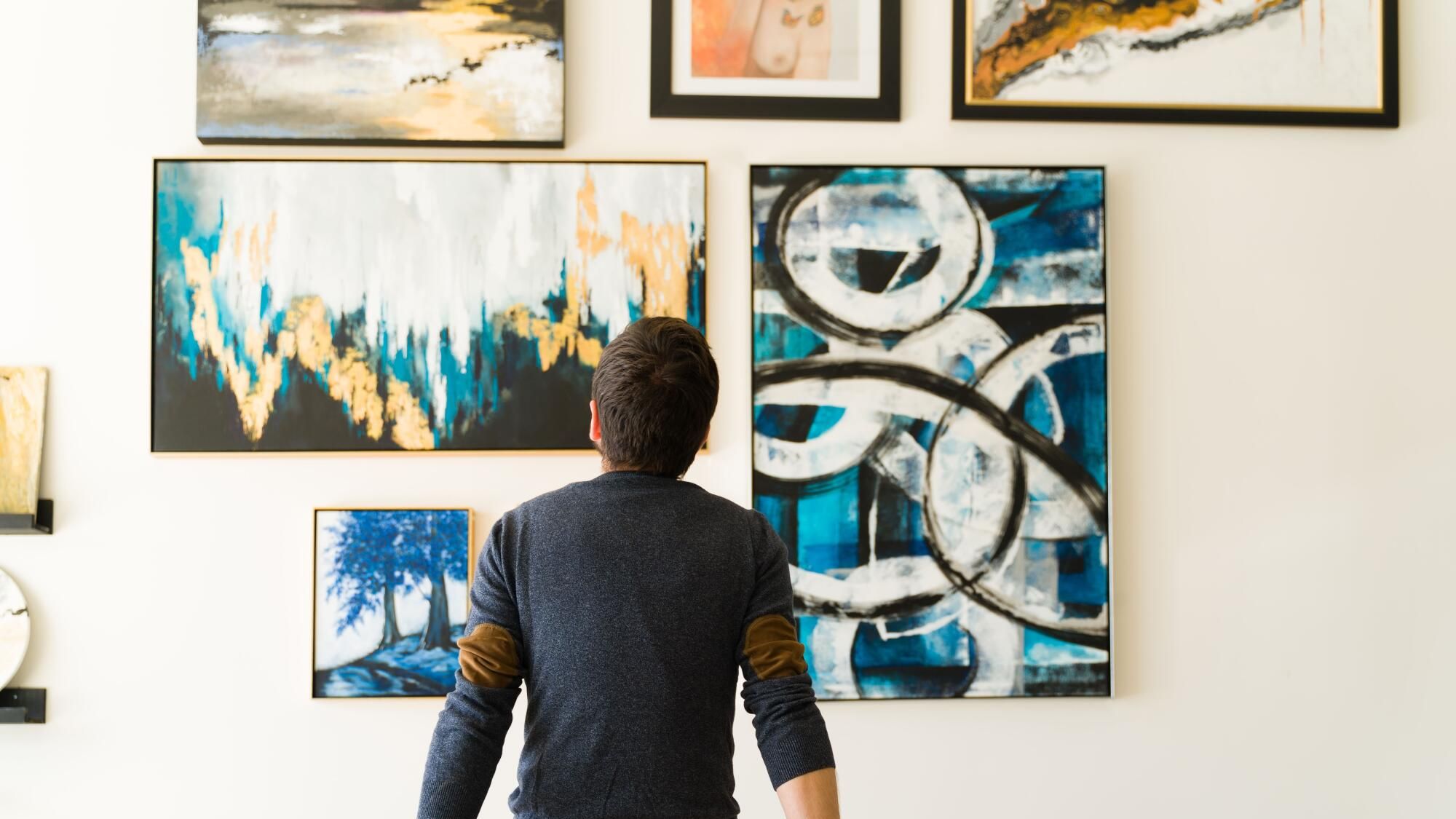
“I had to wait 53 years to enter an art gallery”
I had to wait 53 years to enter an art gallery. Fifty-three. The age when some people discover yoga or kombucha. I discovered… the Sarti Gallery. Thanks to an article on the occasion of the exhibition Between Heaven and Earth (until April 3).
The address – 137, boulevard Saint-Honoré – is located in the heart of the beautiful Parisian neighborhoods. A private hotel. And a meeting with David Boaretto Sarti, the son-in-law of Giovanni Sarti, founder of the place thirty years ago.
Needless to say, I got off my bike with my prejudices slung over my shoulder. For me, a private gallery was the place where only mysterious-looking collectors enter, ready to draw out a checkbook – yes, I still have that image from Epinal – to treat themselves to a work worth thousands, even millions of euros.
Intimidated, I ring the doorbell. And then… David opens the door. From the first steps, my certainties melted away. The gallery owner guided me to this new place for me. Better: he allowed me to touch a 13th century work, the one that opens the exhibition Between Heaven and Earth.
Yes: touch. Me who doesn’t even dare to blink too suddenly in front of a painting at the museum! By touching the gilding of a Virgin and Child attributed to Duccio di Buoninsegna, I understood that I was not just looking at a painting. I was encountering a story. Each work tells an experience.
David, as passionate as he is fascinating, then invited me to admire Delilaha painting by Giovanni Antonio Galli, known as Lo Spadarino (1585–1652). “Here, Delilah, contrary to traditional iconography, does not cut Samson’s hair to deprive him of his strength. This attractive woman, who only sought enrichment, look at what she has done. And she seems… to regret,” he explains to me.
I approach. Scissors and silver coins no longer hold his attention; she is holding the famous fleece, looking defeated. It’s all there. But the real subject is his face, betraying his moods, his guilt. Paintings don’t need a chatty cartel to tell stories. But they sometimes benefit from being accompanied by David Boaretto Sarti, a professional gallery owner.
“It is very important that entry to this place is free. Everyone must be able to come, every day,” he emphasizes. Many do it: students, retirees, “but also families with children,” he explains. Everyone is welcome.”
Regulars even come to “get some fresh air” among the works of art. Because everyone can enter an art gallery. Without a ticket, without a pass, without a whisper. There we can contemplate magnificent works – here, Italian primitives – without crowds, without suspicious guards, without jostling, without noise, without having to rush to see a scrap of canvas, without pushing to let someone take THE photo to feed the photo gallery on their mobile phone.
When I closed the door of the G. Sarti gallery, heading towards my bike, I tried to find the woman who had entered there an hour earlier. Impossible. My apprehensions were gone. My a priori had dissolved. An art gallery was therefore not a forbidden sanctuary, but a living, welcoming space.
I found myself thinking, “What will be next?” » Because from now on, I can’t wait to repeat the experience, to open other doors, to meet other gallery owners, like David Boaretto Sarti and above all other silent stories that are just waiting for a glance to come to life.


