
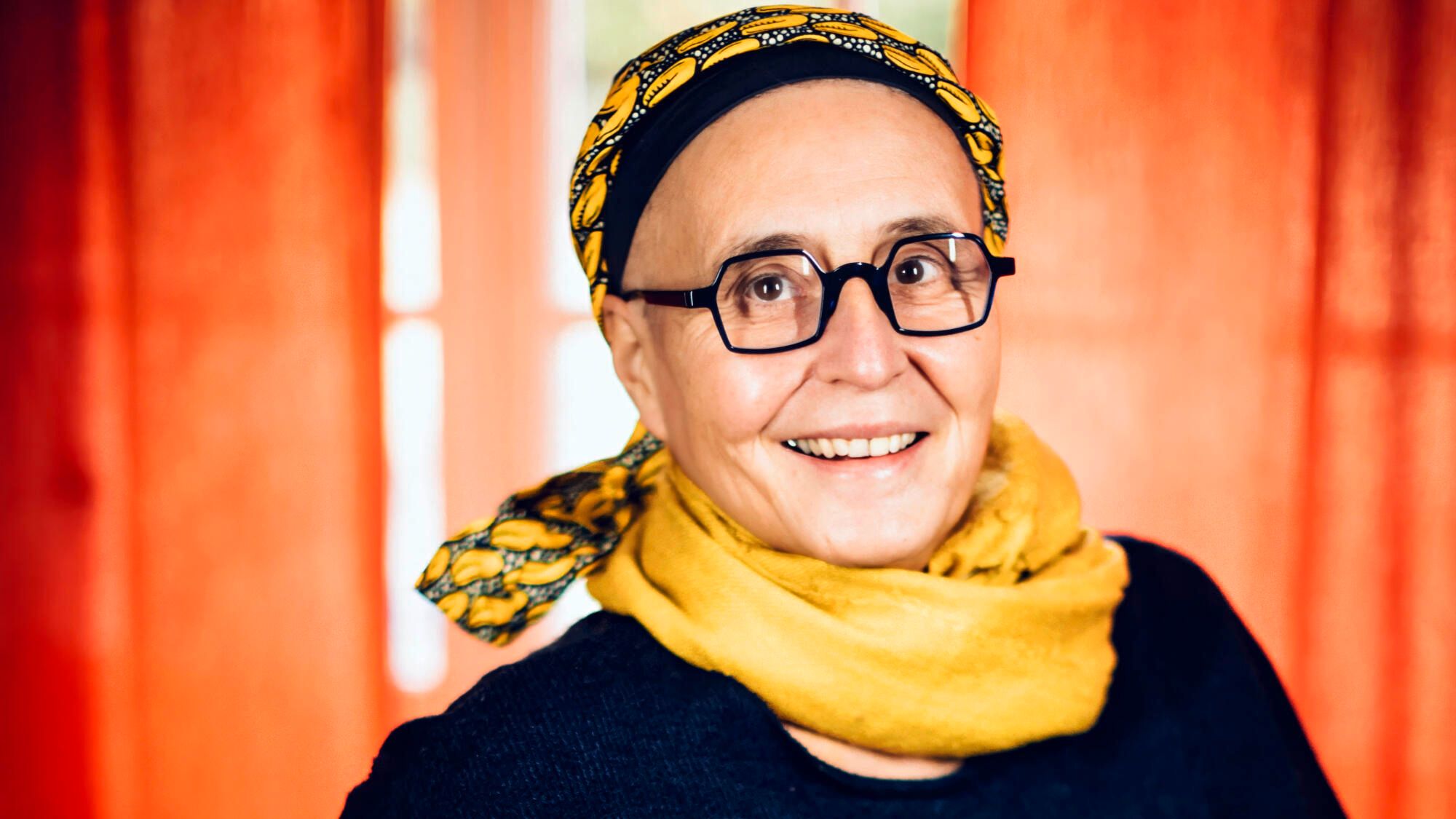
Lent. “Let’s think about the major issues on a global scale”
This 5th Sunday of Lent is an important moment for CCFD-Terre solidaire. What are the issues?
Beyond the financial aspect, which is obviously essential, our volunteers are taking advantage of this day to raise awareness among the general public about the actions of the associations that we support throughout the world.
In the troubled times we are going through, we can be tempted to withdraw into ourselves. It is important that our fellow citizens, particularly Christians, do not forget the issues of international solidarity.
Where does this sensitivity come from?
From my childhood. My parents were post-Vatican II Christians, from a wealthy background, but attentive to the big questions of the world. When I was 10, they took in a Cambodian boy who arrived with the boat people. He became our brother.
At the age of 20, I left for India with an association that worked with the untouchables, a poor and discriminated caste. I was thinking of becoming an educator or getting involved in humanitarian work. With all the enthusiasm and preconceived ideas that one can have when one is young, I wanted to solve the world’s problems!
Where did you start?
Through studies in agronomy and then in comparative development policies and practices. My first professional experience took me to Burundi, with coffee farmers. It was in 1993, just before the crisis which resulted in the genocide of the Tutsis in Rwanda.
The political and human context was already very tense. Two years later, with my husband, we went to Haiti, sent by the Scouts and Guides of France to develop a learning network. The local association was undermined by internal conflicts.
Some advised us to take power to carry out the project, given that we had the money. We preferred to resign and return to France after a few months. It was a violent but decisive learning experience. And in 1996, I joined CCFD-Terre solidaire quite naturally.
Why naturally? What is special about CCFD-Terre solidaire?
At CCFD-Terre solidaire, we do not have our own project, we do not send volunteers to the four corners of the world. The basis, since the launch of the association by different Church movements in the 1960s, has been partnership: identifying local actors, relying on their diagnoses and supporting them over the long term in the development of their projects.
We do not manage emergencies but support local organizations to develop civil society. It is a relationship of trust and loyalty.
However, you did not stay long at CCFD-Terre solidaire…
I was young and I found that I did not have enough expertise to evaluate projects without having ever led one myself. I lacked contact with the field. I decided to work in France on professional integration issues.
I learned to manage finances, human resources and administrative matters. I spent twenty years in different structures with people in great precariousness, with life paths marked by addictions, family violence, prison, sometimes migration.
A career quite far from a certain model of social success, therefore…
Yes. Several people have also warned us: “It is not easy to deviate from the path towards which your diplomas are leading you, to earn less money. To stand firm in your choices, don’t stay alone.”
So, with a few families, we decided to settle in the south of Essonne, in neighboring houses, to experience a form of fraternity and mutual aid on a daily basis. This responded, among other things, for the young parents that we were, to the intuition that “it takes a whole village to raise a child”.
Was there a political dimension to this life choice?
We did not consider ourselves activists. Rather, we sought to give meaning to our lives, by following the Gospel and being vigilant to what the people around us were experiencing, particularly precariousness.
And as we wanted to cling to something bigger than our small collective, we approached the Mission of France, with which we have been traveling for thirty years.
Can you introduce us to this movement?
Do worker priests mean anything to you? The initial intuition was “burying”: living in the world without being noticed, to let the Gospel work on it from the inside, with patience.
Today, the Mission of France is a “diocese without territory”, a community of lay people and priests who seek to be close to what the Church is far from, not necessarily in a parish but in proximity to the most vulnerable. The idea is not to convert, simply to be a presence, where we are.
At a time when parishes are emptying, this way of living the Church can prove disconcerting…
This is true, but it finds its source in the words of Christ, and I believe it remains relevant. For me, the Church is not in the churches. Or at least, not only. A Christian is called to be of service to the world before being of service to the institution.
This is what Pope Francis said so well when he spoke of “peripheries”, “the Church going out”. The central question is how faith transforms our lives, with, fundamentally, this first question from God in Genesis: “What have you done with your brother?”
“For me, the Church is not in the churches. Or at least, not only.”
Virginie Amieux
How did you return to CCFD-Terre solidaire?
I reconnected with the international world by working at the Catholic Cooperation Delegation. Two and a half years ago, I received an unlikely call. I was asked to think about the presidency of CCFD-Terre solidaire. I almost burst out laughing. In this position, we usually find people who are very knowledgeable in international law and geopolitics.
But I let the call resonate within me. It is an important notion in the Christian tradition, with Elijah, Samuel, Jonah, Mary… Who are you to judge what you could be used for? After a moment of reflection, I chose confidence, I said yes.
What are the major current issues for CCFD-Terre solidaire?
Today, our model of international cooperation, inherited from the end of the Second World War, is being swept aside by Donald Trump. Each country is tempted to go it alone, while the economy is completely globalized and the major issues – climate, debt, taxation – can only be resolved on a global scale.
More than 700 million people experience hunger. Half of the world’s population lives in countries where debt weighs more than education and health combined. 75% of the world’s wealth is held by 10% of the population…
And we are unraveling our global solidarity systems! As if we didn’t care that people are unable to live… Did you know that in France, public development aid was cut by 800 million euros last year?
This is because national finances are in the red. France has no shortage of difficulties…
Above all, she lacks vision! We live in a globalized world. Thinking that we will be able to develop without others is not only a human fault, it is a strategic error.
We need each other. You and I, just with our clothes, our cell phones full of rare metals, we are already traveling around the world. You have to look things in the face and not be afraid.
“To think that one will develop without the other is a human fault and a strategic error.”
Virginie Amieux
What are the missions of CCFD-Terre solidaire?
We work on three axes: first support for local partners, then raising awareness of major international issues, emphasizing their structural dimension.
What does this mean?
That even if it is necessary, charity does not solve problems which often have structural or political causes. Let’s take an example. Hundreds of thousands of tons of Moroccan tomatoes are produced each year for export to France.
If we think about the quantity of water it takes to grow them, in a country where sources are drying up, it’s as if we were exporting water from Morocco directly to us! We can finance the drilling of wells, but that will not solve the problem…
We need to change the software, develop alternatives to export monoculture which impoverishes the soil and is unnatural. Our local partners are developing agroecology, which is more resilient and more respectful of ecosystems.
And your third mission?
This is advocacy: relaying the words of the countries of the South to our compatriots but especially to our elected officials, our leaders, our bishops. Last year, for example, Sister Gladys, from the Church and Minerals organization, came to testify about the consequences of extractivism (the massive exploitation of a territory’s natural resources, editor’s note) in Latin America.
She spoke concretely about water pollution and the risks it poses to pregnancy, increasing both the number of abortions and congenital malformations.
What do your volunteers do in France?
Many associations envy our 7,800 volunteers, true activists of international solidarity. They raise awareness in schools or parishes, challenge their elected officials, welcome people who are migrants or in precarious situations.
Our challenge is to renew our teams, showing imagination. There is reason to hope because although the forms of commitment have changed, young Christians are very aware of international issues and do not lack ideals.
The biography of Virginie Amieux
- 1969. Born in Strasbourg (Bas-Rhin).
- 1991. Diploma from the National Center for Agronomic Studies of Hot Regions (CNEARC), then DEA in Comparative Development Policies and Practices.
- 1993. First field work in Burundi.
- 1995. Marriage with Eric. Mission to the scouts of Haiti.
- 1996. Head of “popular economy, solidarity economy” at the CCFD.
- 2002. Worked in different professional integration structures for twenty years.
- 2004. Fraternal life with several families. Commitment to the Mission of France.
- June 2024. Elected president of CCFD-Terre Solidaire.


