
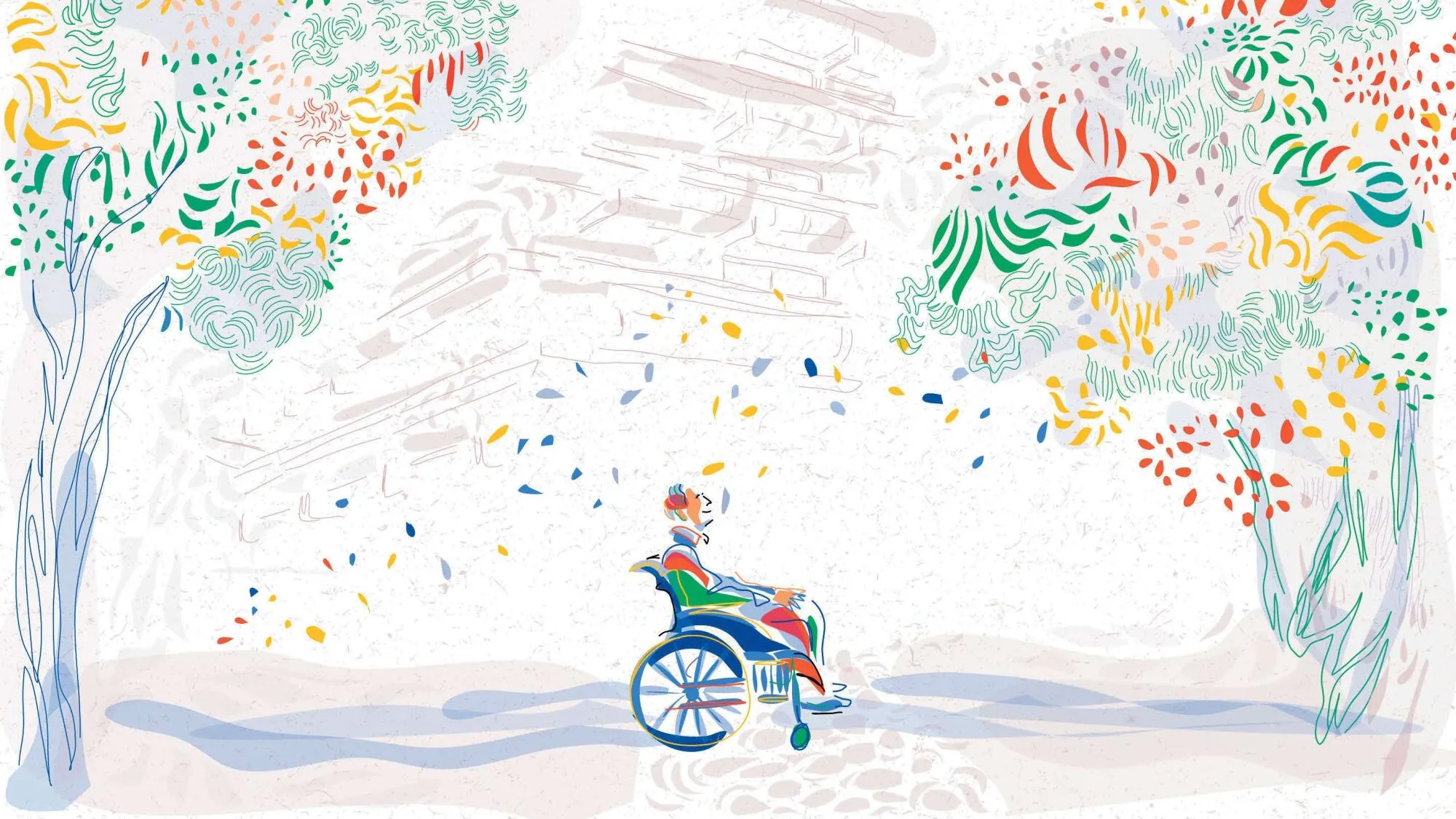
The rebirth of spinal patients
Éri is in his room, he is ready to receive you, a nurse tells me. Jean-Éric, known as Éri, stands straight in his electric chair, his hands in splints which support his fingers. His peaceful face exudes kindness. On the walls, flags of Reunion Island and Olympique de Marseille. He has lived in mainland France for seventeen years. “I was in Grenoble when I had the accident. Accidents are like that: you see when it happens to others, and that day, it was my turn. » Éri talks to me about time stretching out. “The first three months, I remained in intensive care, immobile. I had doubts: would I be able to move again? But arriving here was the beginning of a discovery: I can progress. »
He describes the steps carried out with the physiotherapist and then the exercises he does alone. “Now, when I pull an elastic band, I feel my abs,” he describes, mimicking the gesture. As you say, it’s like being reborn: you have to learn everything again. » “What does being reborn mean to you? »: Eri has just answered one of the questions that I came to ask these patients who are housed for many months in this low building, located in the west of Lyon: the Pierre-Delore pavilion of the Henry-Gabrielle hospital, in Saint-Genis-Laval (Rhône). After serious damage to the spine, they must relearn everyday actions. They who have sometimes come very close to death, do they experience this time as a rebirth? Assumptionist religious and journalist Pilgrim, I believe that the God of life, “the one who raised Jesus from the dead,” accompanies them. But how? The health executives presented my request and sent me the names of those who would agree to speak with me.
I listen to Eri tell me about the young people hospitalized with him. He has a particular concern about it. “The relationship with the past hurts, but I can say to myself: I lived. I was a truck driver, I traveled all over France, I had a son, I have a granddaughter. But these young patients around me, they haven’t lived yet. » Leaving him, I keep the impression of a man who experiences what he experiences turned towards others. Moreover, “in the unit, they say that my room is the living room where we meet! » he smiled.
The spinal cord injury unit where Éri lives is built in a square around a central courtyard. The rooms overlook the outside: from Eri’s, I could see the sky and trees. But as I wander the corridors, the doors I knock on remain closed or open into empty rooms. Why am I surprised that their occupants have appointments or errands to run? I expected to find them immobilized by the consequences of an accident: they are not where I locked them. In fact, it was my fear of accident and illness speaking. But where are they? I feel like Mary Magdalene on Easter morning in front of the empty tomb: Jesus was not there where we expected him either. Her astonishment must have been immense but I think that in her, as in me, a flame was ignited. If he is no longer there, it is because he is elsewhere, because there is life. The story has not ended.
“Here, we put ourselves in a box even though we don’t know each other, because everyone knows it’s hard. »
Jean-Marie
A little later, I meet Jean-Marie, returning to his room after a physiotherapy session. . He has been there for “two weeks and three days”, he specifies. Aged around twenty, he receives me lying on his bed. With concentration and intensity, he tells. His leg was paralyzed without the doctors understanding why. Then the diagnosis came: a genetic disease slowly led to damage to his spinal cord. After two major operations, he does not know how long he will stay here. “There is no need to rush,” he analyzes. My progress goals for walking normally again are from week to week, day to day. » He discovered the brotherly humor that reigns between patients, as a form of support. “Here, we hang out, we joke, even though we don’t know each other, because everyone knows it’s hard. At night, you are alone with what happens to you. It’s your life and no one can carry it for you. » Everyone’s rhythm is different but living together creates this solidarity.
I am leaving the unit planning to return in a few weeks. In the lobby of the Delore pavilion, three screen-printed panels catch my eye. We see the Rhône flowing along a quay in Lyon and, above, these words: “The water from there now watches us pass… always. » What a strange sentence! We might believe that life has left Jean-Marie or Éri on the platform, but the perspective is actually reversed: here, they continue their lives, differently. I am touched by the “we” and think back to what Jean-Marie told me: everyone carries their own life, but we walk with others. The sign speaks of “now”. This present has become so important. Jean-Marie also added: “Every day is a blessing. » The time I spent with Eri and him was a lived-in, beneficial time. “Was not our heart burning within us? » ask the pilgrims of Emmaus (Lk 24:32) after their encounter with the resurrected Jesus. His presence condenses the present. I believe that the Lord accompanies these men.
“It’s not something that can be decided. We find out how we react. »
Laurent
Back a month later, I meet Eri at the shopping center, about a twenty-minute walk from the hospital. He came in an armchair to eat with friends. Friends from before? “No, we met here,” he explains to me. “They take off my splints to eat. I taught them how to do it. » When it’s time to pay for the sandwich and the drink he wants to take, he asks me to take his wallet out of his pocket. As I watch him join his new friends, I think about this mixture of autonomy and dependence that he experiences. What trust in others! I also think of a sentence confided by Jean-Marie: “The relationship with your body is built. » And I realize that it is edified by passing through others, caregivers, physiotherapists, friends as well as strangers.
Accident or illness transforms the relationship with one’s own body . Suddenly, we need others for actions that we previously did alone. This affects our relationship with others. As I walk to the hospital, I think of Laurent, one of the patients in the unit. One day, while crossing the courtyard of his workplace, his leg was paralyzed; When I woke up the next day, it was my entire lower body. Due to an old herniated disc, a disc moved, injuring the spinal cord. He has been in a wheelchair for several months and is barely starting to walk again. During my first visit, he was returning from a weekend in his native village where many had not seen him since the accident. Had he felt embarrassed by their gaze discovering him seated in an armchair? Laurent paused for a moment before answering me: “No. We are someone for others. We matter to them. » No doubt, Laurent, like Eri, has experienced the worried gaze of those close to him, but he knows who he is. And his friends found him, beyond the visible changes on his body. It’s a bit the same experience that the disciples have when faced with the resurrected Jesus: something has changed so much that at first glance, they no longer recognize it. So, the Gospels tell us, Jesus puts them on the path based on the relationship that united them: a first name, a familiar gesture… And they recognize it. Their relationship with Jesus is part of who they are, and the relationship Jesus has with them is part of his resurrected body. We sometimes sing this great mystery at mass: “We are the body of Christ. » Our body is not only a biological organism, it is a crossroads of relationships with others, with our loved ones, with so many people, with the world and with God. I’m sure the patients at Delore Pavilion are experiencing something of this.
This time, when I enter his room, I find Laurent sitting at a table: no more armchair! “I’m going out in the next two weeks,” he tells me, beaming. However, a sword of Damocles remains: “It is not a disease that can be cured. In a month, a year or twenty years, the disc may move again. And how will this happen? » This uncertainty could paralyze him, if we dare say so. “That’s true, but I didn’t react like that. It’s not something that can be decided. We find out how we react. » Words that would soon find an echo in what Thibault was going to confide to me.
“Our loved ones must also take their own steps and we must help them move forward. »
Thibault
Thibault is 20 years old. Sitting in his armchair, his build matches the numerous rugby photos that decorate his room. A very serious accident almost killed him. After coming out of the coma, he went for weeks without being able to speak or move. He has been here for a year, but is preparing to leave this summer. “Once you admit that you are forever in a wheelchair, you accept to resume your life, with more anticipation. » I am admiring. Thibault is also surprised by his own attitude: “If I had been told straight away that I would be in a wheelchair, I don’t know if I would have accepted this situation so easily, without anger towards those responsible for the accident. » How do Thibault, Laurent and the others manage to live without bitterness the evil that happens to them?
Thibault is now worried about his loved ones: “They also have to take their own steps and we have to help them move forward. » This attitude is certainly not the result of chance. Laurent also thinks that “the before does a lot for the after”. According to him, all the little choices that shape us contribute to the way we get through the ordeal, heal and come to terms with what happens to us. Jesus, in the Gospel according to Saint John, says that those who have done good will be resurrected to live and those who have done evil, to be judged. What Laurent and Thibault explained to me so simply helps me understand these words of Jesus. There is a way of living for oneself, to the detriment of others, which locks us into judgment… and prepares our judgment. And another path that opens us to a life of relationships and sharing, and prepares our resurrection for eternal life.
This is my last visit to the Delore Pavilion . Eri is tired. “Come back tomorrow,” he whispers softly. Is it an “off” day? Jean-Marie is wary of doubts and negative thoughts which turn into serious self-questioning and lead to despair. He’s right. In spiritual combat, humility is recognizing that the life force that inhabits us is not omnipotent: there are “without” days. Many painters wanted to represent the resurrection of Jesus as a flash of omnipotence shattering the tombs. They have forgotten that between his death and the sober discovery of the empty tomb, there is time: two nights… The resurrection is a beginning that unfolds, a “new creation”, a “new life”, as Saint Paul says. She leads those who welcome her from beginning to beginning, in the spirit of a just life, open to others in all circumstances. Freed from time and space, the resurrected Jesus makes himself present to all human existence, at the Henry-Gabrielle hospital and elsewhere. Recognized or not, it enlivens our lives.
Travel diary
The rebirth trajectory of a young person close to me, after an accident, made me want to collect, echoing Easter, the experience of patients in similar situations.
Landmarks
- A specialized unit
“Spinal cord injured”: this is the name of the unit where Éri, Jean-Marie, Laurent and Thibault live. The adjective comes from Latin medulla bone marrow. - Long stays
From six to eighteen months: this is the average length of stay in this rehabilitation unit, or rehabilitation when the damage is irreversible. - Rather young patients
Between 19 and 49 years old: this is the age of the patients, the vast majority of whom are men.


