A Landes municipality saves with its own energy
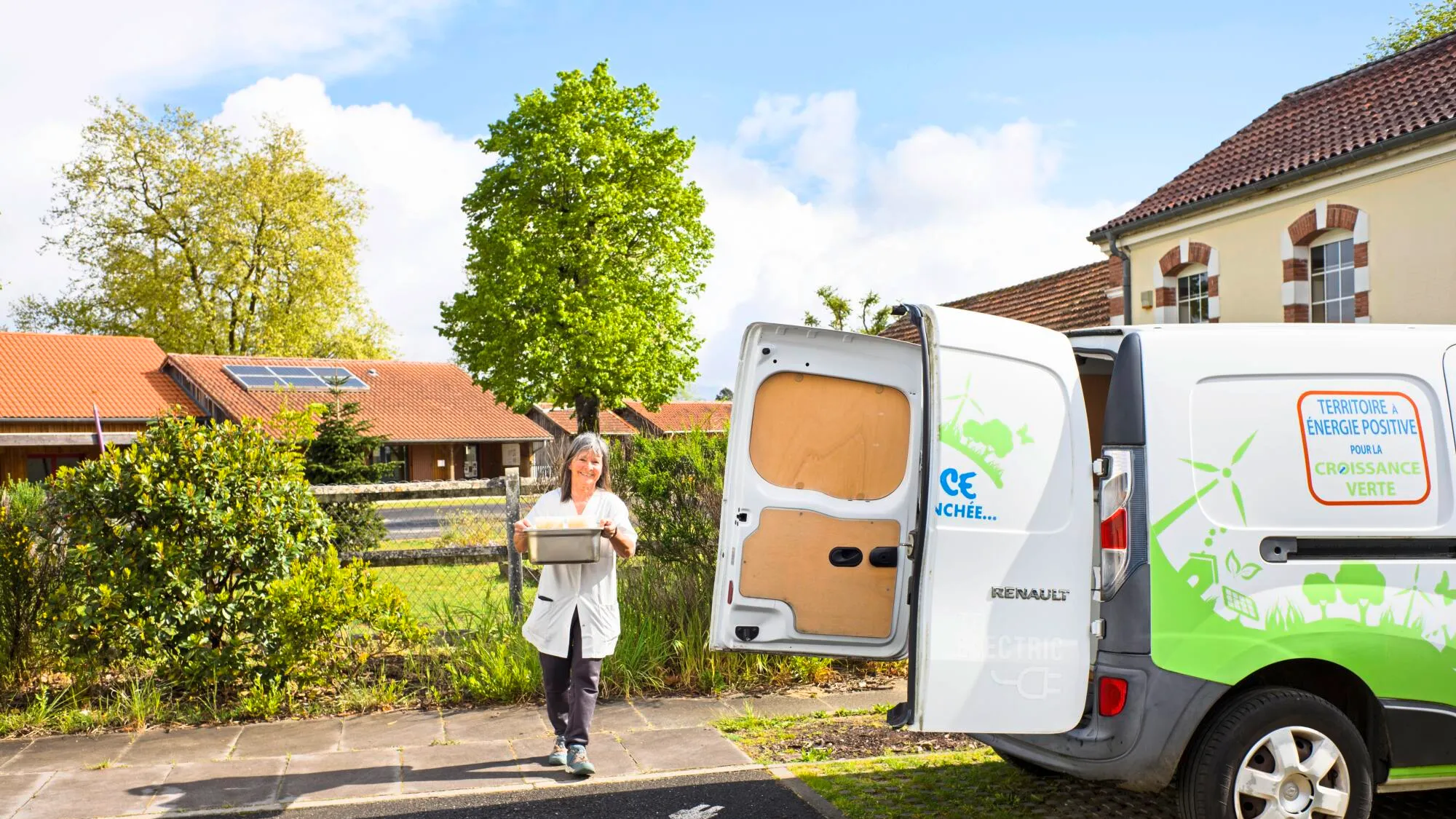
Spinach soup, carbonara pasta, kiwi… It’s 11 a.m. under the sun in Escource (Landes), and Geneviève Chazaly, town hall employee, loads the municipal Kangoo with around ten meals to deliver to the elderly of this town of 864 inhabitants… as large as Paris. “The furthest lady delivered today lives 12 km from here! » she notes.
No need to check the fuel level before leaving on tour. The fuel for this electric utility vehicle is the golden rays which fall on the roofs of the surrounding public buildings: school, town hall, church, village hall, technical premises, etc. In total, 1,200 m² of photovoltaic panels networked.
Including the approximately 90 candelabra topped with a mini-panel, the sun provides 61% of the town’s annual electricity needs. A rare feat in France. Many communities come to draw inspiration from this village located in the heart of the Landes forest, halfway between Bayonne (Pyrénées-Atlantiques) and Bordeaux (Gironde).
Involve residents
However, everything started badly. In 2009, storm Klaus destroyed an important source of income for the village: maritime pines. Their regular cutting in fact increased the revenue of forest communities like Escource. “With 70% destruction on municipal plots, we found ourselves with nothing, having to sell off wood at two euros per ton,” remembers Patrick Sabin, 66, who had only just been elected for his first term as mayor.
The former business manager then sees renewable energy operators parade through his office promising good returns to replenish the coffers. “What was presented to me was mainly going to finance foreign pension funds. I wanted the energy to be produced by and for the municipality, involving residents as much as possible,” he explains.
In 2012, Escource benefited from a first grant of 60,000 euros to build its innovative Positive Energy Territory project (read box below). Ten years later, in 2022, goodbye to the fuel tank that heated the school, town hall and media library. Escource is instead equipped with a heat network produced from forest chips. A local, abundant and economical resource.
“Last year, our total energy bill was only 35,460 euros,” rejoices Pierre Lasterra, mayor of Escource since 2024, who is part of the same dynamic as his predecessor. We would have paid 162,920 euros if we had kept the same heating and electrical production methods as in 2008. With the surge in the price of hydrocarbons, it would be even worse this year…” The last gas boiler, in the stadium locker rooms, will be replaced in 2026 by a heat pump.
Collective self-consumption
War in Ukraine, then war in Iran: international crises follow one another without increasing local costs. “A lot of people want to buy in Escource because it’s quiet and we don’t pay a lot of taxes,” says Anthony, 28, a real estate agent in the area, before heading to the pétanque court lined with a solar roof.
Another asset for the quality of life of Escourçois: collective self-consumption. When municipal panels produce more electricity than necessary for the needs of the community, it is resold to residents at a price lower than that of the average kilowatt from EDF. Only condition: buy at least one share (100 euros) of SAS Énergie Citoyen Haute Lande.
A step that Ingrid Feliu has just taken after equipping herself this fall with an electric car via social leasing offered by the government. Working at Sabres, she drives around fifty kilometers a day. “Over a week, I barely spend around ten euros for recharging,” she rejoices. My husband, with a thermal vehicle and approximately the same number of kilometers, pays five times more. »
The Landes village has enough to make municipalities and households green with envy. But can its energy transition really be duplicated elsewhere? “Escource benefited from a visionary mayor, who was able to benefit from significant subsidies at a time when his project was innovative,” explains Jérôme Baylac, president of the community of communes of the Morcennais region. Today, state allocations are falling, local authorities are reduced to apothecary accounts. It’s much more difficult to invest in the transition. »
Patrick Sabin tirelessly calls for getting rid of fossil fuels. “At the beginning, it was mainly in the name of climate change. Now, it is also urgent to reduce France’s trade deficit and save money. We no longer have excuses. »
A network of positive energy
Created in 2011 at the initiative of a handful of rural municipalities, the national network of Positive Energy Territories (Tepos) today brings together around a hundred communities who wish to put the energy transition at the heart of their territorial project.
Some, like Escource (Landes), Malaunay (Seine-Maritime) or Muttersholtz (Bas-Rhin) are very advanced in the common objective of reaching 100% renewable energies in 2050. Others are “driven” by these pioneers. The goal of the network is to share experiences and tools.