
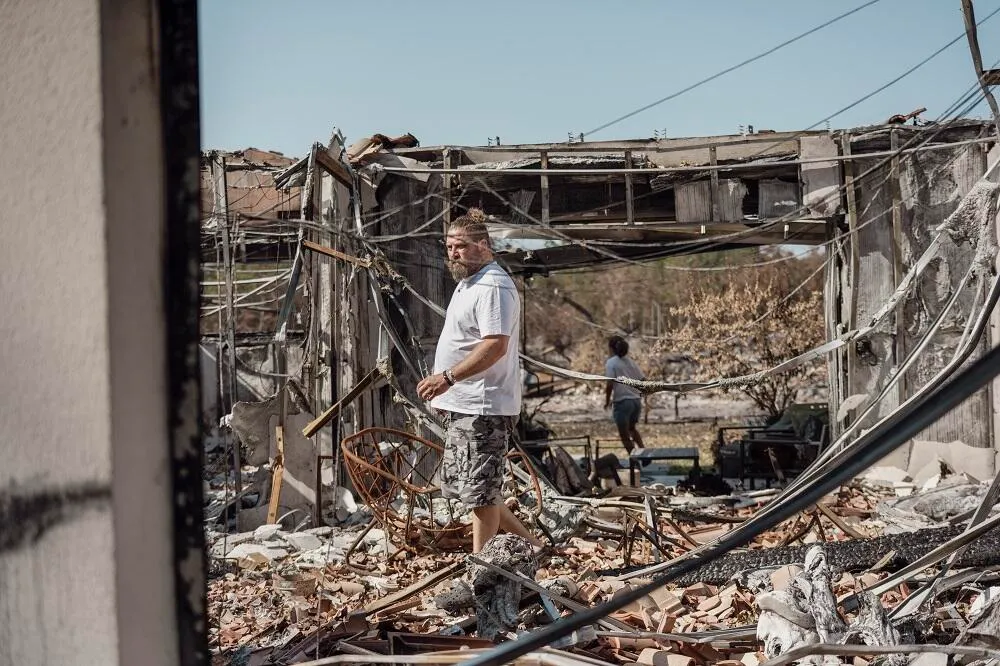
Fires 2026: after the flames, the long administrative battle of the victims
Starting from scratch
From May to July 2026, France experienced the strongest average temperature anomaly in the world (+2.8°C compared to normal between 1991 and 2020), according to the European climate monitoring program Copernicus, and recorded the worst drought in its history, a consequence of climate change. From July 5, early fires destroyed 4,900 ha in one week in the Pyrénées-Orientales. At the end of July, fires in the South-West led to the largest evacuation since the Second World War – 220,000 people. In mid-August, a new fire threatened in Gascony, a few dozen meters from homes.
Hundreds of affected households lost everything. Their property, their memories and their administrative papers are reduced to ashes. They now have to start from scratch. And fight with insurance companies, more or less likely to compensate them for the damage. Because they cannot benefit from the regime put in place for natural disasters. In nine out of ten cases, fires are the product of humans, through negligence, stupidity or malice.
The Prime Minister, Sébastien Lecornu, promised, on August 17, aid of ten million euros for Gironde, two million for Landes. He also announced the relaxation of town planning rules and the issuance of building permits within one month. But nothing says that these wishes will quickly take the form of a roof for the victims. Because dealing with insurance companies is often a headache.
Insecure French people
To get out of this situation, households that can call on an insurance adjuster, a sort of lawyer who defends their interests against the companies. You then have to delve into the contracts, discover the little boxes that you have not checked, the lines that you have not read and understand, sometimes too late, that not everything is covered. If the contract provides for 30,000 euros of insured goods, the compensation will not exceed this sum. According to an OpinionWay study for the Vyv mutual group, nearly four million French people were poorly or uninsured in 2025 in the face of economic and climate risks.
Since the Covid pandemic, our home has become our most precious landmark. The space that protects us from the harshness of the world, from the crises that follow one another. The space where we accumulate all the goods that constitute our identity. When this sanctuary is attacked, our balance shifts. First there is the feeling of collapse, the anxiety attacks at the idea of never finding home again.
A resident of Porge, Juliette Tessier, 55, will never again do “those simple things” like taking out the crystal tableware set at Christmas, intact after more than a hundred celebrations; sleeping in her solid pine bed, the one that her husband Didier had had since he was 20. The couple completely lost their house and took refuge for a time with their daughter in the Basque Country. Every day, he lists on the computer the goods to be declared to the insurance company. With the fear of finding yourself facing a wall of procedures.
“Some insurers refuse to cover damage caused in the garden by the retardant spilled by the firefighters when the exteriors are not insured! » denounces Fabrice Barthélémy, director of the Disaster Solidarity Fund. In fact, home insurance does not cover gardens or DIY premises if the insured has not taken out an extended warranty.
An endless wait
Compensation could not be received for six months, or even two years depending on the situation. And when it comes time to rebuild, some companies don’t support new protection standards, such as non-combustible insulation on roofs. 400 km from Le Porge, in the Corbières massif, a large number of victims are still fuming. Jacqueline and Jean-Loïc Villa, retirees from the wine-growing village of Saint-Laurent-de-la-Cabrerisse (Aude), have been waiting for the valuation of their property for over a year now. Their house is still in the same state as the carcasses of Le Porge, in Gironde.
On August 5, 2025, fire struck the limestone, scrubland and vineyard valleys. That day, thick black smoke created a sky at the end of the world. Jacqueline and Jean-Loïc prepare a bag with their identity documents, birth certificates and bank statements. But they are taken by surprise. The fire spread 16 km in an hour and a quarter. “Go away, go away!” » shouts the former winegrower to his wife as he sees the flames shooting towards them. In a panic, they forget the bag on the dining table. They had barely left the house when, a few moments later, the fire engulfed it. For the next six months, Jacqueline remained in a state of astonishment. “Fortunately, our daughter took care of our administrative procedures,” she says, grateful.
First step: redo the papers. At town hall, the couple at least has the chance to be known. The mayor can certify his identity and help him reconstitute his documents.
The Phocaean experience
Fire no longer even affects homes nestled in the privacy of forests. It can enter cities and attack even more populated areas. On July 8, 2025, the Estaque district, in Marseille (Bouches-du-Rhône), was also a victim. That day, a car caught fire on the highway and the blast of the mistral, in the scorching summer, caused the flames to spread across 750 hectares of scrubland. They attack the commune of Pennes-Mirabeau and reach the north of the Phocaean city. The inhabitants of Estaque, nestled between the sea and the limestone hills, received a message from the prefecture, which told them that, given the progression of the fire, it was better to remain confined.
“For me, it was out of the question,” recalls Alain, a 78-year-old former school principal. From his window, he sees like a volcano erupting. The conifers catch fire and their pinions turn into projectiles, creating new infernos. Alain and his family flee to the Mediterranean below. Within a few hours, his house caught fire along with those of his children, who all lived on land around their parents’ property. In Marseille and Pennes-Mirabeau, more than 90 homes were partially or entirely destroyed.
Cruelty of the event, the flames did not engulf Alain’s house. They deformed the beams that supported the floor. The walls are cracking and the insurance expert is categorical: everything must be demolished to rebuild everything. In November 2025, Alain brought in a backhoe loader. “Since then, everything has been razed but I cannot rebuild,” laments the retiree. I don’t know how much I’m going to get and I can’t advance the funds. » His case is at the heart of a conflict between his insurance and that of the owner of the car that caused the fire. Which party should pay and how much? The agreement is dragging.
Housed in a neighboring town thanks to his insurer, Alain longs for his life in Estaque. In the morning, he had a coffee at the port to chat a little with his friends. In the afternoon, he tended his cactus garden, patiently planted over the years. “But I don’t want to feel sorry for myself,” he brushes off. I prefer to focus on each task at hand to look forward to the future and return home. » Very united, Alain’s family helps each other in all administrative procedures, the youngest son in charge of operations, he who “always knows how to arrange things”.
Mutual aid and support
But the victims of Estaque also draw their strength from anger. Since the fire, they have come together to fight against the slowness of insurance and more than 120 have filed a complaint against X. In January, the collective acquired the status of an association. This notably criticizes the prefecture for having delayed in deploying relief operations. The Aix-en-Provence public prosecutor’s office carried out the investigation to identify possible criminal responsibilities in the fire, but it closed the case without further action in July, due to lack of evidence.
No matter, the association does not intend to give up and is already preparing to file an appeal. Noting the extent of the damage in Gironde this summer, she also made contact with victims of the Porge. “We want to warn them of what awaits them, to give them advice,” explains Marie-Blanche Apercé, member of the Association of victims of the fire of July 8, 2025 in Marseille. So they don’t get fooled like us. »
In such crisis situations, mutual assistance slowly sprouts resilience. On the other side of France, on the edge of the Atlantic Ocean, Ludivine feels tears welling up in her eyes when she talks about the solidarity that has been created between her neighbors in Porge. “Before, we didn’t know each other very well,” she confides. Today, we greet each other, we tell each other our stories and we have formed very strong bonds. » Houses burned but not lives. Among the inhabitants, hope can still take root.
A “fire school” in Marseille
For the residents of Estaque in Marseille (Bouches-du-Rhône), there is no longer any question of remaining in denial. The historic fire of July 8, 2025 – 750 hectares and more than 90 houses destroyed – could occur again in this district at the foot of the scrubland. A year ago, Julie de Muer, resident of Estaque, launched the “School of Fire” project. “We organize urban walks to understand how to live better in our environment in the face of risk,” she explains. Surrounded by landscapers and ethnologists, Julie conducts field surveys. For her, we must no longer see the landscape as a setting, but learn to coexist with it. Today, the team is pleading with the Marseille metropolis to restore ancestral prevention techniques. Like prescribed burning and pastoralism, which help to stem the spread of fire.