Strikes in middle and high schools: the origins of anger
In small clusters, teenagers lean against the barriers of the Saint-Exupéry high school in Créteil (Val-de-Marne) on this morning of September 29, 2026. Everything is calm, we can hear the birds singing. This establishment is not one of the 416 high schools blocked in France during this day of call for a civil service strike.
For a simple reason, Rayan, a first grader, explains to us: “We got what we wanted. » On September 25, the rectorate in fact promised to honor their requests, certainly to try to stifle the emerging protest.
Because this Cristolian high school was the first to launch the strike movement, on September 21. The spontaneous momentum first came from the teachers, exasperated by the absence of staff. Half of the supervisory positions were not filled.
There was also a shortage of a maths teacher, one in French, one in literature and history, or even a nurse. The students took over the next day. And the anger has spread throughout France, fueled by social networks.
Feeling of abandonment
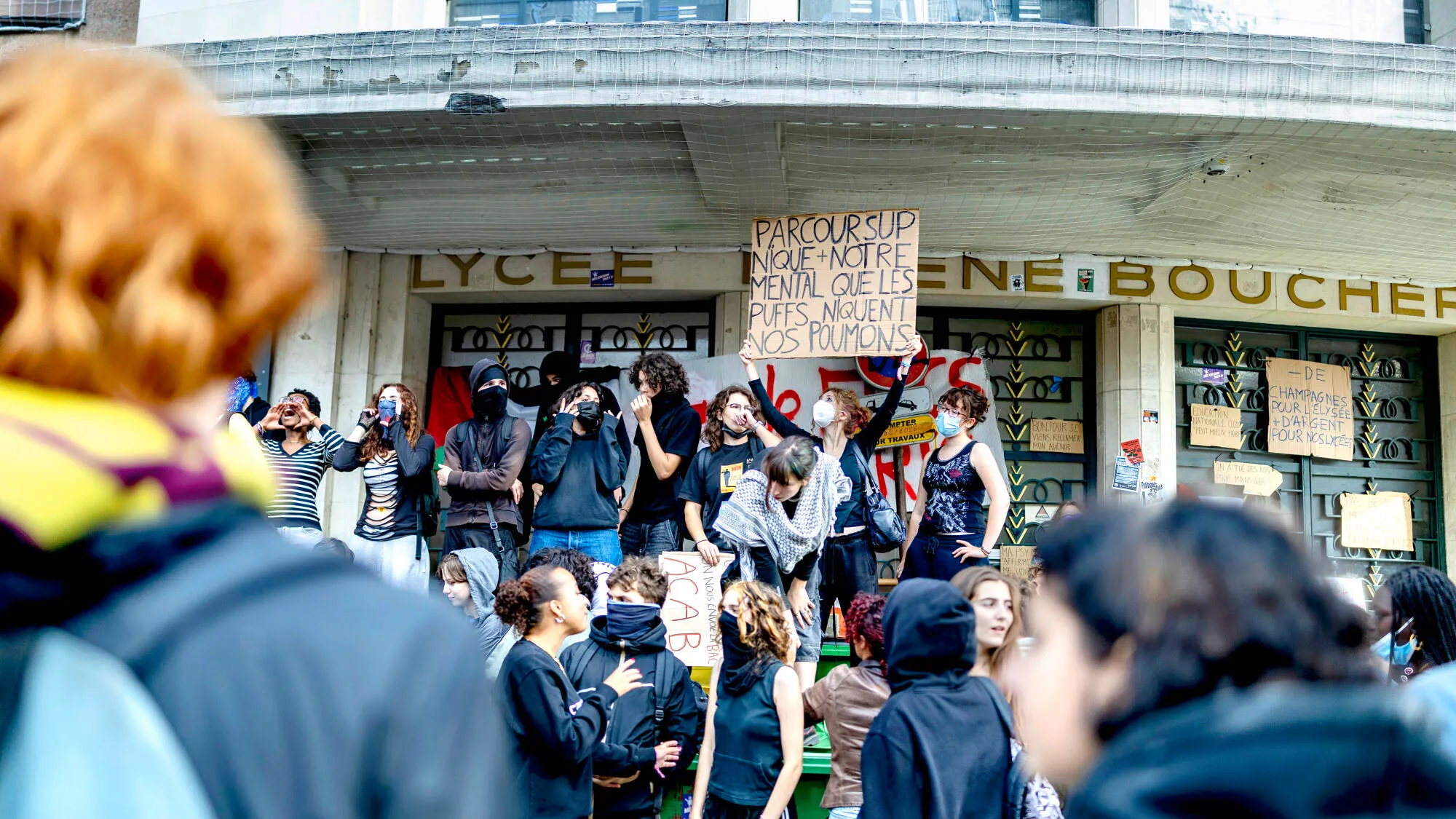
A few kilometers from Créteil, a completely different atmosphere reigns. In front of the Hélène-Boucher and Maurice-Ravel high schools in Paris (XXe), neighbors of each other, trash cans were stacked. Dozens of students shout or hold up signs – like “National Education, 0/20, can do better. »Some film themselves laughing. Others display a serious expression.
Not far away, helmeted CRS stare at them. If the Minister of Education, Édouard Geffray, recognized that many of their demands were “legitimate”, he deplored, on September 30, that 119 students and staff had been injured since the start of the movement. Sometimes because of thugs outside the high schools or unconscious acts, like this student who lost a finger while firing a mortar in front of his high school in Massy (Essonne).
At Hélène-Boucher, students clumsily try to set fire to a trash can. They only manage to produce a large plume of smoke. A CPE instructs young people to bring it carafes from neighboring restaurants to put out the emerging blaze.
Arrests have multiplied: more than 5,000 since the end of September, while the protests had still not calmed down on October 5. Emmanuel Macron reacted by criticizing the presence of deputies, often from France Insoumise (LFI), in front of high schools: “Political leaders are not there to stir up fears and make the worst happen. »
This speech makes Rayan sigh: “They only talk about us to say that we are supposedly violent. If we mobilized, it’s because we couldn’t make ourselves heard otherwise. We are abandoned, honestly. We are told that we are LFI, but we are 17 years old, we don’t even vote! »
Certainly, there are high school students politicized in front of establishments. This is evidenced by the “Mélenchon 2027” stickers on Hélène-Boucher’s walls. Or refusals to speak to a Christian newspaper like The Pilgrimto favor “more chill media (cool, editor’s note) » But many young people talk willingly.
They talk about the deterioration of their learning conditions. “There are 35 of us per class,” explains Léa*, first year at Ravel. Sometimes there aren’t enough chairs. We waste several minutes finding them in other rooms. The students are hyperdissipated and the teachers don’t have time to follow us. »
Anxiety about downgrading
Rayan, for his part, has had enough of windows that don’t open, projectors that are broken or school trips canceled due to lack of funds. Élise, a student at Hélène-Boucher, would like the heating to finally work in winter. She would also like an English teacher. She hasn’t had one since the start of the school year.
Three weeks of learning evaporated. Léa says that her sister didn’t have a French teacher for six months last year. She also denounces endless days, from 9 a.m. to 6 p.m. most often, not counting homework.
All this for mediocre results in France, as international evaluation surveys show. A downgrading of which these students are well aware, and which they live with anxiety, they say.
This feeling of deterioration is confirmed by the figures. In 2024-2025, 7.5% of secondary school teaching hours were lost in France due to a lack of replacement teachers, or… 15.4 million hours. In 2018, this rate “only” amounted to 2.2%**. The national education crisis has finally exploded in the streets.
*His first name has been changed at his request.
**According to the DEPP, the statistical service of the Ministry of National Education.
The number to remember
59% middle and high schools would have at least one teacher not replaced.
Source: SNPDENUNSA survey of 1,550 school heads, May 2026.