
Have the French really become poorer?
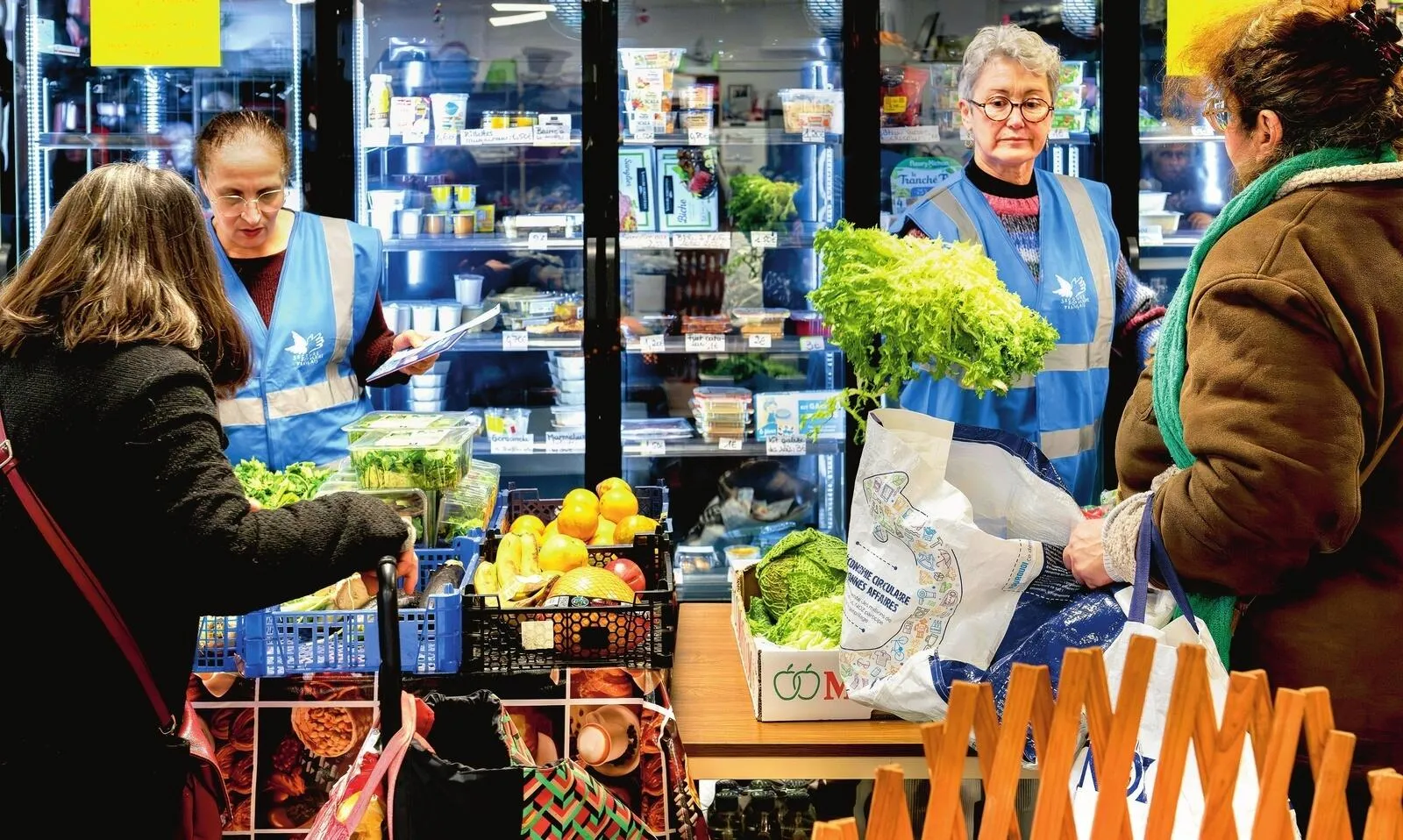
“We’re going to have a lot of people,” warns Anne Roignant. This manager of the Secours populaire in Rueil-Malmaison (Hautsde-Seine) was inundated with calls before the opening of her emergency hotline on October 29, 2026. Even in this wealthy town in the second richest department in France, the number of beneficiaries is exploding: + 18% in 2025, + 15% this year. Only those who have 13 euros or less per day per person are helped, an amount calculated after an interview. Those eligible will be entitled to a food parcel.
Inflationary outbreak, social protest, youth revolt: everything seems to attest that France is in crisis. Moreover, the feeling of downgrading is growing. One in two French people (52%) consider that their parents lived better than they did at the same age. An increase of ten points over five years, according to an Elabe survey. The French would have become poorer, that would be an established fact.
And yet, the indicators which assess the standard of living of the French tell us the opposite. Let’s take one of the most relevant, gross household disposable income per consumption unit. It measures income after taxes and benefits, weighted by family size. Let’s look at its evolution since 2001, that is to say over a generation.
This real income (corrected for price increases) increased by 21.7% on average between 2001 and 2025, according to INSEE. Likewise, the real median standard of living increased by 17.6% between 2001 and 2024. It stands, in 2024, at 26,740 euros per year. Half of French people live with less, the other half with more. The typical Frenchman, right on average, therefore lives rather better today than a generation earlier. This is not what many of our compatriots feel.
Soaring constrained spending
Several explanations can be put forward. The first lies in the increase in the share of constrained spending in the French budget. Those that they are obliged to pay every month, such as rent. This share increased from 12% in 1960 to 27% in 2001, then 30% today.
Our wallet therefore seems less full. The main culprit? Soaring housing prices. The price of old housing has increased 2.6 times in France since 2000, according to INSEE. Even taking into account the 17% increase in the median standard of living, housing costs twice as much for the French as it did twenty-five years ago.
Second explanation: the price of housing is not included in the consumer price index, which makes it possible to measure inflation and changes in the standard of living. Because housing is considered an investment when it is acquired. The index does, however, take into account rents. “This means that if you are a tenant and have occupied your home for a long time, you have not necessarily seen your situation deteriorate, as evidenced by the improvement in the standard of living. But if you want to buy, you are going to have to pay an insane price compared to your parents,” underlines Pierre Madec, economist at the French Observatory of Economic Conditions. Young professionals and families wishing to become owners therefore have good reason to feel downgraded.
Final explanation: the index poorly measures the loss of well-being felt when a consumer chooses in favor of lower quality foods to preserve their budget. Conversely, it does not always realize the quality effect it benefits from on certain products, such as computers. So with one euro, we buy much more power today than in 2001. “And yet, the consumer will not necessarily feel it since the nominal price of computers does not systematically fall,” remarks Philippe Moati, co-founder of the Society and Consumption Observatory.
Many other products weigh less on our budgets today than in 2001, such as telephone bills. Or quantity of food, baguette at the head. Above all, it is the prices of housing and energy – fuel, gas, etc. – which have exploded, much faster than the standard of living.
Conclusion: “There is indeed a gap between the standard of living calculated by INSEE and the reality experienced by households,” considers Sylvain Billot, economist specializing in inflation. There is no perfect indicator. It must be supplemented by others. » Pierre Madec agrees: “If you are subject to rising housing prices because you live in a tense area, that changes a lot of things. Purchasing power evaluates an average, and no one recognizes themselves in the average. »
Philippe Moati also explains this gap among the French by the hyperconsumerism of the time: “The “desire to purchase” has grown even more than purchasing power. We are constantly asked to consume. Many French people aspire to buy the same things, much more than during the Trente Glorieuses, even when they are modest: subscriptions to streaming platforms so as not to be marginalized in society, a smartphone, designer clothing… The inability to do so can create anger, frustration and resentment. Or else, we have to tighten our belts on food, which we didn’t do before. This can make you feel impoverished. »
Above all, behind the average, there are winners and losers. And the big losers are the poor. The French poverty rate, or the share of inhabitants living with less than 60% of the median standard of living, rose to 15.4% in 2024, compared to 13.2% in 2001.
A record since the creation of the indicator in 1996. This means that nearly 10 million French people live on less than 1,337 euros per month. The country is also recording an infamous increase in the number of homeless people: from 86,000 in 2001 according to INSEE to 350,000 in 2024 according to the Foundation for Housing the Disadvantaged.
Inequalities are increasing
Pierre Madec, however, wishes to qualify: “Overall, the poor are a little less poor than at the start of the 2000s. But they are falling behind compared to the others. This explains the increase in the poverty rate, which is a relative indicator. » One thing is certain, however, he adds: “Income inequalities in France have never been as high as today. »
As proof, he cites the indicator which evaluates the relationship between the standard of living of the poorest 20% and that of the richest 20%. The latter now have a standard of living 4.6 times higher than the poorest 20%. Never seen before, again, since the creation of the indicator in 1996.
The cause? The explosion of wealth income compared to salaries. Since Emmanuel Macron came to power, France’s 53 billionaires have, for example, seen their fortunes double, according to Oxfam France. Thanks, in particular, to a policy of reducing taxation on capital.
“The increase in poverty is a political decision,” denounces Daphné Chamard-Teirlinck, advocacy manager at Secours catholique. The active solidarity income (RSA), for example, has not been increased enough. » Philippe Moati recalls that the poorest 10% had also seen their income increase under the presidency of François Hollande.
Poverty specialists know: it is much closer to us than we think. Let’s return to the Secours populaire de Rueil-Malmaison and listen to the people who march there. Ons, mother of four children, is unemployed. She filed for divorce. Her husband earns a good living. But he is violent. He won’t pay child support.
Between brutality and precariousness, Ons has decided. Pablo succeeds him. This ex-cook has “psychological” problems. He divorced and no longer sees his children. He tumbled. “I had a difficult time, I was no longer doing anything,” he explains in a soft voice, his blue eyes vacant. He has recently been on the street: “I can’t cope anymore. »
The next one is called Alhousseynou. As a young engineer, he led a comfortable life. A casino addiction made him lose everything, including his job – “I kept asking for payday advances. » He became homeless and is struggling to find a job. There is no question of alerting his well-off family in Senegal. Question of pride.
“And because they would ask me to come back. I don’t want to. » Then, we talk to Léa, mother of three children, part-time care assistant. With 1,217 euros of income, including aid, and 849 euros of charges, he has 3 euros left per day and per person. “We do what we can. Everything goes first to my children. I want them to be well dressed. I don’t want them to feel bad about themselves. »
When she has nothing left, she lives on the Secours populaire stock. She also fled an abusive husband. Anne Roignant explains that single mothers are the profiles she receives the most, along with foreigners. It also welcomes more and more modest retirees and students. And lots of children, who came with their parents.
Child poverty is growing
There is no doubt: in terms of child poverty, France is regressing. In 2024, 22.4% of children in France lived below the poverty line, or 3 million minors, compared to 18.4% in 2001. France is now the fifth worst performer in the European Union (EU).
“There is an urgent need to act,” warns Pierre Madec. If only because it will be costly to our economy. Poor children have a much lower chance of succeeding in school and entering the workforce. »
“40% of the people welcomed at Secours catholique are children,” warns Raphaël Quartier, research manager for the charity. The French don’t imagine it. In our annual report published on November 12, we asked them who are the poorest. Only 14% cite children. »
Finally, let us emphasize that the situation in the country is rapidly worsening. Purchasing power declined in 2025 and 2026, according to INSEE. Such a decline two years in a row has only occurred twice since 1960. Wages are no longer increasing enough to compensate for inflation. “The root of the problem is that growth is insufficient,” judges Philippe Moati. Some blame the cost of labor. Others administrative complexity, deindustrialization or lack of investment in research. »
The fact remains that France is the only EU state, with Lithuania, to have experienced negative growth over the last three months. And it has almost no room for maneuver, weighed down by a record public debt. Enough to legitimately worry the French who do not yet have the feeling of being downgraded.
Has France become poorer, compared to other countries?
The answer will surprise followers of the declinist discourse. In the world, France was ranked 28e gross domestic product (GDP or wealth) per capita in 2001, out of 204 countries examined. In 2024, she would be 30e out of 200. It has therefore not really regressed. Over the period, it was overtaken by Singapore, Australia and New Zealand. But it also passed other countries, such as Japan.
If we consider GDP alone, France today remains the 7the global economy. Only India and China have exceeded it since 2001. And in Europe? In 2001, France was ranked 10e in wealth per capita among the 27 countries of the current European Union. In 2025, it still occupied this place.
If we take into account inflation, real per capita wealth in France increased by 16% between 2001 and 2025. A progression almost similar to that of Belgium or Spain. Some countries have done worse, others better, such as Germany (+ 26%) or Denmark (+ 27%). Or even much better, mainly Eastern countries. But they started from much lower.
At the start of 2026, Italy has now, and for the first time, joined France in terms of wealth per capita. Some editorialists saw it as a symbol of French decline. And yet, if we take into account its (higher) inflation, Italy has become much less rich (+1.1%) than France compared to 2001.
However, a symbolic example can fuel the French’s feeling of downgrading: that of the United States. In this country, real wealth per capita increased twice as much as in France between 2001 and 2025. Result: if Paris has become an economic destination for an American tourist, the United States is gradually becoming unaffordable for the French traveler.
Sources: Eurostat and World Bank.