
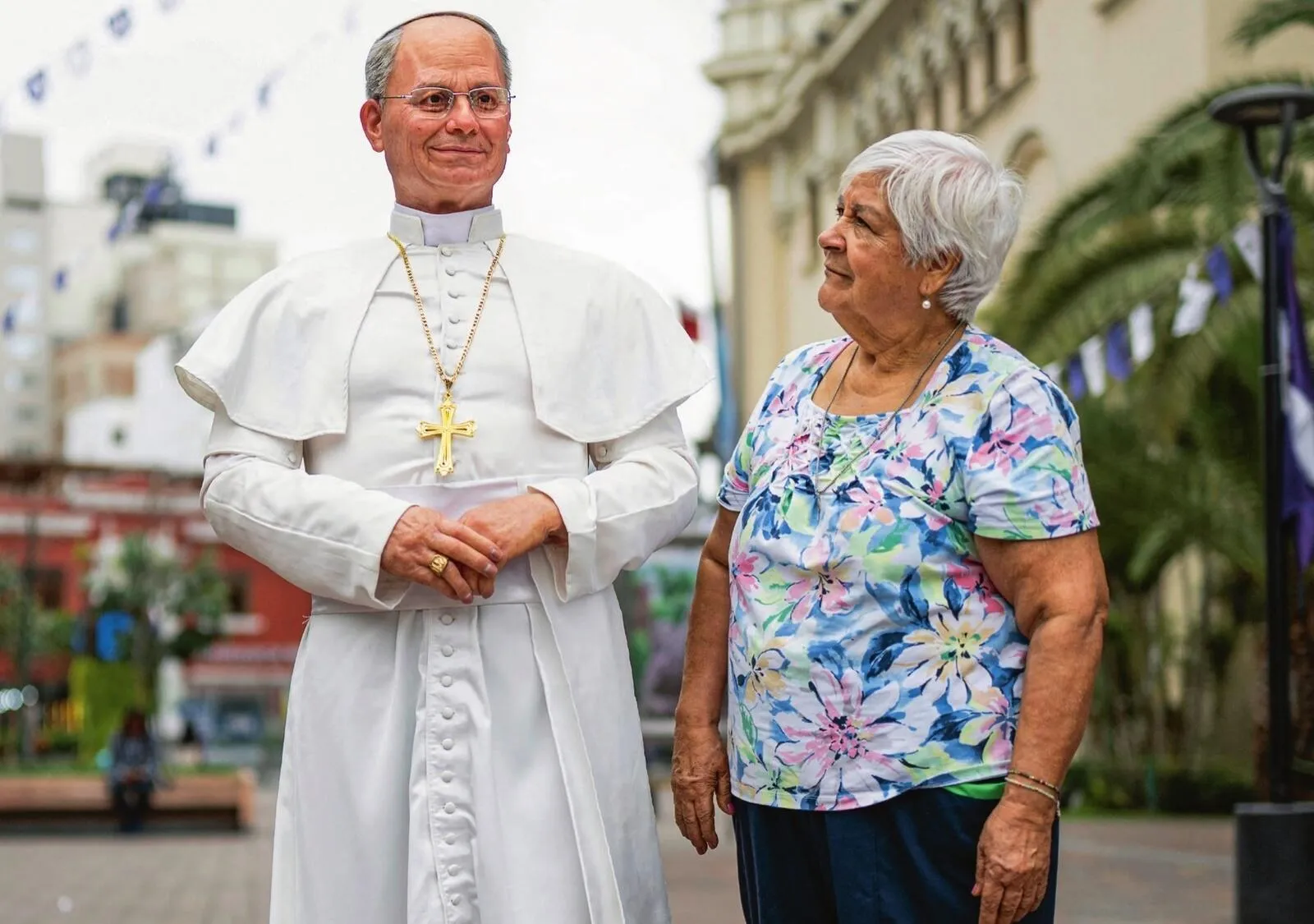
Leo XIV in Peru: the Church in the spotlight
The visit of John Paul II in 1985 and that of Francis in 2018 can attest to this: few countries welcome a pope with as much joy as Peru. This time, the fervor should be even greater, since it is a “Peruvian pope” who is expected from November 11 to 17. By staying almost a week in Peru, Leo XIV devoted an exceptional amount of time to it for a pontifical trip. Portrait of this Church which will find itself at the center of attention.
The engine of popular piety
Paradoxical Peru. Although 67% of the adult population declares itself Catholic, the country nevertheless has a ratio of priests per capita that is half as high as France. Added to this small number of clergy is the specific geography of the Peruvian territory, with areas that are particularly difficult to access. Thus, some communities only see a priest once or twice a year.
“This lack of priests dates back to the country’s independence, in the 1820s,” indicates theologian Véronique Lecaros. Catholicism was maintained thanks to the brotherhoods which organized community life in the villages around popular devotions. » The importance given to patronal festivals and statues of saints still bears witness to this today.
Another particularity of local parish life: the laity play a very active role. During the synod on the Amazon in 2019, Pope Francis designated this commitment as an example for other regions of the world where the lack of priests is felt.
An influential role in public life
At the origin of the famous “liberation theology”, we find a Peruvian priest: Gustavo Gutierrez. In the 1960s and 1970s, he was one of the main theorists of this approach favoring the preferential option for the poor, attention to social justice and human rights. At the time, the Vatican, while welcoming certain contributions, was concerned that it could lead to a politicization of the faith and a Marxist dialectic.
While the world was in the midst of the Cold War, and Peru was suffering the Maoist Shining Path guerrilla war, John Paul II then chose to take the opposite view of this theology, relying on a movement renowned for its doctrinal rigor and social conservatism: Opus Dei. When he died in 2005, nearly a quarter of the episcopate was close to this movement, including the cardinal archbishop of the capital Lima. “Since then, Pope Francis has rebalanced things, but generations of priests have been trained according to the Opus Dei model,” analyzes Véronique Lecaros. The weight of the organization also remains strong in the political domain. In the recent municipal elections in Lima, the far-right list emerged victorious, led by a member of the movement. Under his influence, and now that of neo-Pentecostal groups, the country claims a conservative identity, even in its social laws. Abortion, for example, remains illegal there, except for rare exceptions.
A presence as close as possible to needs
“In Peru, the Church is present where no other institution is,” underlines Luis Vildoso, of the local branch of Aid to the Church in Need. In the most deprived areas of cities, remote rural areas and the forests of the Amazon, government actors are often absent. The Church, which can count on its hierarchical organization and its international support network, becomes, in fact, the main interlocutor of the populations. And finds himself on the front line “to meet his material and spiritual needs”, summarizes Luis Vildoso.
Defending the environment, a permanent fight
This action is extended by a marked ecological commitment, in the wake of Laudato si’ of Pope Francis. “The Peruvian Church is very involved in protecting the environment,” assures Véronique Lecaros. One of its main concerns is the illegal extraction of minerals. Environmental degradation, lasting soil pollution but also human trafficking and violence: its consequences are deleterious.
Leo XIV is expected to address these subjects on November 15, during a stopover in the Amazon region. According to the Archbishop of Lima, Carlos Castillo, he should deliver a “very deep” and “very strong” message, against “the tendency to destroy nature and convert everything into merchandise”. Especially since, behind these degradations, there are geopolitical issues for the control of these essential materials, with a clash between the United States and China, the latter wanting to strengthen its influence in the country. Even in the heart of the Amazon rainforest, Peru can therefore be a place of choice to send messages to the whole world.
How many Catholics are there in Peru?
67% of the adult population in Peru declares themselves Catholic.
Source: Pew Research Center, study published in 2026.


