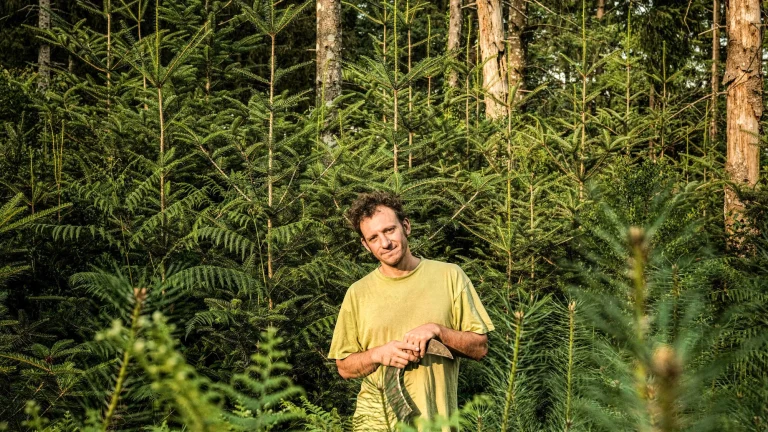
After a serious accident, Anaïs leaves on foot and changes her life
What got you started?
First there was a very sudden brake application. Hit by a car on a public road, I came close to death. A desperate situation requires a desperate solution. I therefore vowed to leave on foot and backpack towards Mont-Saint-Michel if I made it through. This was a big challenge because at the time, hiking was not my cup of tea at all.
Finally out of the woods, I still had to organize a break supposed to last nine months. At the beginning of March 2022, I took the first step in a journey that took me much further than the gates of Cotentin. But I didn’t know that yet!
For you, was this walk a pilgrimage?
Initially, it was essentially about honoring a promise with the afterlife without being particularly religious. Gradually, Mont-Saint-Michel crept into my thoughts continuously: a beacon whose luminous brush guided me. It was very reassuring!
Things became clearer as I approached. The spiritual dimension and prayer, the presence of God and the invisible then emerged as evidence. The stops at places of spiritual welcome certainly contributed to the process. I am thinking in particular of the Landévennec Abbey, on the Crozon peninsula. The monks appeared to me as great inner travelers, or as milestones that show you the path to follow.
Many paths lead to Mont-Saint-Michel. Why did you choose the customs officers’ path which goes around Brittany?
For its simplicity: on this path, you go straight, leaving the sea on your left. And there was, of course, the promise of landscapes shaped by wind, waves and tides. Without forgetting, along the way, some delicious oysters from local producers.
The GR®34 instructions detail a north-south route which ends at the Saint-Nazaire bridge. But I found it much more exciting to have in my sights the triangle silhouette of Mont Saint-Michel, so emblematic and recognizable. Two different visions of the same thing: the stonemason who breaks stones or who builds cathedrals.
By taking your tent, you chose autonomy. For what ?
I had the intuition that camping would offer me great freedom of movement, while remaining within a reasonable budget. And it turned out to be very pleasant to take your little home anywhere – a bit like on a boat, in fact.
This form of autonomy is accompanied by beneficial rituals that punctuate the day: pitching and putting away your tent, finding a campsite or bivouac for the evening. It’s incredible, the junk we carry around “for fear of missing out”, these essential objects that weigh us down unnecessarily! It seemed important to me to respect my part of the contract with the Lord by almost always walking alone.
After nine months of walking, how did you experience your arrival at Mont-Saint-Michel?
As we slipped towards autumn, the length of the day, reduced to nothing, meant that we had to take shorter stages. What a beautiful allegory of our lives! The Mount stands out from very, very far away. We have plenty of time to meditate, to let our hearts leap with joy. It’s time for positive feelings. You feel lighter in your body and in your mind, relieved to finally reach your goal. The impression, too, of visiting the archangel Saint Michael, the strongest of the angels. Like a protective friend waiting for you!
I extended my stay at the pilgrims’ house a little by spontaneously offering my help with some household chores. It was strange, all of a sudden, to become transparent in the eyes of the hosts who copiously ignored my presence, thinking that I was an employee. Just the day before, I was part of the small informal community of pilgrims who spoke to me.
This walk took you much further than Mont Saint-Michel, since it encouraged you to change your life…
Gradually, I understood that the question was not so much what we want to do In his life, but rather of his life. On a pilgrimage, we leave behind our daily life, but not only that. By stepping back literally and figuratively, we more easily shed the “old man”. In his letter to the Ephesians (4, 22-24) does not Saint Paul invite us to “put on the new man”?
After careful consideration, I decided to pursue my path differently, still alone, by continuing to write daily chronicles – what I had started during my pilgrimage. Go to sea to bring back words that do good. As a painter would do, I depict the moments that touch me, I share them so that they resonate in others as much as they do in me. Live first, write later. Publish, if possible, afterwards. Stay for a long time.
So you bought a boat?
Yes, I bought a habitable sailboat, a miniature house measuring twelve by four meters. With it, I can go far, sailing day and night. It doesn’t walk very fast: ten to twelve kilometers per hour on average, less than an electric bike!
On the transom, I swapped my French national flag for the Inter-Celtic flag, which combines the flags of the eight Celtic nations. It was given to me by the Irish, and I wore it proudly all summer.
Why did you name your boat Saudade II ?
The Roman numeral II indicates that this is my second boat. The first was a very small Breton canoe with gaff sail, which was also called Saudade. This word speaks of an emotion shared in the Portuguese-speaking world: Portugal, Brazil, Mozambique or Cape Verde. It is a form of happy nostalgia, the ability to mobilize positive memories: the village or the city in which we grew up, the color of the blue sky above Lisbon, the people we still love and who remained there.
I like this way of looking to the past to derive free and immediate well-being, instead of projecting oneself into a future and hypothetical happiness, often conditioned on the possession of material things. If I have this or that, then I will be happy. Here, it’s exactly the opposite. I think about the past which makes me happy, but also a little sad because it has passed… which doesn’t matter!
You now live on your boat. How do you decide your destinations?
Desire and intuition dominate. There is, first of all, the desire to travel the world in its liquid form. I would like to stay in the Marquesas for a long time, within two to three years. I broaden my scope each year, returning at the end of summer, like the swallow which is the symbol of my sailboat. In winter, I take refuge at the port.
For my next trip, I would like to go to Quebec: the North Atlantic, via the Azores, with a stopover in Saint-Pierre-et-Miquelon (which also depends, curiously, on the parish of La Rochelle).
All day between sky and sea, you have time to contemplate Creation. Ultimately, isn’t this a way of continuing your pilgrimage, stripped down and abandoned in the hands of God?
Indeed, the time at sea is stretching and getting longer. He loses in materiality what he gains in spirituality. We have the impression of evolving in another dimension. Furthermore, solo navigation allows you to be in direct contact with the boat and the elements.
It’s a wonderful way to be in contact with yourself and nature, a privileged relationship without filter and without disguise. It is a very happy way of life because it is extremely bare, where God has the silence to speak.
The sailboat and its human trace their route across a blue desert, a 360° horizon crossed only by marine animals, clouds, the sun and the wind.
How is a woman alone on a boat perceived?
In yachting, there are proportionally more men skippers than women, idem for solo sailors. It’s often an endured situation, when the partner doesn’t like sailing, whereas for me it’s a completely accepted choice.
I am often asked to repeat if I really am sailing alone. Yes, I handle the work of several crew members alone. Yes, everything is slower and I don’t sleep much, only intermittently. In reality, this situation rather inspires respect because it takes a little courage to go out to sea alone, at night for example. The sailors immediately integrate me into their community without restriction, it’s very nice. Before being a woman, I felt perceived as a sailor. The solo and more.
What do you like in this life?
I appreciate the alternation of periods alone and moments of great sociability during meetings in port and on land. Sailors are often very open and happy to meet their peers. I like the proximity of the elements and nature, sometimes they are very small details. The yacht basin in La Rochelle is teeming with fish, it’s like living above an aquarium. When I get off the boat, I say a happy “hello darlings” to them and I’m delighted.
I like to share, through writing, rare moments that I experience at sea and which amaze me. The boat is a sort of space-time capsule, a privileged place for meditation and peace. I like feeling outside of time, in an almost eremetic life but still open to the world.
Do you plan to live on this boat for a long time, or do you have other plans?
If I manage to spend one or two years in the Marquesas, I will have to return. So after the Pacific it should be the Indian Ocean then back to the South and North Atlantic via the Cape of Good Hope. A good stretch of the way at the slow pace of the boat, and avoiding big storms if possible. It may take some time, barring major damage.
My project? To like. Live every minute as if it were the last, or rather the first of a second life. It’s already not bad! The rest will take whatever form it wants, mine is to be at sea and write it, as long as it is given to me.
The final word?
I will use the words that stood out at the end of my pilgrimage to Mont-Saint-Michel: Deo gratias!