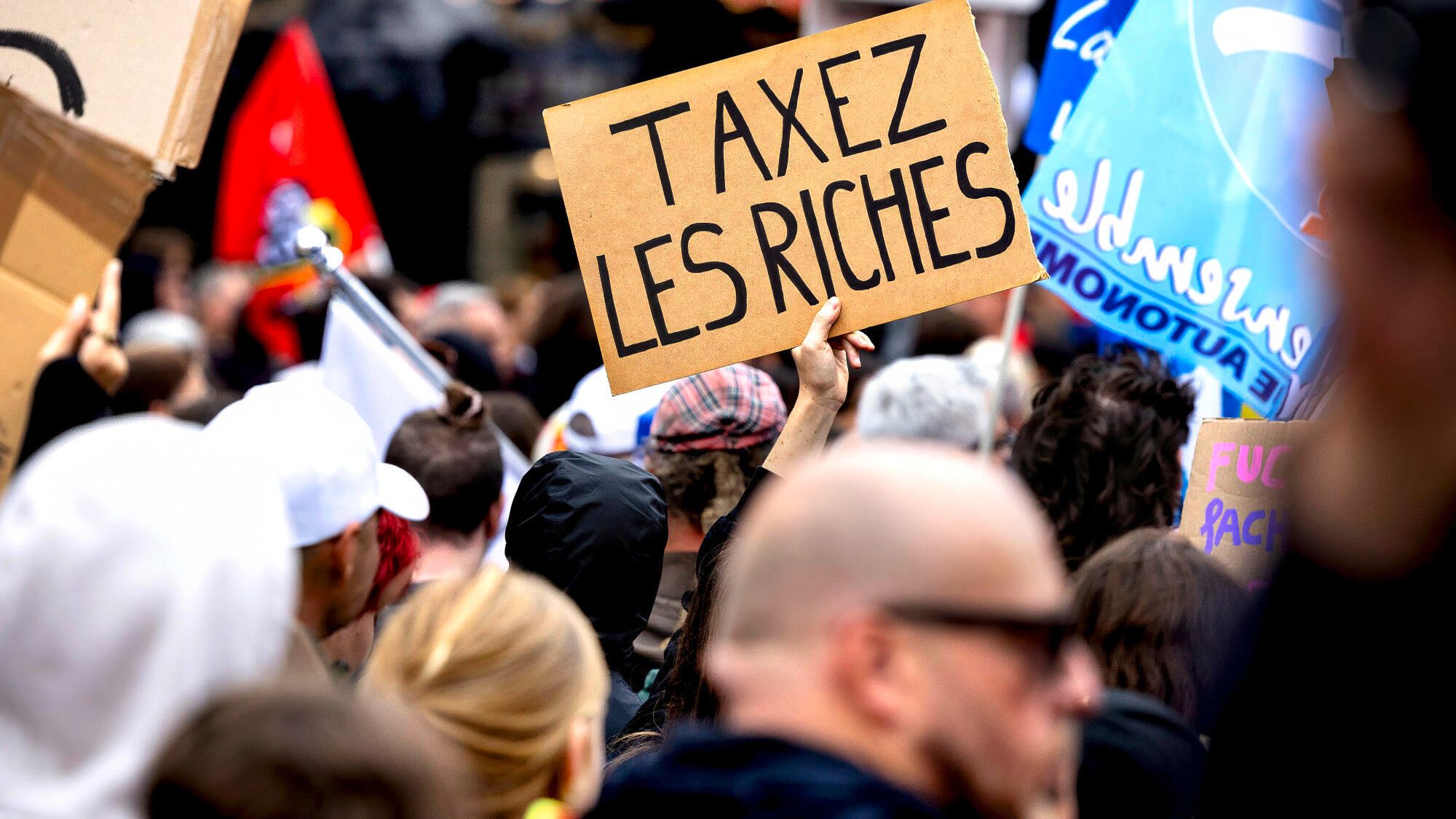
Do you really have to tax ultralates?
“Elon Musk will be the first trillionaire in the world. What does it mean? ” In a recent interview with the American media Crux, Léon XIV indirectly echoed the debates that have agitated French society in recent weeks. This pope, so attached to the social doctrine of the church, points to “the gap increasingly broad between the income of the workers and the money that the richest receives”. In our country, the richness of the 500 largest professional fortunes has increased by … 844 % in twenty years, according to the observatory of inequalities, when that of the most modest stagnates.
Tax ultra -ties? If the idea returned to the front of the news, it is because of the growing feeling of social injustice among the French, as evidenced by the massive mobilization of September 18, 2025. According to an Ifop survey, 86 % of them would be favorable to the tax invented by the French economist Gabriel Zucman. This claims to correct an imbalance: while the tax is supposed to be progressive, the ultra-ties pay less than the very rich-the tax rate is 26 % for the wealthiest 0,0002 %, against 46 % for the wealthiest 1 %. They use optimization mechanisms strategically using tax rules.
At a time when the state is looking for additional revenue, this tax could also bring in around five billion euros per year, according to the tribune of seven economists published on September 9. The principle of the tax is simple: it establishes, for some 1,800 households with a heritage of one hundred million euros or more, a minimum taxation of 2 %. If the amount of taxes already paid does not reach 2 % of its assets, the wealthy taxpayer must supplement it.
Screw tax optimization
The originality of the Zucman tax consists in including in the calculation no longer only the tax income but “all the assets” – private goods, professional goods and financial titles held by holdings in which these “centimillionaries” place their money. The only function of these “mother companies” is to hold others. However, ultra -ties are not taxed on the profits of these subsidiaries. This type of taxation would thus help to thwart their tax optimization strategies.
Except that to believe his contemptors, he would scare away the richest in the country. According to the Economic Analysis Council (CAE), this “expatriation” effect would however be limited, if we refer to the example of the United Kingdom, which increased the imposition of the richest in 2022, as well as Spain, in 2023.
However reduced, this tax exile would still have consequences. In the scenario of an increase of four billion euros in the taxation of ultra -drills, the CAE estimates at 0.05 %, or 150 billion euros (out of 2,900 billion), the drop in GDP linked to expatriations. In addition, according to the employers’ organization Le Medef, a new tax would discourage business creators and investors. Last June, the Senate rejected a law establishing the Zucman tax on this reason.
But for lack of studies, this objection remains of the order of “speculation”, believes Nicolas Glimplel, member of the CAE. The main thorny point of this ultra -ties imposition lies in its possible short -term practical consequences. The tax includes the shares and actions of companies, an essential portion of the wealthy heritage. However, these titles are not “liquid” silver immediately available. The mechanism could force some to sell those they hold, with the risk of low -cost assignment or loss of control of their company.
Alternative tracks
In addition, in the sector carrying new technologies, cutting-edge start-ups attract investors. This brings up the price of their actions and stores their owners in the Ultrariches category. But the value of said shares can go down very quickly. And it turns out that these successful entrepreneurs have little liquidity, since their heritage is mainly made up of their company.
Arthur Mensch, founder of Mistral AI, one of the most promising French start-ups in artificial intelligence, explained on television that he did not have the 24 million that would be theoretically requested. On the other hand, he says he is “rather convinced that it takes more tax justice in France”.
As an alternative, the government is considering a revisited wealth tax which would make it possible to combat tax optimization: it would only aim at ultra -checks, subject to a minimum tax of 20 % on income. Basically, the subject refers to the very nature of our economic system, a source of fractures. “The economic well-being of a country is not measured exclusively to the quantity of goods produced but also to the degree of equity in the distribution of income,” recalls the social doctrine of the Church.
2 %: the minimum rate of Zucman tax on the wealthy heritage
2 %is the minimum tax rate on the heritage of the richest 1,800 households offered by the Zucman tax.