From north to south, how repeated heatwaves disrupt the landmarks of our childhood
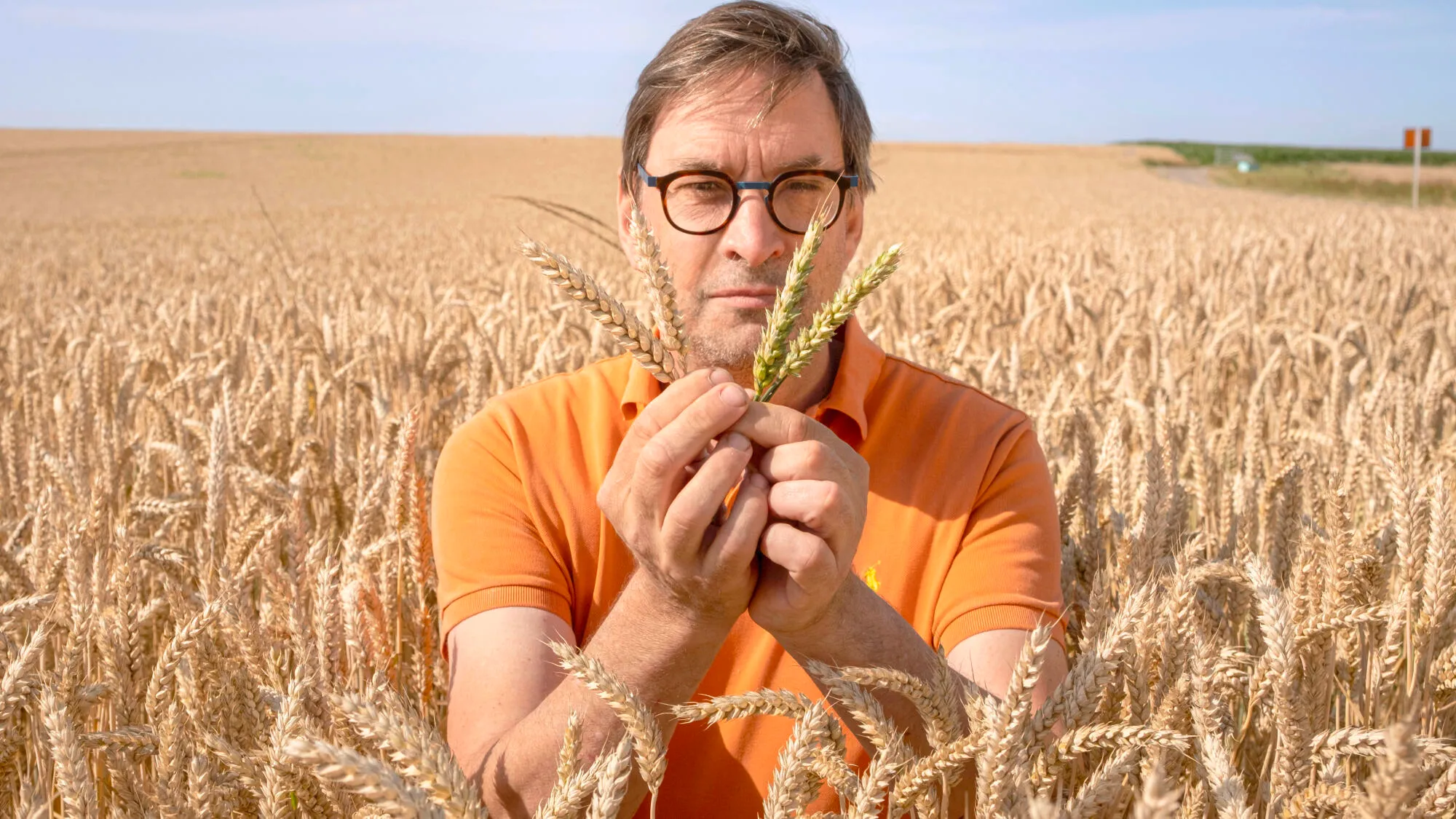
In the middle of his plot of Vieux-Manoir, in Seine-Maritime, Sébastien Windsor rubs the ears of wheat between his hands to bring out atrophied and withered grains “like rice”. Their color is abnormal. “They should be yellow and not brown,” notes the farmer, president of the national network of chambers of agriculture. “Like the last three years, the performance will not be good. » The interior of Seine-Maritime has not been spared from the recent heatwaves. “Almost 40°C here, and so early in the year, I had never seen that in my twenty-five years of career. » The spring months therefore began early. “We started a month earlier than my parents’ time,” he says. Historically, Norman farmers took their vacation at the beginning of July to begin the harvest at the end of the month, or even in August. “This year, I will have finished before the beginning of August. »
France is becoming “Mediterraneanized”
In the neighboring field, the flax will be pulled out at the beginning of July, “also something never seen before”. This precocity is not a guarantee of quality. On the contrary. “The fields should be green, but all the white areas you see are dead standing flax. » A small relief for the breeder, his pigs were relatively spared from the record temperatures which led to excess mortality among farm animals. The whole world must change. Corn, better adapted to these heat conditions, could develop further in the region. “But we must maintain a diversification of cultures. It’s not as simple as saying that you just have to plant apricot trees. For the moment, we do not have a miracle solution. » The president of the chambers of agriculture is convinced: “The agricultural map of France will evolve, crops will have to migrate. There are no longer any preserved places. »
“The agricultural map of France will evolve, crops will have to migrate. There are no longer any preserved places. »
Sébastien Windsor Farmer, president of the national network of chambers of agriculture.
Can we still speak of a France with a temperate climate? The large Vidal-Lablache school maps hung on the walls of post-war schools are more obsolete than ever. “We must in any case say goodbye to the climate that we have experienced,” adds Vincent Dubreuil, geographer at Rennes 2 University and co-president of the Breton High Council for the Climate (read p. 21). According to him, France will retain its regional contrasts, but it is becoming “Mediterraneanized”. Hot and dry summers will reach the center, north and west. In the east, the heat will be accompanied by greater humidity, while the south will take on the appearance of Sardinia or Sicily. The consequences are already visible. “In certain areas of Occitania, the vines are dying,” illustrates Sébastien Windsor. Conversely, viticulture began to develop in Brittany and even in Normandy.
Tourist influx
The new climate map of France shakes up our benchmarks. Faced with increasingly scorching summers, the vacation highway no longer necessarily leads south. For some holidaymakers, the GPS now indicates the Channel coasts. In Tréport, this tourism of freshness is already a reality, and the town takes on the air of a climate refuge. At the beginning of July, while Bordeaux (Gironde) or Montpellier (Hérault) are suffocating under 41°C, the pebble beach, swept by a sea breeze, displays 23°C. Renowned for the high cliffs of the Alabaster Coast, the region has one asset: its freshness.
Coming from Paris with her family, Amaya relishes her choice: “I was looking for a place to escape the heat. I looked at the weather map and said to myself, “Here, let’s go here!” It’s the best place you can be in France at the moment. » During the heatwave in June, the hotels were full. “Between June 15 and 28, we recorded an increase of more than 30% in tourist numbers at Tréport,” confirms Eddie Facque, president of the Sister Cities community of municipalities. Same observation at the Voiles campsite, in Flocques. “During the heatwave week in June, Parisians came to telework in the mobile homes,” says its manager, Benoit Vigouroux. To the point of wanting to make freshness a new commercial argument: “I have to add it to the campsite’s website. »
“We have been overbooked since the heatwaves of May and June,” confirms Julie Grandsert, communications manager at the Palangre residence. The private establishment serves as a senior residence and place for seasonal reservations. The common areas are air-conditioned and every comfort is offered: swimming pool, hairdresser, massage, gym… “We take great care of us,” greets Christine, a resident for six months.
Nicole and Claude have lived in room 205 since the residence opened in 2023. The couple spent fifty years in the South, near Monaco, where they worked. “Thirty years in Cap d’Ail and retirement in Cagnes-sur-Mer,” recalls Nicole, who celebrates her 90th birthday this month. If she returned to Normandy, where she was born, it was to escape the Mediterranean harshness: “I suffered a lot. We lived cooped up in our homes with the air conditioning, it’s not a life. Here I can go out for a walk, my husband can ride a bike. » Spend your retirement on the Côte d’Azur? The dream of a generation could now change course. “Even if we still have friends there, we won’t go back there,” she repeats.
Éliane finishes her lunch. Arriving at the residence a little over a year ago, also in her nineties, she does not regret her choice. “I lived for seventeen years in the Var, in Cavalaire, and seventeen years in Cannes. There, I had air conditioning but I didn’t go out. We no longer tolerate heat the same way at 90 as at 60. » Her daughter is based in Portugal and would like her to visit her more often. “But yesterday it was 42°C at her place, I’m better here. And I made friends in the residence. That’s why I’m here, so I’m not alone. »
“The next Saint-Tropez”
The phenomenon is too recent to appear in the statistics, but real estate agencies are already seeing it. Retirees, particularly from the northern third of France, who had bought a second home in the South, are selling to buy in Le Tréport. A way to reduce travel time and stay cool. Former fishmonger, baker, then hotelier around Le Tréport, before leaving for the South, Eliane also notes the growing interest in her native region. “When I left, in 1982, it wasn’t as touristy as it is now. In my time, the Bay of Somme was unknown! » Gisèle, sitting in the reception lounge, jokes: “It’s going to become the next Saint-Tropez, they’re all going to come to us!” »
Forty years later, the Picardy estuary is experiencing a considerable tourist influx. Neighboring 30 km, Le Tréport is full of second homes and seasonal rentals. The city has also been in a “tense zone” since September 2025. “The entire tourist offer encroaches on the housing part,” regrets Eddie Facque, the president of the community of municipalities. “Young people in the area can no longer find housing, it has become too expensive. They cannot afford to buy on the coast. They no longer stay on the territory. We find ourselves with the same phenomenon as in the Basque Country or in Brittany. » Secondary homes are spread up to 10 or 15 km inland, “something we didn’t have until three years ago”. The mayor fears a “general saturation” in an area which is preparing to accommodate the construction site of the expansion of the Penly nuclear power plant. We will have to find 13,000 places for workers.
But this climatic refuge remains relative. If the heat waves are generally shorter and the nights more bearable, Tréport has also been close to 40°C in recent weeks. In his town of Flocques, Eddie Facque is trying to find solutions. He had low-energy buildings built with green roofs, “where the temperature was 23°C during the hot weather”. But the problem is brick, the region’s emblematic material: “It’s beautiful, but inside, it’s 30°C. » In the school adjoining the town hall, the heat was difficult to bear. “Even three or four years ago, the idea of air conditioning our homes seemed absurd. Now we are thinking of doing it in municipal buildings. » Here, many remember the heatwave of 1976. “But it was not at this temperature level,” recalls the elected official. Soon, we will no longer be talking about the green Normandy countryside. »