
how the restoration of monuments boosts the local economy
“Heritage is a boosting element for the local economy, particularly in rural areas,” emphasized Stéphane Bern last August in The Pilgrim. The conviction of this herald of the cause of heritage is shared by players in the sector, whether catering companies, tourist offices or delegates from foundations, elected officials and the public. Awareness took time to emerge. However, on the ground, positive experiences are multiplying.
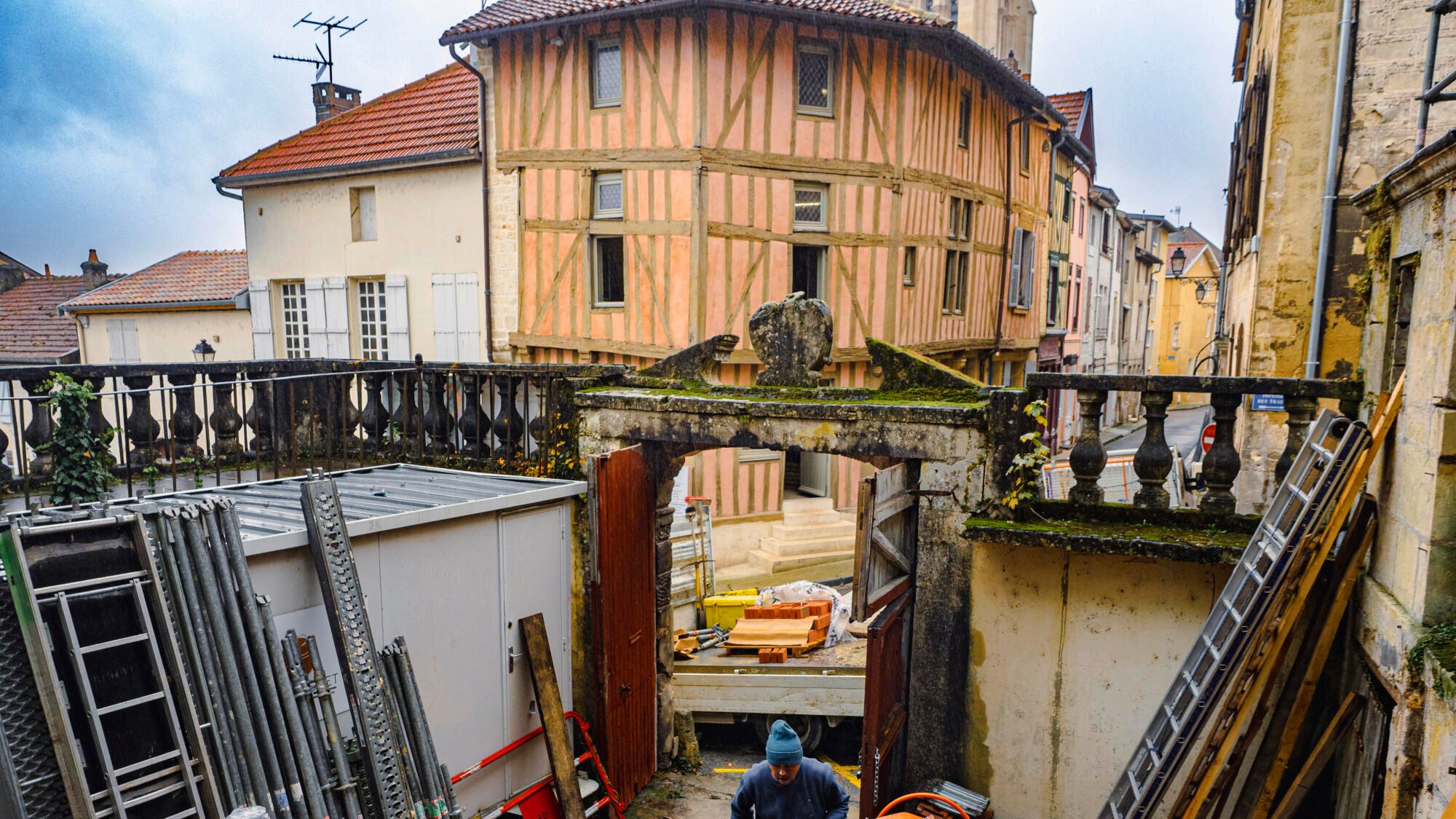
Meet in Joinville, in Haute-Marne, 3,000 inhabitants in the middle of a deindustrialized rural area. In the opinion of Véronique, who grew up here, “until recent years, it was sad. The streets seemed abandoned. Today, this young retiree and her husband, Jean-Christophe, notice that “old homes have become very pretty. And the banks of the Marne have regained their character.” By what miracle, knowing that, since the mid-1980s, the town has lost 40% of its inhabitants and that vacant housing has been abandoned by owners who no longer had the means to maintain it?
Nebulous real estate companies then bought them to rent them, without renovating them, to a population impoverished by the closure of the foundries – half of the young people in the surrounding area are without diplomas or jobs. The paneling, fireplaces and other oak floors were shamelessly looted. “The city was self-destructing with resignation,” recalls Bertrand Ollivier (without label), who arrived at the head of the town hall in 2006. “We had to stop this spiral, change its image on the outside and restore the pride of the inhabitants.”
A long-term bet
Since 2013, a proactive program focused on housing has combined threat and promise. On the “stick” side: forty orders were issued at the same time to put the owners on notice to carry out the restorations, under penalty of seizure. “It was innovative to attack private property in this way. We were criticized for it, but it was about safeguarding our common heritage!” recalls the chosen one. On the “carrot” side, with the help of the departmental territorial management, the municipality is looking for financiers and making agreements with social landlords to transform certain residences into rental apartments at moderate prices.
This is how Nicole, 86, moved into a HLM apartment on rue des Royaux three years ago: “I wanted to leave my house and get closer to the shops. I was won over by its old style and its terrace, right in the city center.” Little by little, in this elegant street, she appreciated seeing medieval houses with brown, red or blue-gray half-timbered timbers, sober blond stone buildings and even majestic 18th century mansions re-emerge under the gray plasterwork… The process is slow, but seventy buildings have already been saved. The neighborhood also resonates with the noise of the work which is continuing.
The municipality employs a project manager who acts as a link between all stakeholders. “We absolutely had to redo the roof, and she helped us obtain subsidies on the condition of restoring the facade at the same time,” explain Véronique and Jean-Christophe, who inherited a narrow house bordering the river. Result: the corbels were cleared by one of the companies specializing in the region’s historic monuments, to which this investment program particularly benefits. (see infographic below). Now the couple are renovating the interior themselves “to create three comfortable studios.” They hope to rent to Parisian engineers who will come for the work prior to the construction of Cigéo, the radioactive waste burial center in Bure, 25 km from Joinville.
Although the decline in the number of inhabitants has slowed significantly, the situation remains fragile. While remaining cautious, the city wants to “be ready” if any fallout comes from Cigéo, from 2030. In the meantime, it is counting on the arrival of a new population: retirees who leave the Paris region because housing is too expensive. “Brittany and Perche are saturated,” smiles François Griot, responsible for heritage at the city, “so we’re trying to convince them!” We must talk about “improving the living environment and sustainable housing rather than restoration”, he insists. The two go hand in hand, but sometimes “people think that heritage is a “superfluous thing for the rich”, or that it is limited to visiting monuments, like in the TV show Roots and wings.”
Very unique cities
Tourism, while welcome, is therefore not Joinville’s priority. No more than that of other “small towns of character”, a label to which the municipality has adhered since 2015: these 265 small towns and villages (read box at end of article) affirm their principles in a charter, in particular their desire to remain alive all year round by maintaining, thanks to the promotion of their heritage, businesses and artisans who transmit know-how. “This approach helps each city to reveal its own character and to fight against this standardization that we observe too much in France,” insists Laurent Mazurier, director of Small Cities of Character of France, who lists: same catchment areas at the entrances to cities, same street furniture…
Thanks to this label, cities obtain town planning advice and engineering for their projects and can exchange experiences. “Our report, in 2023, concluded that it is essential that the different local authorities work more together, also with heritage labels and with the State, in areas away from large metropolises,” confirms Élise Moreau, president of the Regional Economic, Social and Environmental Council of Burgundy-Franche-Comté.
She cites the successful example of the archaeological site of Bibracte, west of Autun (Saône-et-Loire). This hill and its museum of Gallic civilization benefit from the Grands sites de France associative network. And its management is ensured by a public establishment for cultural cooperation in which twelve rural municipalities participate. “We are starting to observe the positive impact of this very dynamic site on the economy of these villages. It attracts tourists, but also academics, cultural associations, participants in restoration projects…”
A newfound attractiveness
A “flagship” heritage project can therefore irrigate an entire territory. This is what Denis Thuriot hopes, both mayor (LREM) of Nevers (Nièvre), president of the community of municipalities and co-president of the national network of Cathedral Cities. Indeed, Pougues-les-Eaux, in the Nevers conurbation, was chosen, on October 13, 2025, to host from 2029 the ambitious construction site – financed by private sponsorship – of the construction of a life-size copy of the framework of Notre-Dame de Paris. As for the ship Hermione in Rochefort (Charente-Maritime), or for the replica of the fortified castle of Guédelon (Yonne), we are talking about more than 300,000 visitors per year. “For me, it is a spotlight, which will benefit, in turn, our beautiful cathedral and those of neighboring cities – Autun, Bourges (Cher), Moulins (Allier) – adds the mayor of Nevers. In addition, this creates a center of attractiveness around the woodworking professions, important in our region, and for our Bertranges forest, labeled “exceptional”.”
In these regions of “the diagonal of the void” that industry has largely deserted, heritage can even become interesting in terms of investment! The Banque des Territoires, an emanation of the Caisse des Dépôts, launched, on September 16, 2025, on the majestic Ducal Square of Charleville-Mézières (Ardennes) a second national program called “Territoires d’Histoire(s)”. The principle is simple: the Bank provides 250 million euros of equity and seeks the same amount from private investors ready to invest in the long term. Another 500 million were raised via bank loans. In total, one billion euros will be invested in fifty sites throughout France by 2030.
Interested investors
In Charleville, the program will rehabilitate two pavilions on this square, listed as Historic Monuments, to create a high-end hotel-restaurant. Equipment that is lacking in the region, both for business customers and for certain types of tourism. It is up to the hotel establishment to generate sufficient revenue to repay the investment, in the form of rent to the Banque des Territoires. “It’s ambitious but on our first program, in progress since 2019, it’s working,” comments, satisfied, Constance Mourier des Gayets, director of real estate investments at Caisse des Dépôts. Here again, the preparation of each file and the study of their viability require coordination between the regional directorate of cultural affairs – which awards state subsidies for the restoration of listed monuments –, private developers, elected officials, etc.
This specialist also notes an evolution in the type of projects that are being set up in these castles, former hospices, barracks or mills… “Initially, it was mainly hotels and restaurants. From now on, these vast buildings will house several activities: a beer brewery will be next to a coworking space or an associative third place; a childcare center with a solidarity grocery store and a France services house…” Thus, social and economic ambitions are increasingly coming together those of lovers of heritage and sustainable development. A great promise to bring old buildings back to life throughout France.


