
In Grenoble, an exhibition on the epic tale of a global icon: Mickey
In the air, Mickey swaggers. At the controls of his plane, he makes multiple advances towards Minnie, his passenger. A wink and a strong smile: nothing helps. The kiss is long overdue. Mickey insists… Minnie responds by slapping him, before throwing herself into the void, her bloomers deployed like a parachute. Mickey loses control of his machine. This scene of Plane Crazya short silent film, immediately grabs the visitor at the entrance to the Sainte-Cécile convent. Located in the heart of old Grenoble (Isère), the place hosts the exhibition “Mickey, it all started with a mouse”.
“No less than 180 works and objects of art are presented, most of them from French private collections, more than 90% of which have never been shown to the public,” underlines Bruno Girveau, the general curator. The journey goes back to the origins of the myth. In 1928, Mickey was still just a little mouse, an adventure hero born from the pencil of Ub Iwerks, whom Bruno Girveau describes as a “drawing genius, often forgotten but absolutely central”. With his friend, the enterprising Walt Disney, this young creative will invent a new animated language.
From this adventure, however, history will only remember one name. The silent short film, Plane Crazysigning the very first appearance of Mickey will never be shown to the public, any more than the second, The Gallopin’ Gauchobecause cinema is then in the process of switching to talkies. Mickey’s “official” debut took place on November 18, 1928 with Steamboat Willie. Défi, this sound film is screened at the Colony Theater in New York. He met with immediate success. “The first Disney hero was born on the big screen: a fundamental point for understanding his story,” recalls Aurélie Perret, in charge of exhibitions and collections for the Glénat fund.
European inspiration
A story which is part of a European connection, revealed by the exhibition. “After the First World War, Walt Disney, then aged 17, stayed in France with the Red Cross as part of the reconstruction programs. He takes the opportunity to immerse himself in the work of the European illustrators he admires,” reveals Aurélie Perret. Among them, Benjamin Rabier, creator of the duck Gédéon and the Laughing Cow, or Jean-Jacques Grandville, illustrator of Fables of La Fontaine. “So many artists use animals to tell stories, often with morals,” she underlines, before continuing her story by recounting the return of Walt Disney to the United States.
Beginning in advertising and frequenting cinemas assiduously, the young man was interested in the short films screened at the start of the screening or during the intermission, in this case the adventures of Félix the cat. The idea of a character designed for the cinema then imposed itself on him. He imagines Oswald, a rabbit destined for success… before this hero is confiscated from him by a Hollywood producer. Dispossessed of its creation, Disney must start from scratch. “It needs a new animal capable of seducing the public,” comments Aurélie Perret. It will be a mouse, which his wife suggests he name Mickey.
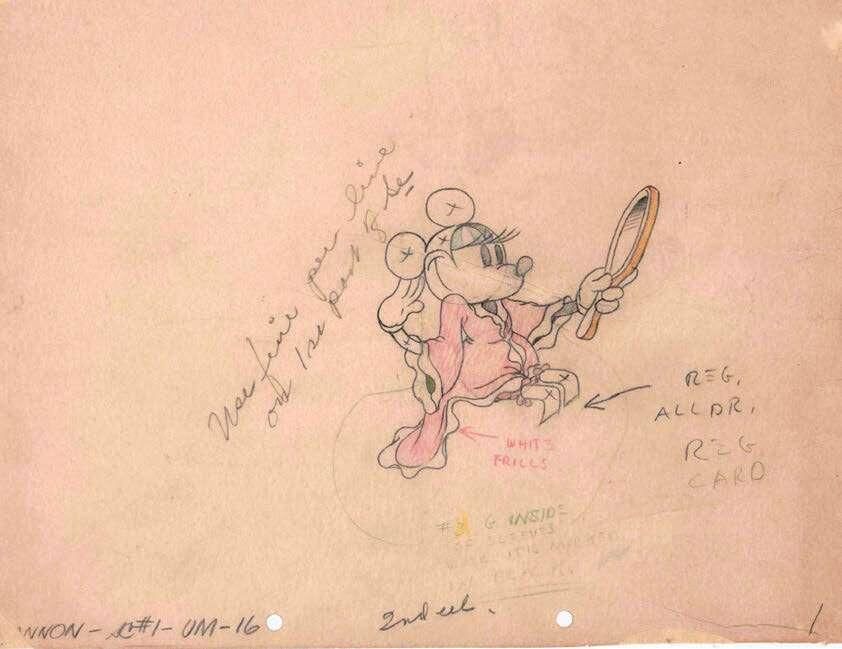
The rodent becomes the pillar of a booming industry. The exhibition also explores behind the scenes through one of the very first cinema storyboards, The fishing trip (1931), where sketches and annotations bear witness to a narrative under construction. The images then take shape thanks to “celluloids on production decor”, painted by hand and superimposed on watercolor backgrounds, as in The brave little tailor (1938). “Treasures, reflections of incredible artisanal know-how,” enthuses Aurélie Perret.
Contemporary craze
But Mickey doesn’t confine himself to the screen. Very quickly, he established himself in the American press, before invading magazines and children’s books throughout the world. He entered France in 1934, with Mickey’s Diary whose success cannot be denied. Among its readers, at the turn of the 1960s, little Jacques Glénat, subscribed by his grandmother. Having become a publisher and collector of comics, he is the one who is at the origin of this exhibition, presented at the Sainte-Cécile convent, the headquarters of his publishing house. This loyalty is crowned by obtaining the license from the Walt Disney Company to publish new adventures of Mickey. “There is always someone more passionate than you, more obsessive,” confides the septuagenarian.
The visitor experiences this in the last section, devoted to derivative products: toys – from dolls to spinning tops to games consoles – to the most diverse objects, such as the children’s chest of drawers. This “Mickeymania” goes so far as to inspire contemporary artists. How to explain such enthusiasm? Jacques Glénat has his idea: “In Mickey’s world, we don’t gut each other. There is no violence, no religion, no sexuality, no war. And the bad guys never win. » At the dawn of the hundredth anniversary of the little mouse, this exhibition brilliantly returns to the journey of a unifying icon. A bold and timeless character, shaped by imagination, innovation… and solid business sense!


