
Leo XIV in France: a new Catholic breath
On August 22, 2026 in Rimini, Italy, Leo XIV shared his emotion in front of the thousands of “contemporaries who request baptism in societies considered to be among the most secularized in the world”. At the Vatican, in 2025, he met with joy, at his request, 550 French catechumens, witnesses of a unique wave in Europe, which is astonishing in its number as well as in its youth: among the 21,000 adults and adolescents baptized at Easter 2026, four out of five are under 40 years old. But beyond that, the Vatican is also said to be interested in the resilience of French Catholicism, although it is a minority in a post-Christian society – 5.5% of regular practitioners (1).
As proof, Cardinal Jean-Marc Aveline, president of the Conference of Bishops of France (CEF), confided on June 9, 2026, when announcing the program of Leo XIV’s trip, the Pope’s “great esteem” for the “missionary vigor” of France.
Another sign that does not deceive, October 9, 2025, on the occasion of the publication of Dilexi youthe Pope’s first major text urging the linking of faith and social commitment, one of the two personalities to present it in the press room at the Vatican was the French Franciscan Frédéric-Marie Le Méhauté, known for his theological work promoting the words of the poor. Let’s dive into these two fundamental movements of French Catholicism.
Share the sweetness of God
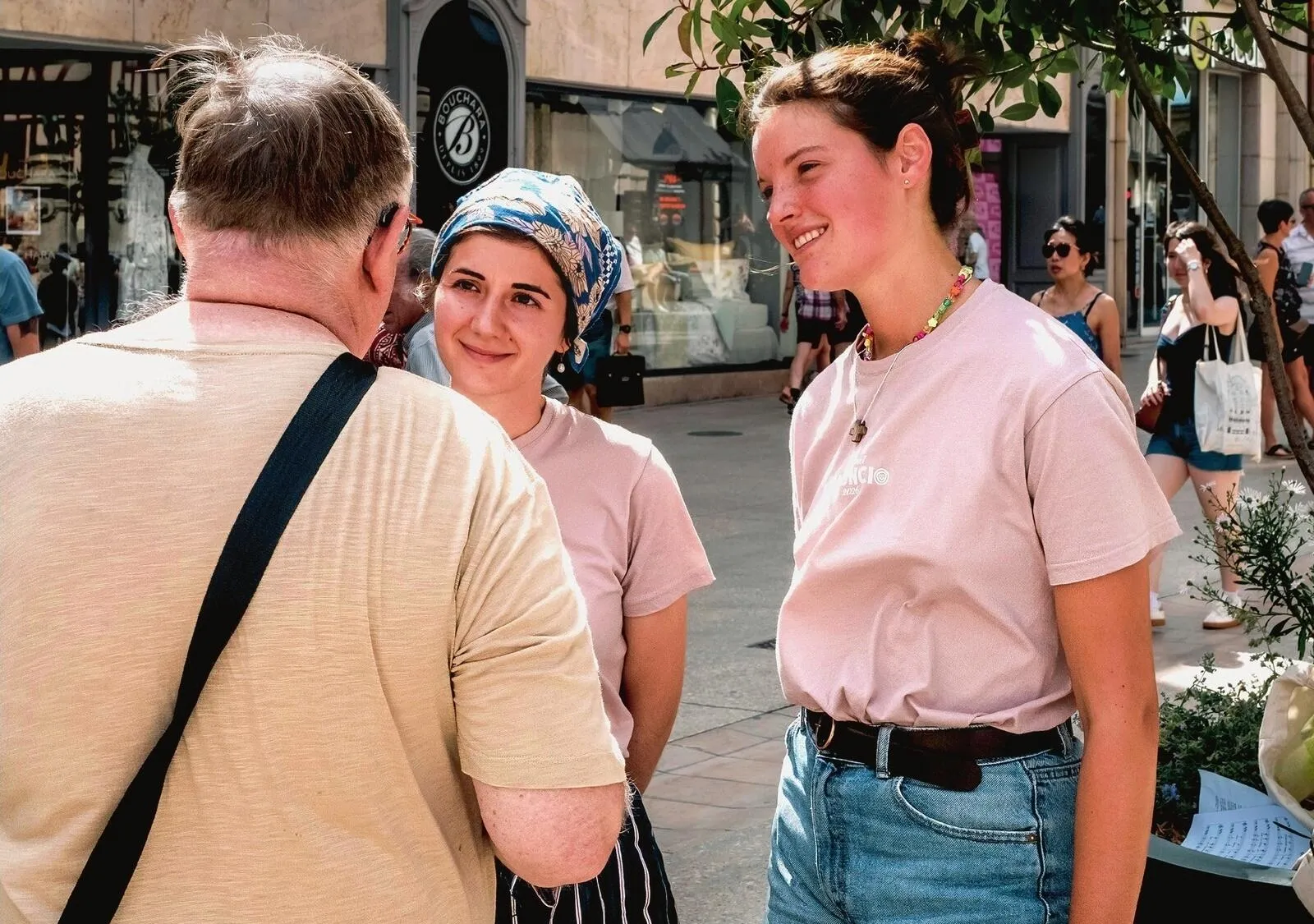
Her name is Marie-Emmanuelle and, in the middle of the main pedestrian street crossing the city center of Dijon (Côted’Or), she sings in a duet, in a beautiful voice, religious songs, making passers-by and tourists stop. At his feet is a sign displaying the words of Psalm 41: “As a thirsty deer seeks living water, so my soul seeks you, my God. »
A few steps away, other pairs engage in conversation with those who want to on the big questions of life: love, forgiveness, the existence of God… Once back in the host parish, over an aperitif, this 22-year-old student explains: “We want to bring to all these people something of the beauty and gentleness of God, to share with them this hope that he is always with us. The Gospel challenges us to step out of our comfort zone and love others. » Like her, several hundred of them take ten days out of their vacation to participate in the Anuncio Festival and are sent in small groups to various tourist places.
Created in 2008, this association is emblematic of the missionary momentum which is taking hold in France, often at the initiative of young people. Its particularity? The conviction that the time has come to meet the French. In the jargon, this is called direct evangelism. “Twenty years ago, it was a bad word,” smiles Raphaël Cornu-Thenard, its founder. “From now on, the big news is that many priests are wondering how to reach a population that has lost all religious culture and which, as a result, has much less preconceptions with regard to Christianity. »
A figure in this renewal of the mission, this father of a large family from the John Paul II generation is also the co-founder of the Mission Congress which, for its 10th anniversary, brought together around 20,000 people in the fall of 2025 at the Accor Arena in Paris. This annual meeting welcomes multiple Christian realities, from the Mission of France, dedicated to popular circles, to the traditionalists of Notre-Dame de Chrétienté, to promote a “missionary culture”. A concern carried until the 2000s especially by new communities (Emmanuel, Chemin Neuf, Béatitudes, etc.).
A cultural revolution
Rue de la Liberté, seated on a terrace, Don Guillaume Chevallier, priest of the Saint-Martin community and parish priest welcoming these young people, confides: “The organization of a Mission Congress in Dijon in 2024 (as in 140 cities in France, editor’s note) launched a dynamic in the diocese. Since then, times of mission with rural parishes have been experienced. Some were overwhelmed to discover the sympathy and spiritual thirst of the people they met. »
This cultural revolution was not always well received by certain faithful of the generation marked by the Second Vatican Council, uncomfortable with methods considered offensive, while they themselves had chosen to erase the all too visible markers of religion in a society in full dechristianization.
Another striking illustration of this missionary shift is the success of the Alpha Course. Since its arrival in France in 2000, this ecumenical formula for discovering the Christian faith around dinners has reached around 190,000 people. More than the number of inhabitants of Dijon!
A sign of the times again, in 2023, at the invitation of the CEF, more than 2,700 people from 85 dioceses participated in the Kerygma gathering. A “nursery” there promoted 200 field initiatives: mission in the rural world or with teenagers, priest’s coffee, Valentine’s Day in a different way…
For Mgr Pierre-Antoine Bozo, member of the permanent office of the CEF: “This new missionary breath amazes the bishops as a whole. Today, many Catholics embrace their faith in a more uninhibited way. » In the France that Leo XIV will soon visit, every baptized person is in fact invited to become “a missionary disciple”, according to the expression of Pope Francis.
The poor at the center
On the heights of Lourdes (Hautes-Pyrénées), at the Cité Saint-Pierre, Secours catholique reception center, Nicole has just put on her sunglasses to hide her tears: “When you are poor, you become invisible to others, it’s as if you were dead. » Elegant hairstyle, slightly hunched shoulders, the fifty-year-old recounts the humiliation of having scavenged to feed her family.
Around her, a dozen people have gathered to listen to testimonies on Dilexi youa text in which Leo XIV asks that the Church be “the place where the poor have a privileged place”. After a silence, Nicole continues: “Luckily I met Christians, their consideration saved me. » A few days before August 15, around 300 people from the Saint-Laurent Network gathered in the Marian city.
Born in 2005, this network, which notably offers meetings to discuss the word of God, today has 160 groups of Christians, often from the fourth world or from precarious situations. His conviction? The Church is only right when it starts from the words of the poorest.
“Today in the Church, we talk a lot about leadership. But true leadership cannot do without listening to the poorest, adds Gilles Rebêche, close to this network. Twenty years ago, we were not very heard. But the collapse of religious congregations has created a great void. Local churches have taken on this most precarious concern. »
An emblematic figure of this renewal of charity, this deacon founded the first French diakonia service (from diaconos, “servant”, in Greek), in the diocese of Toulon. A service working not to coordinate works of charity, but to put the poor at the center of the life of the Church.
Thirteen years ago, the Conference of Bishops of France, supported by various movements, also set about taking up this challenge. For three days, the Diaconia 2013 gathering will bring together 12,000 people – including 86 bishops! –, and will leave a lasting impression. Today, around a third of dioceses have established a diakonia service. A development driven by the field influence of the Saint-Laurent Network, committed to bringing to life the legacy of Father Joseph Wresinski, founder of ATD Quart-Monde.
Another sign of this new spirit of charity is the proliferation of shared accommodation between young people and people in difficulty: Lazare and the Association for Friendship with street people, Ensemble2Générations with elderly people, La maison de Marthe et Marie with young mothers, the Village de François welcoming various audiences, etc.
Two main triggers
Sitting in an armchair, happy to take a moment away from the hustle and bustle, Jean-Marie Martin, the linchpin of this network, passionate and direct, remembers: “In October 2021, the day after the submission of the Ciase (2) report to the bishops, in Lourdes, we hosted a day during which each bishop was invited to share the word of God with people in precarious circumstances. Mgr Éric de Moulins-Beaufort, then president of the CEF, told us that this time had helped them to agree on a common reaction to this report. » The abuse crisis has, in fact, played a decisive role in raising awareness of the importance of listening to the words of the poor, particularly among bishops.
Another accelerator, the pontificate of Pope Francis and his demand for a “poor Church for the poor”. A difficult radical conversion given the fairly bourgeois sociological profile of French Catholics, which can go hand in hand with a downward posture and a fear that charity will be used for political purposes.
This taking into account of the words of the most precarious, however, is beginning to take root, with effects on the very government of the Church. “We are in the process of creating a diocesan group with poor people in order to listen to them, including in determining the missionary orientations of the diocese or in the conduct of parish communities,” underlines Mgr Laurent Percerou, Bishop of Nantes.
The fact remains that these two current shifts, missionary and charitable, have essentially grown separately for around twenty years, even in mutual distrust. Leo XIV, who made unity the central axis of his pontificate – notably by choosing as his motto In Illo uno unum (“In him who is One, let us be one”) – will he call for combining these two major impulses of French Catholicism?
- Who goes to mass at least once a month. Source: Bayard-La Croix–Ifop study of December 8, 2025.
- Independent Commission on Sexual Abuse in the Church.
Pilgrimage to Chartres: a success and questions
At Pentecost 2026, there were more than 20,000 people flocking to Notre-Dame de Chartres Cathedral (Eure-et-Loir), most of them after a 100 km walk from Paris. Average age: 22 years old!
Having become the symbol of a generation of young people in search of identity, this pilgrimage is not without raising questions for the Catholic Church. Because even if pilgrims only place the fact of being able to attend masses called “in Latin”* in fifth position, this pilgrimage has made the Tridentine rite a marker.
For the French episcopate, supported by the Vatican, this constitutes a real problem of ecclesial communion. The historic pilgrimage – same date, same route – was offered since 1935 by the student chaplaincies of the diocese of Paris, before stopping in 2022.
From now on, it appears preempted by the Notre-Dame de Chrétienté association, which defines its three “pillars” as follows: “Christianity, tradition, mission. » Seizing the third, the organization has been planning, for several years, “missionary chapters”, made up of young people ready to chat with questioning passers-by. A start of an acculturation effort?
* Survey conducted in 2026 by the Notre-Dame de Chrétienté association.


