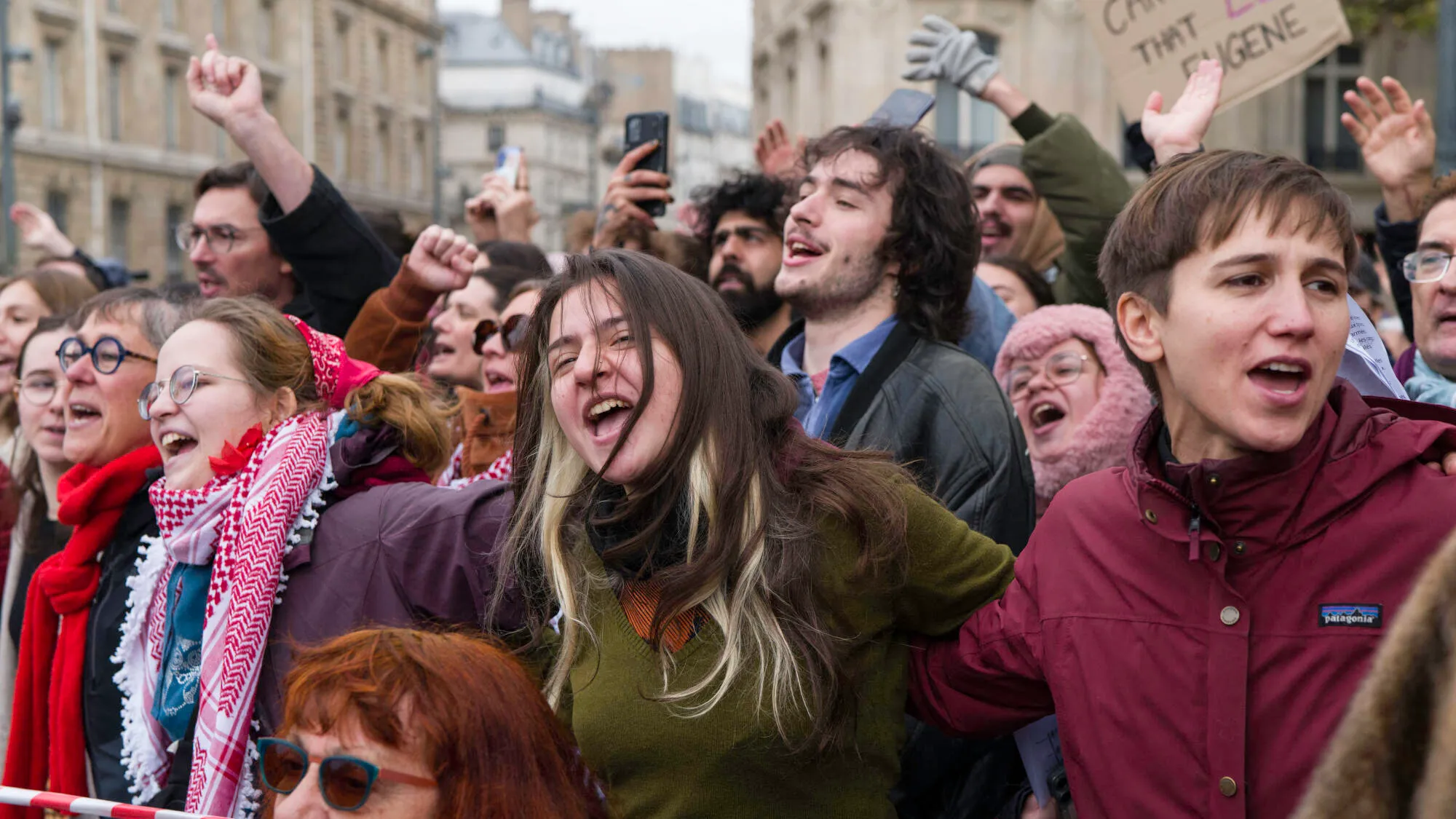
Presidential election 2027: young people make their voices heard
Many thought they were withdrawn into themselves and their circles of friends, stupefied by social networks and indifferent to the affairs of the city. This is another face of young people that has revealed itself since the start of the high school mobilizations in September. “Politics fascinates them, and this moment of protest materializes the very keen interest that we feel among the students we meet,” comments Raphaël Culliford , general delegate of the association Parlonsdemocracy, which involves professionals from public institutions in educational establishments (read box at end of article). Images of violence and looting have often eclipsed the hope held by this youth movement: the aspiration of an entire generation to take control of its future.
And this despite, or because of, the fear that inhabits him. Indeed, according to data from the latest annual reference survey “French Fractures”, published on November 16, 2026, 53% of 18-24 year olds say they feel a feeling of fear on a daily basis, compared to 37% for all those questioned.
“Global warming, wars, pandemic risks, downgrading and purchasing power are a set of concerns that maintain this feeling of fear,” explains Anne Muxel, sociologist and political scientist, co-author with Pascal Perrineau ofInventory of French fears (Ed. Odile Jacob). Fear also of not being able to enter a job market that is increasingly competitive and undergoing profound transformation with the arrival of artificial intelligence (AI). »
A concern shared by Tao, 17, in his final year in Marseille at a vocational high school. “I fear not finding a job after my studies,” he confides. The increase in the minimum wage speaks to me, because I want to live with dignity from my work. »
An “expressive” citizenship
How can you change things when you’re young? The majority of high school students, although informed and aware of these issues, do not have the right to vote. This is partly what explains this unprecedented mobilization of young people, as a major electoral deadline approaches.
In the absence of a ballot to slip into the ballot box, they acted outside the marked civic paths. “We have a way of getting involved that is specific to our generation,” explains Marius Mesnil, co-secretary general of the High School Union (USL). On social networks, we broadcast videos of the blockade which went well. Suddenly, each high school wanted to organize its own. »
A mode of action used after having demanded, in vain, changes through institutional channels and petitions, he pleads. Example: patchy or overloaded schedules, from 8 a.m. to 6 p.m. As a result of the Blanquer reform implemented in 2019, they were singled out by the Citizens’ Convention on Children’s Time.
Also rare: launched in 2024, a petition from middle and high school students on TikTok has exceeded 300,000 signatures. “At the time, the high school representatives were not even received at the ministry to talk about it,” laments Marius Mesnil. This demand was also brought to the level of academies, without success. »
The change in school rhythms is today among the “10 emergency measures” supported by the youth movement, alongside the renovation of establishments, the hiring of staff in National Education, the end of Parcoursup, or even the overhaul of high school democracy.
Blockades, marches, petitions on social networks… These ways of getting involved in the affairs of the city are part of a profound transformation of citizenship, according to Vincent Tiberj, university professor at Sciences Po Bordeaux. “Since the 1960s, citizenship has been increasingly “expressive”, with a demand for direct participation in decisions, he analyzes; and less and less “allegitimate”, in the sense of handing over oneself to political elites, through a vote every five or six years. The distance with these elites and the institutions they represent continues to widen. »
The temptation of radicalism
When it becomes too strong, this distance can result in violence. Damage to buildings, mortar shootings in high schools, attacks on principals: these realities also mark the current social movement. “The temptation to be radical among the younger generations is real,” emphasizes Anne Muxel. Nearly one in three young people consider that violence is justified to defend their interests, according to the “Fractures françaises” survey. In a context of crisis in political representation and strong distrust of those in power, anger boils over to the point of leading to violent acts. But this form of radicalism is also gaining legitimacy in public opinion, since one in five French people also finds it justified. »
For the majority of high school students and students, however, the relationship with politics is experienced through exchanges of ideas and sharing of information which have taken on a singular scale in the last two months. “I was unaware of the living conditions in suburban high schools, like the ceilings that were falling or the toilets that no longer worked,” says Léa, 15, in second in a Parisian high school, also experiencing material difficulties. It opened my eyes and motivated me to go and demonstrate. »
All the young people interviewed for this article testified to this moment of politicization, the one where they became aware that their personal, local situation echoed that of other young people elsewhere. “A generation cannot be decreed,” explains Vincent Tiberj. It is created from the moment when you are aware of sharing a common reality and feeling united. »
Impact at the polls
A major question for the 2027 elections is how first-time voters of this generation will express themselves, or not, at the ballot box. In 2022, only 52.5% of voters aged 18 to 24 voted in the two rounds of the presidential election, compared to 69.3% of all registered voters, according to INSEE. What will it be next year?
“The participation of young people will certainly be massive,” estimates political scientist Robi Morder, specialist in high school and student movements. The fear of the National Rally coming to power is indeed very significant among young people in school. Those who are involved in the current mobilization will probably move from passive voters, or even abstentionists, to active activists of the vote around them. »
For the benefit of which candidate? According to an OpinionWay survey for The Echoes published in mid-November, 41% of 18 to 24 year olds would vote for Jean-Luc Mélenchon in the first round, i.e. 10 points more than in 2022. Behind him, Marine Le Pen is in second position with 24% of voting intentions.
“If student and urban youth lean to the left – a long-standing tropism –, another part, particularly in rural France, those who left the school system early and experience many difficulties in the world of work, are attracted by the National Rally. And she condemns the current mobilizations,” explains Anne Muxel.
The fact remains that 18 to 24 year olds only represent 11% of the electorate, while half of voters are over 50. But failing to vote at the polls, part of the youth has already shaken up the presidential campaign. While security and immigration issues dominated until the summer, other subjects have since emerged: public services, purchasing power, climate, discrimination… and of course education.
“Educational questions will be central in the debate, each candidate must have a very solid program,” believes Marius Mesnil. Because if some high school students do not vote, their families will still be able to take their expectations and hopes into account.
“My turn!”: training young people in democratic issues
If young people are passionate about politics, they do not always know the institutional balance of power or the dangers of fake news. The “My turn!” program » wants to train, between now and the presidential election, several tens of thousands of pupils and students aged 17 to 23 in democratic issues, in strict compliance with the principle of neutrality.
Supported by the associations Let’s Talk Democracy and Au Contact Citizens, Citizens!, it consists of organizing workshops and simulated elections. It also offers digital content intended for young people and teachers.
Information on amontour.org and the Instagram account @amontour_off
What is the place of young people aged 18 to 24 in the French electorate?
11%. This is the share of 18-24 year olds in the electorate.
Source: Insee, February 2026.
How many emergency measures are being called for by the youth movement launched in September 2026?
10 emergency measures are now being demanded by the youth movement launched in September 2026.