
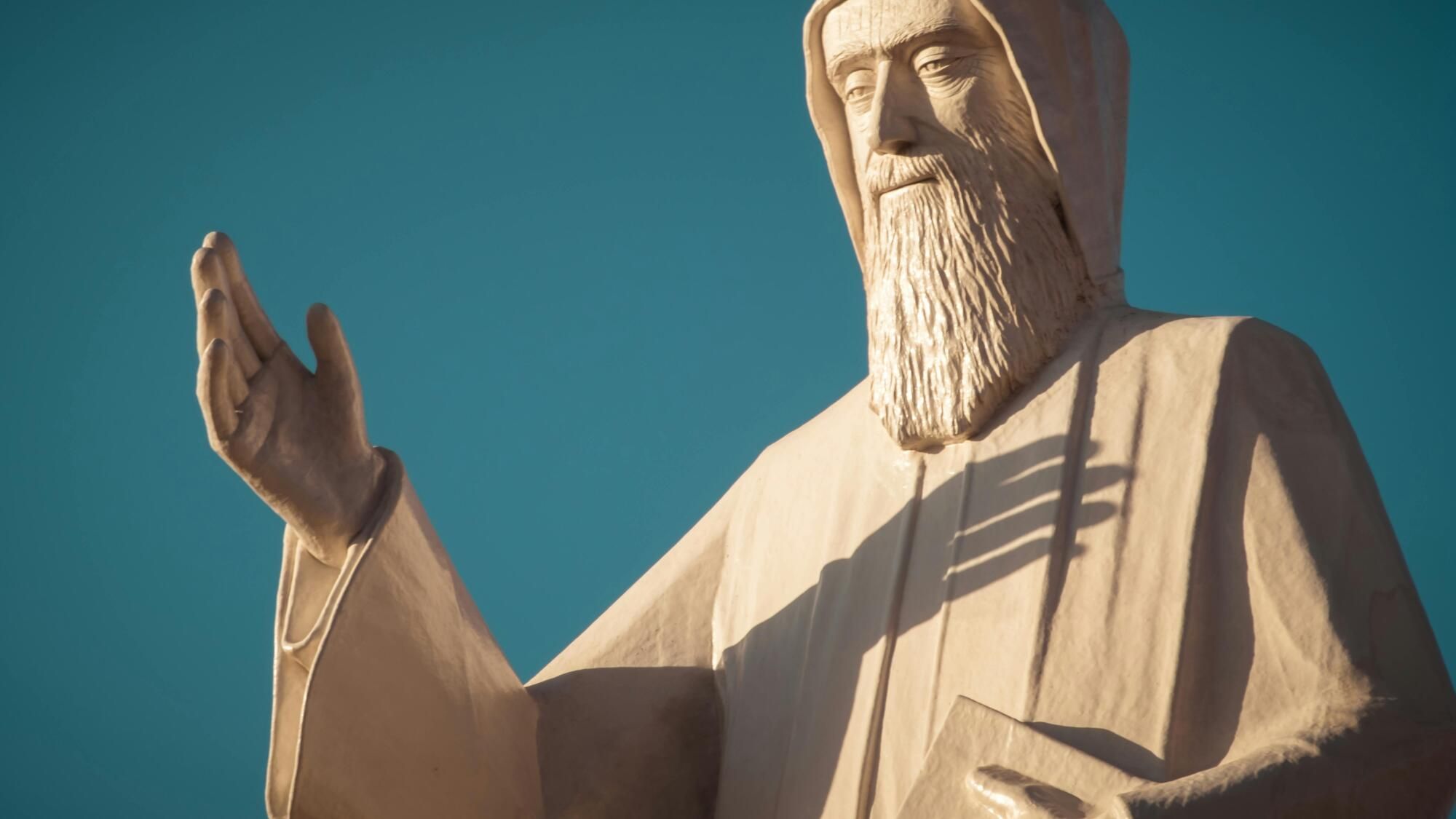
Who is Saint Charbel, at whose tomb Leo XIV will pray?
“Leon XIV was elected pope on May 8, the day of the birth of Saint Charbel!” Father Georges Ghattaf, superior of the Maronite monastery of Saint Charbel in Villiers-sur-Marne (Val-de-Marne), does not feign enthusiasm. It must be said that the Lebanese religious has reason to rejoice: Pope Leo “The Pope sends a very strong sign: Saint Charbel was a pure, merciful heart: Leo XIV invites the world, and particularly the Middle East, to follow his example.”
An early vocation
Born in 1828, the future saint, fifth of his siblings, was named Youssef. His parents, fervent Christians, passed on to him a taste for prayer and a great devotion to the Virgin Mary. The country was then under Turkish domination, and his father died during a mission for the army when the child was only five years old. His mother remarried a pious man who was ordained a priest shortly afterwards, in accordance with the particular discipline of the Maronite cult. Youssef prays daily to the Virgin, going to a cave near his sheep’s pasture. During a prayer, the young boy heard a voice say to him, “Leave everything, come! Follow me!”.
At the age of twenty-three, and despite the initial opposition of his parents, Youssef therefore entered the Notre-Dame de Mayfouq monastery as a postulant, and took the name of Charbel, one of the first martyrs of the church of Antioch. Two years later, he took the vows of poverty, chastity and obedience, then began the studies required to become a priest at the Saint-Cyprian monastery of Kfifan. He was ordained in 1859. “Saint Charbel celebrated mass every day of his life in gratitude to God for his kindness” underlines Father Georges.
A model for today
In 1875, Charbel obtained permission to live in a remote mountain hermitage. He spent 23 years there, and from time to time received faithful who came to ask him for advice. He earned the reputation of an excellent confessor. “His whole life was made up of prayer and silence. I believe that his example speaks to us for today: we must know how to escape the noise of the world to return to the essentials of the Gospel, to detach ourselves from the material, as he did, to follow Christ alone” explains Father Georges.
After his death, Charnel’s body remained intact, and several unexplained phenomena surrounded his burial: lights emanating from his tomb, pinkish oozing from his body… The rumor of his holiness was almost immediate. The hermit was beatified in 1965, at the end of the Second Vatican Council, then canonized in 1977. “Since then, pilgrims have flocked from all over the world to pray at his tomb. I have seen Indians, Chinese, Americans there…” enthuses Father Georges, “many testify that Saint Charbel offers great graces of conversion, of inner peace. For all Lebanese, of all faiths, he is the symbol of the country.”
His notoriety now extends well beyond the borders of Lebanon. And Father Georges concludes: “While he has lived a quarter of a century cut off from the world, now the whole world, and even the Pope, is coming to him!”


