
Why the EU-Mercosur agreement crystallizes farmers’ anger
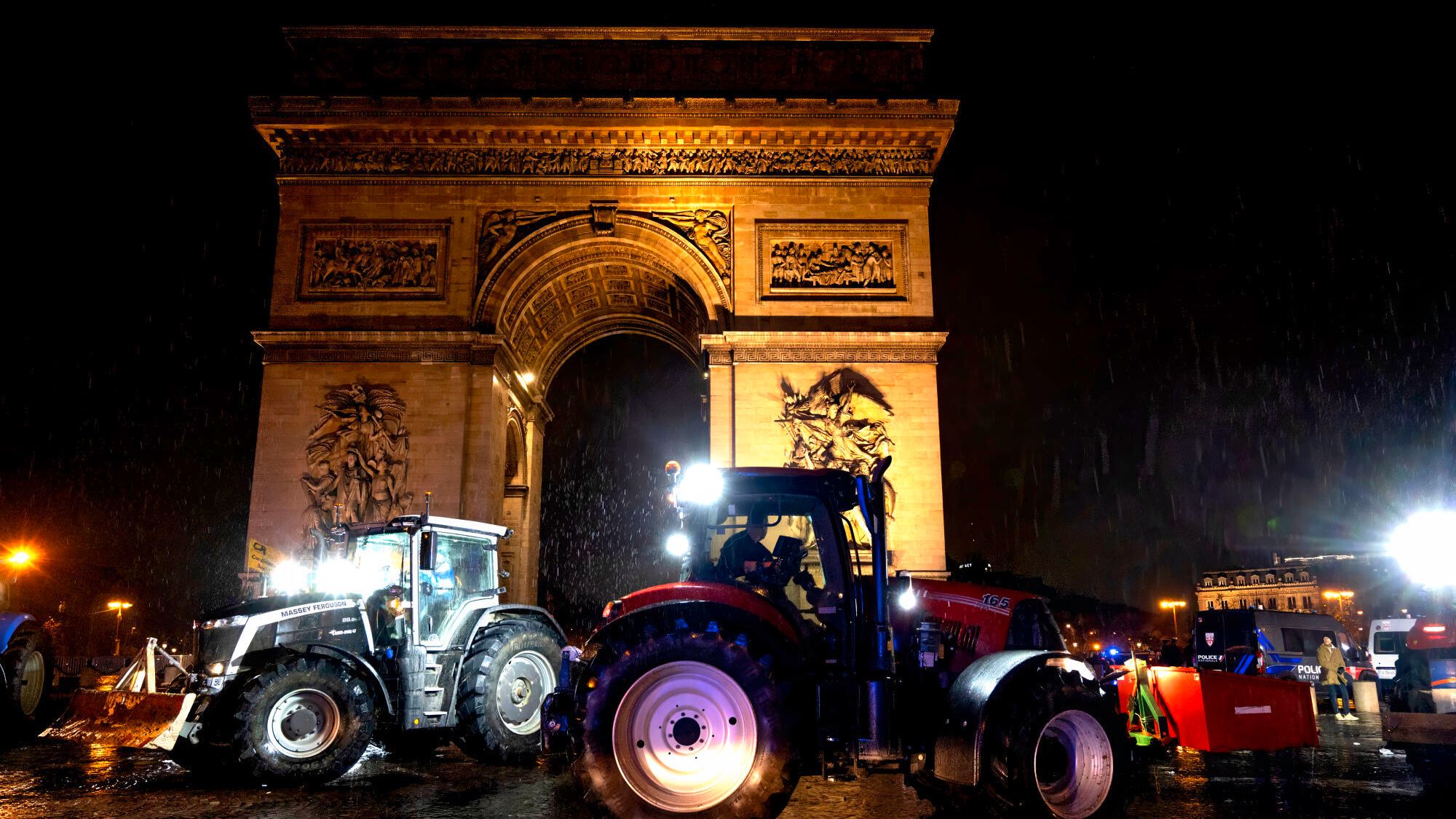
Nothing stops them, not even snow. A few days before the announced signing of the agreement between the European Union and the Mercosur countries (Argentina, Brazil, Paraguay and Uruguay), the unionized farmers of the Rural Coordination “went” to Paris on January 8. Some tractors were stopped by law enforcement on the way.
Others scattered on small roads to avoid getting caught. These resourceful people ended up at the city gates, parked there by the police. The day before, the state had banned them from demonstrating in front of places of power but some of them still managed to reach the heart of the capital.
Why this last stand? Because they can no longer make a living from their work, they say in front of a wood fire, coffee or beer in hand. The reasons are multiple and go well beyond Mercosur alone. Recent cattle epidemics, for example.
“Forty cows were killed because of tuberculosis even though almost none had it,” says Thierry, 52, a dairy farmer in Lot-et-Garonne. He explains that cows that react to the tuberculin test should be killed, but that does not mean they have tuberculosis. We can only be sure by examining their lungs. Tears prevent Thierry from continuing for a while. “I bought a milking robot for 160,000 euros. I don’t have enough cows to pay for it anymore. These measures are killing us.” This subject makes Vincent Cascales, co-president of the Dordogne Rural Coordination, fume: “We are sending men to the Moon but we do not know how to do reliable tests for these animals.”
A little-known treatise
Their deepest anger, however, is directed at competition from low-cost countries. France is flooded with food at unbeatable prices. Because labor is often cheaper elsewhere, standards are less strict, there are fewer banned pesticides. A scarecrow crystallizes their grievances: the Mercosur treaty, which will be initialed on January 17 by the President of the European Commission, Ursula von der Leyen, in Paraguay.
However, Mercosur should not be the gravedigger of French agriculture. Guardrails have been erected. Meat exported from South America cannot exceed 1.6% of the European Union’s annual consumption for beef, and 1.4% for poultry. Beef with growth hormones or antibiotics will be banned. The fact remains that, for these farmers, this hated agreement has become the symbol of global trade which benefits them less and less. For the first time in almost fifty years, France imported more agri-food products than it exported in 2025*. “We already see products from South America on our stalls,” sighs Thierry. He also produces Agen prunes, which are still profitable. But he sees growing competition from prunes from Chile and Argentina. The Mercosur agreement is supposed to protect 344 European geographical indications, including the Agen prune. This does not reassure him in any way. “Mercosur will kill our agriculture,” he thinks.
In theory, French farmers who sell abroad could benefit from Mercosur, like winegrowers. But even among them, we are wary, like Maxime, wine grower in Dordogne: “It is the wine merchants who will have a better margin. Not sure they’ll send it back to the producers. »
“City badgers”
In reality, few farmers interviewed know the details of Mercosur. “I don’t know what that will change,” admits Josiane, producer from Lot-et-Garonne. “I didn’t even look, I know that whatever happens, it won’t be beneficial for us,” continues Gabriel, his son. He and his mother raise ducks and grow grain. Only the duck brings in little: Gabriel pays himself a monthly salary of 500 euros. He already hates having to fight against the cheaper Hungarian and Bulgarian foie gras.
Vincent Cascales fears that Latin America’s quotas will one day be increased. Especially since this nut producer learned that Europe had lifted customs duties on American nuts in July so that Donald Trump’s America would lower those imposed on the European Union. Enough to fuel the discourse, alive among many, that agriculture is sacrificed by the Brussels elite to secure agreements that benefit other sectors.
These farmers say they only want two things: to buy their products at decent prices and to leave them in peace. May “the urban badgers” stop imposing standards and controls on them, sources of so much anxiety. “We work a lot. I didn’t take a vacation in 2025 but physically, it’s okay: we have machines, we have comfort,” says Thierry. He points to his head: “That’s where it’s wrong.” »
*Provisional figures. Source: INSEE.
344
This is the number of European geographical indications protected in the Mercosur agreement.
Source: politique.pappers.fr