
2026 World Cup: a cash machine
“Relieve moral misfortunes. » When Jules Rimet invented the Football World Cup in 1930, the Frenchman imagined a global celebration to connect people, particularly the poorest. Nearly a century later, world football seems to have changed ideals.
From June 11 to July 19, 2026, the 23rd will be helde World Cup in the United States, Canada and Mexico, in what promises to be the most commercial World Cup in History. The round trip by metro to certain final tournament stadiums, such as MetLife Stadium in New York, will reach 105 dollars (90 euros). A package of four places for the final was recently offered for sale on the Fifa platform for 2.3 million dollars (2 million euros). As for tickets for ordinary matches, they will be sold three times more expensive than what was promised in 2018 by the organizing countries’ application file.
The icing on the cake is that each half will be interspersed with a three-minute break. These interruptions will allow broadcasters to insert advertising pages. Never has the International Federation of Association Football (FIFA) gone so far in transforming its flagship competition into a gigantic cash machine.
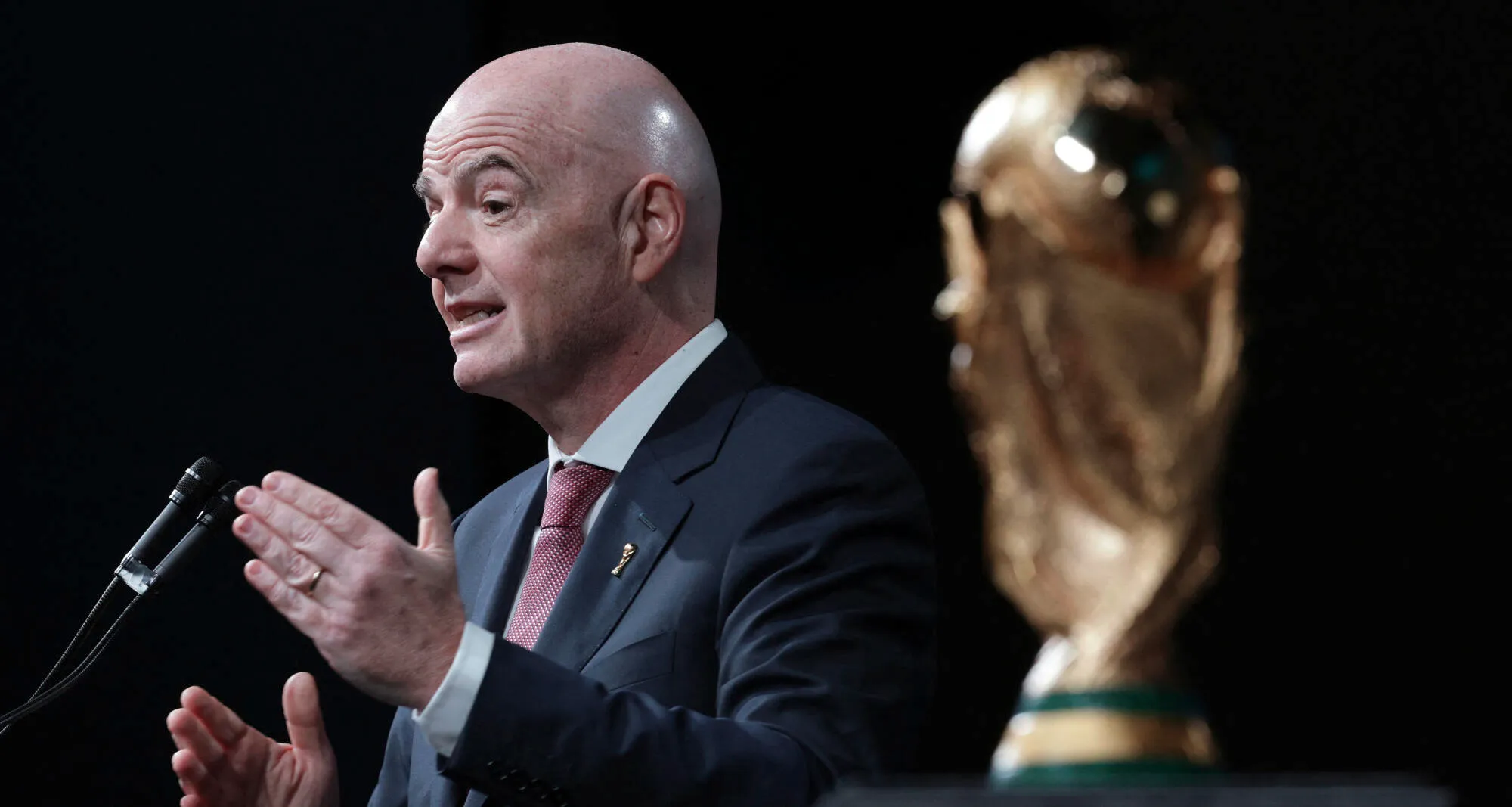
The architect of this development has a name: Gianni Infantino. Since his arrival at the head of the institution in 2016, the Italian-Swiss leader has pursued an obsession: increasing revenues. In two mandates, these increased from 6.4 billion to more than 11 billion dollars. An explosion based on a fairly simple method: expanding existing competitions or creating new ones, ever more profitable.
The 2026 World Cup is the culmination. For the first time, it will go from 32 to 48 teams, increasing the number of matches from 64 to 104. The result is a colossal windfall: more tickets sold, sponsors or television broadcast rights.
American show
To succeed in this shift, Gianni Infantino found an ideal ally: the United States. Host country of the World Cup alongside Canada and Mexico, the American giant shares its vision of football thought above all as an entertainment industry boosted by marketing.
“Gianni Infantino has been convinced for several years that the future of football no longer lies in Europe and that it must be opened to other markets, other rules,” explains a former Fifa employee. So, after the Russian World Cup in 2018, then the Qatari in 2022, the 2026 edition must fully bring football into the era of the American show.
Since the re-election of Donald Trump, Gianni Infantino has unreservedly displayed his closeness to the American president. Appearing on the guest list on the evening of his induction in January 2025, he multiplies the gestures of allegiance. FIFA recently moved part of its offices from Zurich, Switzerland, to Miami, near Mar-a-Lago, Donald Trump’s personal residence in Florida. “Unlike his predecessors, Infantino has continued to nurture his relationship with the United States,” underlines Simon Bolle, author of the investigation. FIFA Connection (Ed. Flammarion).
Active diplomacy
But this race for king money hides above all a logic of power. “Fifa is an association of 211 member federations, most of whose income is redistributed,” recalls Franco-Swiss lawyer Henry Peter, a specialist in sports bodies.
The principle is simple: each country has one vote to elect the president, regardless of its size. France has the same electoral weight as Curaçao, a small Caribbean island of 150,000 inhabitants, qualified for the first time in its history this year.
By increasing Fifa’s income, Gianni Infantino also increases the aid paid to the most modest federations, particularly in Africa and Asia, where he increases his travels.
“The poorest countries are very dependent on subsidies from Fifa,” says Claude Bekombo Jabea, Cameroonian doctor in international relations. An active diplomacy which earned him reign without sharing. His supporters see it as proof of his good management; his adversaries denounce a feudal system intended to make him unavoidable.
Gianni Infantino has already announced his intention to run for a third term in 2027. This American World Cup should allow him to sell, not an exception, but a model for the future. A tournament that would always be larger, more spectacular, and therefore more profitable. But also much further from the popular football once imagined by Jules Rimet.
What is Fifa’s revenue expected for 2026 and where does it come from?
Fifa expects around $11 billion in revenue in 2026, according to its own projections. This increase is explained in particular by the increase in the number of matches, TV rights and commercial revenues linked to the 2026 World Cup.


