
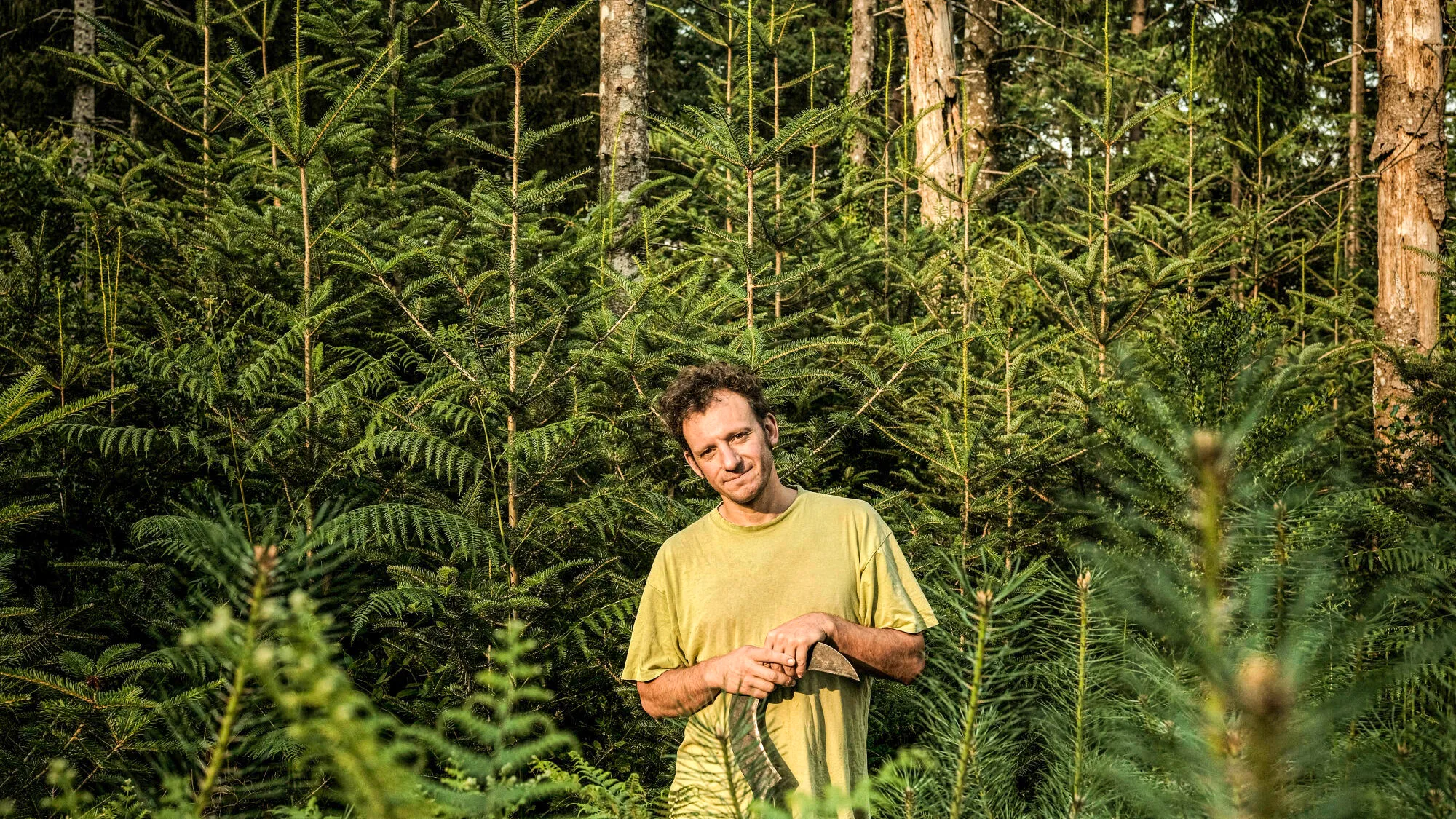
Mathias Bonneau: “I saw the forest capable of resisting”
This summer of 2026, from the beginning of July, thousands of hectares have been ravaged by flames… The forests of 52 departments are exposed to the risk of fire. How do you prepare for such a threatening summer?
For the moment, we have not yet had a fire in my area. Fire is the most violent death for a forest. The one I inherited from my family, called Passet, dies rather very slowly. There was storm Nils which affected us this winter, insect invasions… We wonder when it will stop. But I still prefer this slow agony to a fire. From now on, our main problem will be to manage dying forests.
The heatwaves keep coming. How do you experience them?
Honestly, better than the first one I suffered, in 2022, and which I describe in my book Lumberjack. Because since then, almost every summer has been scorching. Now I know that after each summer period, the forest no longer looks like it did before. But I saw that she was also able to resist.
After this episode in 2022, it was very sad to see areas of dead trees. Today, they are filled with small fir trees. Good news is rare but it exists and reassures me.
The forest evolves over a long time, with many unknowns. We ignore the needs of tomorrow. We just know that the climate will change, so we plant species that tolerate heat. But it is a choice made in a short perspective with regard to an ecosystem which continues to evolve. It’s not like an architectural project with a final delivery date where nothing changes afterward.
How can we consider practicing our profession in these conditions?
I would like to be able to project myself into the future without the threat of the forest disappearing. My job is already complicated in a stable climate. There, we add a lot of uncertainty. This makes me a little bitter. But we can’t just be afraid, we must learn to live with it.
The forest is constantly under attack. And for me, a lumberjack, that means putting in extra effort. Before, we removed dead trees at the end of winter when we had time. It has become our main project. At the time of cutting, the quantity of dead wood becomes as large as that of living trees: for every 500 m³ that grow, around 400 m³ of dead softwood are collected. It’s becoming the norm.
Is loving the forest and being a lumberjack a paradox?
I asked myself this question very early on. Indeed, it is paradoxical. But the question is insoluble. The more time passes, the better I live with it. In my forestry practice, cutting down a tree does not mean an end. It’s a detail, a moment in the life of the forest. Another will take advantage of it to grow and develop.
When I am faced with a magnificent tree and I know that nothing will replace it, it is impossible for me to cut it down. Our actions and decisions have an impact on our environment. The fact of having a telephone, for example, which I cannot do without, is not neutral. But I have no power to change the course of things. On the contrary, in the forest, my cutting choices directly influence the ecosystem. The day I realized this, I felt lucky.
“The forest doesn’t need us, we need it. »
Mathias Bonneau Lumberjack
The spruce forest where you work was planted by your grandparents. Do we cut differently a tree that we have seen growing?
Most loggers are only passing through the forests. They respond to an order, arrive, cut and leave. What gives me a lot of freedom in what I do is being able to work constantly in the same place. We don’t get involved in the same way on a plot where we know we’re going to come back as we do on a plot where we only intervene once.
With my team, we cut differently because we know the life of our trees. We know how they react and we can adapt. When I started this profession, in the early 2010s, I thought that trees were more fragile than they really are. Having seen them react to a cut allowed me to understand that it’s not so serious after all to cut them.
How did you become a lumberjack?
For the purposes of my book, I delved into my memories to find out how this story began. Until I was 25, I helped my parents a lot by taking care of the sheep on the family farm. But it was the moments in the woods that struck me the most.
The first trees I remember are those of a chestnut or spruce forest that I explored with my father. Wood matches my character. It’s a slow ecosystem, and I’m not a very fast person. I struggle with decision making. Unlike a flock of sheep, the forest has the merit of being independent. She doesn’t need us, we need her.
I’m not comfortable with numbers either. In carpentry for example, I am unable to remember the measurements. For me, who is also a draftsman, working in the forest reminds me more of sketching than rigorous drawing with a ruler and compass. There is a form of letting go that does me good.
Can you tell us about the specificity of your way of doing things?
I practice what we call mixed silviculture with continuous cover. In other words, I introduce a mixture of species without clear cutting. I look for heterogeneity in dimensions by ensuring that large and small trees coexist… This diversity is established over a long time. Even though it remains mainly a monoculture of spruce trees, this forest already no longer resembles the one where I started working, nor even the one five years ago.
My grandfather did the planting, my father the first cuts. The challenge was then to support the forest so that the trees grew. I arrived when she was starting to get sick, to suffer from insects, gusts of wind… She is suddenly changing. There are holes, falling trees, decimated edges… I accompany him in this change.
“I hope to pass on my knowledge, my tools, my way of planting. I never work alone. »
Mathias Bonneau Lumberjack
You say that you would not be a lumberjack without writing, nor a writer without wood. Does holding a chainsaw and a pencil call for the same presence in you?
One mobilizes my body, the other does not. It’s a radical difference. When I write, I rest physically. And in the woods, it’s my brain that is disconnected and my body that acts alone. I put my energy in both directions, but I don’t feel like I’m any different. It’s a big gap that I’ve been doing for a long time.
In writing, I work with emotions, I don’t know what will happen. In the forest, it’s a bit the same: the trees grow and I don’t know what that will look like. My position is to wait, to let the forest express itself by imposing a minimum of things. In both cases, I feel like I’m not in control. I let things happen naturally.
Your grandfather planted, your father cut, you restructured. What would you like to pass on to the person after you?
My objective is to switch the forest towards a mixture of species, with continuous cover. I hope to pass on my knowledge, my tools, my way of planting. I never work alone in the forest. For example, for logging (the transport of wood after felling, editor’s note), I work with Benjamin, a colleague, who can now replace me when necessary. Transmission thus makes it possible to reduce liability.
I would have loved to know what forest my grandparents had in mind. Was their project purely economic or did they just want to walk around and collect mushrooms? Did they imagine that my father, my cousin and I would also work in the woods?
Recently, I came across a letter written by my grandfather who was looking for laricio pine seeds. He never found any. Perhaps he planted spruces because they were the only tree available in the nursery. It is for all these reasons that I am happy to write, to leave a trace of what I am trying to do.
The biography of Mathias Bonneau
- May 18, 1988. Born in Castres (Tarn).
- 2006-2011. Training at the National School of Architecture of Clermont-Ferrand (Puy-de-Dôme).
- Winter 2011-2012. First season in the woods with his father, in the 80 ha family forest.
- 2014. Publication of Winter in the woods. Lumberjack’s notebook, story of his first season in the forest.
- 2017. BTS forest management.
- 2018. Creation of his company, Entrécorses, where he works as a lumberjack, forest manager and illustrator.
- 2025. Release of his first novel, Lumberjack (Ed. du Seuil). He recounts his first ten years of practice.


