Put together like a puzzle
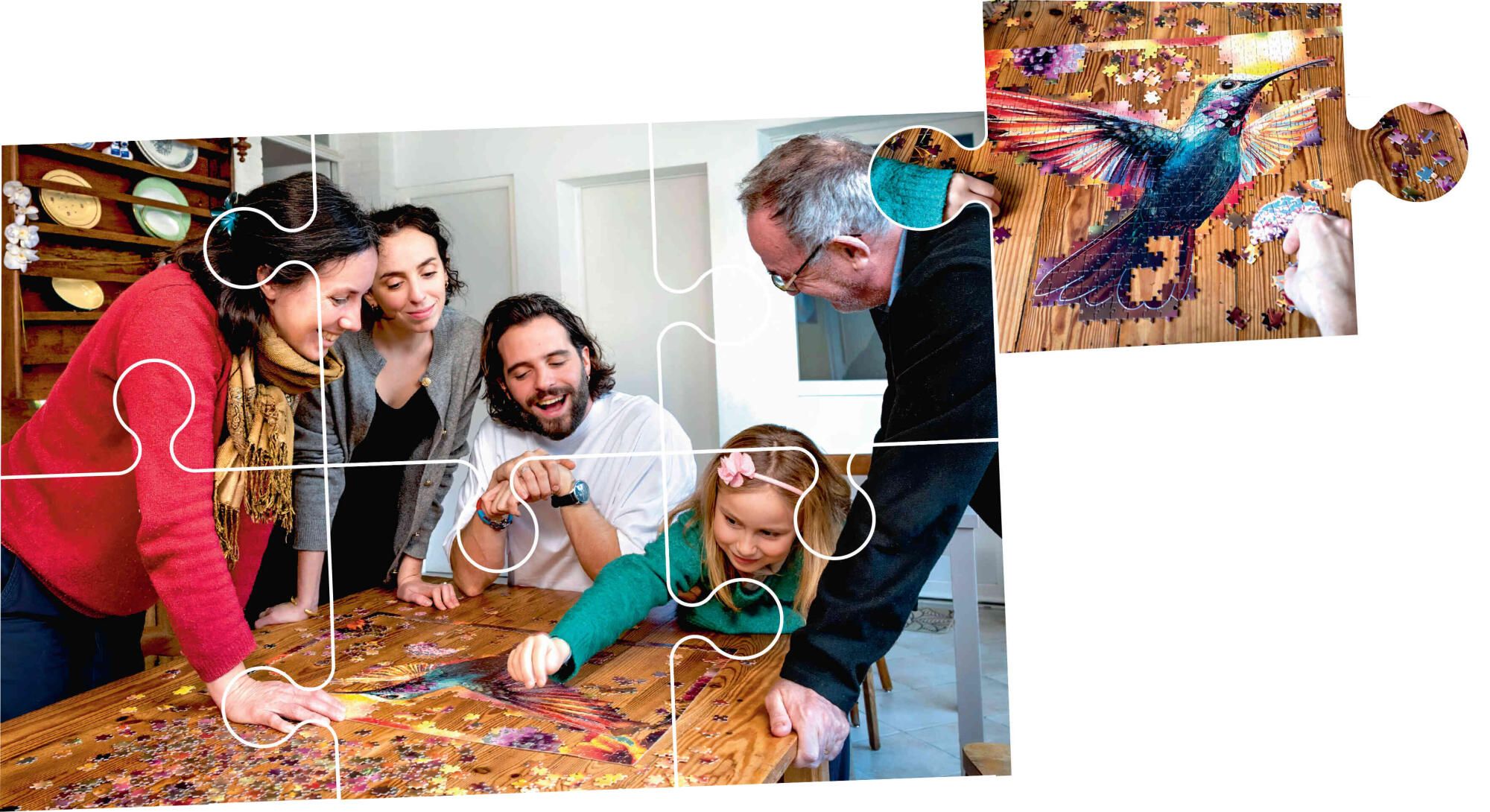
Around the dining room, Joséphine, 7 years old, is busy as soon as breakfast is finished. “I notice the colors and if a line corresponds to another piece,” explains the little girl. His brother Balthazar, 14, comes to contribute to the family puzzle. “I like building something from scattered little pieces,” comments the teenager. Among the Sebals, it was the mother, Dominique, 47, business manager in Vald’Yerre (Eure-et-Loir), who contracted the virus very early: “I did a lot when I was little, then I stopped when I was a student and while the children were young. »
Visiting their father and stepmother, Hannah, 29, and Léo, 32, also participate. “I have neither the patience nor the space to make it at home,” admits the big sister. But the most passionate of the family is definitely Joséphine. She likes geography puzzles, which she uses for school at home, as much as large formats which encourage relaxation with the family.
“You don’t stop playing when you get old, you get old when you stop playing. »
George Bernard Shaw (1856-1950)
Together, but each in their own corner. This is what pleases Martin Douxami, 48, who lives in Les Lilas (Seine-Saint-Denis), near Paris. Over the past year or so, the family has started large puzzles of 500 to 1,000 pieces. “At the moment, we are doing one which represents the solar system, each one takes care of a planet,” explains this mathematics teacher. As a family, we often expect each other. With the puzzle on the table, it’s easy to keep your hands busy for fifteen minutes. » “It’s also good as an antidote to screens,” notes his partner, Sophie Esposito, journalist, who discovered this hobby with her own mother. Passion now wins over Ariane, 10 years old. “When I’m bored, I advance the puzzle,” confides the CM2 schoolgirl.
At the Rollands, in Lyon (Rhône), the puzzle sits on a wooden board, in the middle of the living room. “It requires less concentration than a game. You can discuss, stop and start again at any time,” describes Antoine, 52, teacher-researcher in statistics. If I come home from work and don’t want to start preparing dinner, I sit on the couch while I place one or two items. »
Order in the face of chaos
The three families are emblematic of the strong comeback of this fun activity. And adults are not the last to indulge in it. Indeed, with Covid, sales of puzzles of more than 500 pieces have continued to grow. At JouéClub, for example, they represented half of the sales in 2025 of the brand’s 300 stores. “There is a movement to legitimize adult gaming which is accompanied by economic change,” indicates Samuel Coavoux, sociologist at the National School of Statistics and Economic Administration (Ensae), who notes that “the gaming industries, having conquered the child audience, are interested in that of adults”.
Anthropologist Thierry Wendling puts forward an explanation for the lasting success of the puzzle since the pandemic: “It appears like a pile of pieces that we put in order to compose an image. It is a psychological way of thinking about chaos and overcoming it. » “I have the impression of repairing what was broken,” confirms Dominique Sebal, who finds a soothing side to it. Marion Veziant-Rolland, director of social structures, enjoys “clearing her head”, while Antoine, her husband, is motivated by the “enigma solved” effect. As children, both of them already did puzzles and continue with pleasure. Around them, they noticed that several people who were not doing well were discovering the virtues of this game of patience.
Newfound availability
Sharing a puzzle reopens a space for exchange in the whirlwind of our lives. “These times allow us to talk about important things without seeming too much,” remarks Sophie Esposito. “No matter their age, everyone is busy with this manual activity and at the same time speech and mind can turn freely on serious or trivial subjects,” confirms Thierry Wendling. It’s a bit like family evenings where we met to crack nuts, before the arrival of television. » Samuel Coavoux adds: “Like board games, large puzzles are conducive to building intergenerational links. They are close to collaborative board games. If the practice can also be asynchronous, the fact of participating shows that we belong to the family. »
Baptiste Rolland, 15, evokes this link spontaneously. The third-year schoolboy, who happily looks for pieces when he has down time or is bored, confides: “I also do puzzles with my grandmother. » This one, Béatrice, 76 years old, likes this activity with the family, at Christmas or in the summer: “On my own, I hesitate to tackle a 1,000-piece puzzle, but in our country house, I can start one during the February holidays with some of my grandchildren and finish it at Easter with others,” she rejoices.
And when it’s finished? Everything is possible: some frame it, others prefer to undo the puzzle and keep it to do it again. Sometimes, it is even exchanged within… family.