
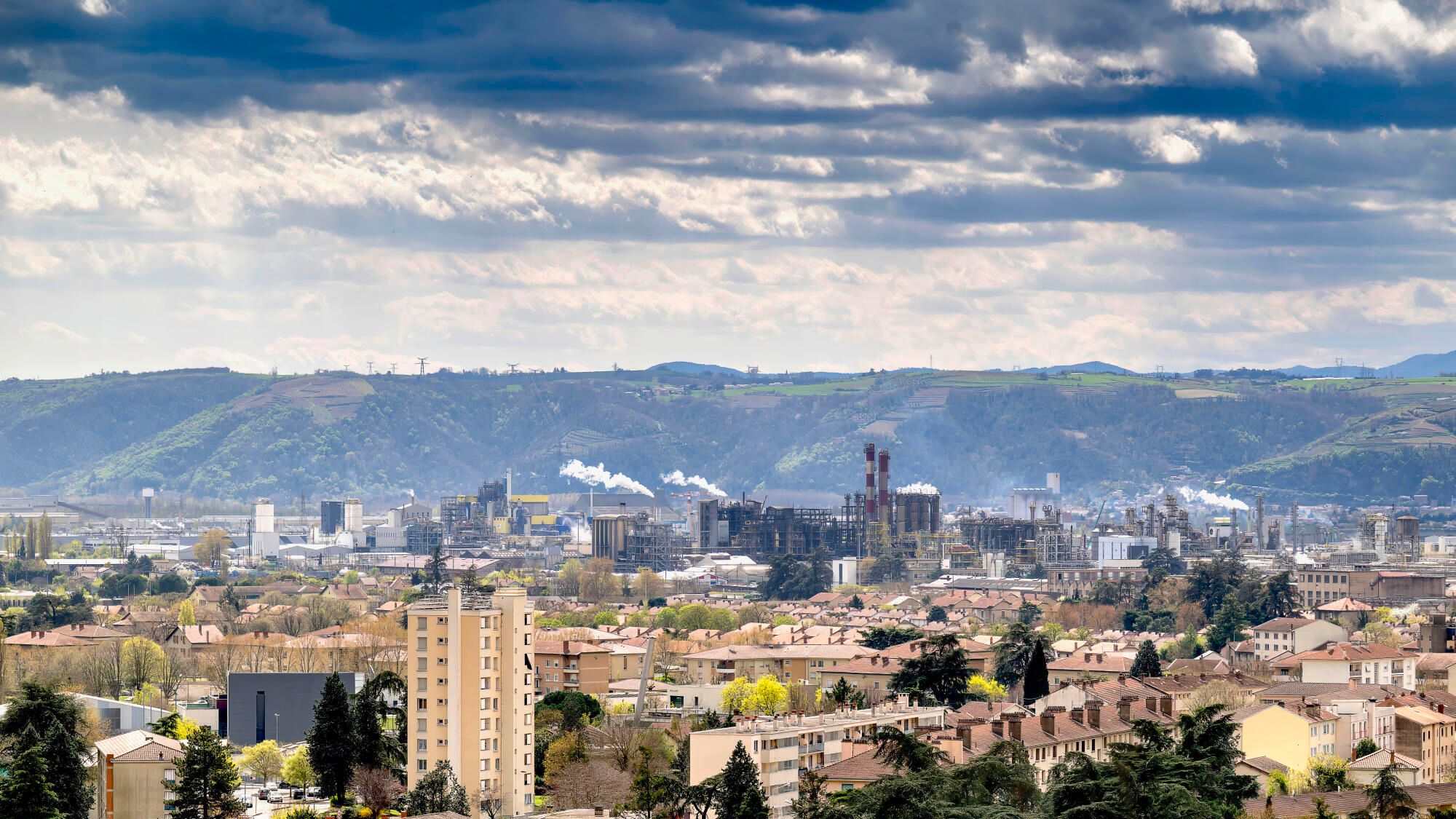
In Isère, a steep gas bill for French chemistry
“Beyond this limit, no smoking”: the sign at the entrance to the Les Roches-Roussillon chemical platform, in Roussillon (Isère), immediately reminds the visitor that they are entering a site where gas is omnipresent. He also receives a mask which he must put on immediately in the event of a leak detected.
Even today, gas is essential in the chemical sector, which consumes a lot of heat to manufacture its products. “Gas gives reliable temperatures, it is easy to use, and it has long remained more competitive than other energies,” explains Jonathan Blandin, energy manager at the site.
At least that was the case before February 28. On that day, the United States and Israel launched war against Iran. It responded by bombing the gas infrastructures of the Gulf countries. And by blocking the Strait of Hormuz, through which 20% of the world’s flow of liquefied natural gas passes.
In one month, prices have skyrocketed. Gas prices rose 70% between February 27 and March 26. For Jonathan Blandin, responsible for purchasing fuel for the platform’s companies, it’s a disaster. He will have to increase their bill next month when a significant percentage of the price of their products, sometimes 60%, depends on the cost of energy.
The margins are melting. Arbitrations become daily. To reduce costs, site managers are considering turning down the heating in the offices and coming there with “an extra sweater”. A paltry measure in the face of soaring prices.
“If the price of gas does not fall, some of our customers will stop their activity,” warns Jonathan Blandin. Seen from the window of the room where he receives, the factory chimneys are still smoking along the Rhône. But for how long?
An unpredictable future
On site, companies are hesitating: buy gas contracts for the following year now or wait for a hypothetical drop in prices? At the risk of them exploding again… To form an opinion, Jonathan Blandin does not take his eyes off the news, watching for the slightest statement from Donald Trump. “That’s why he looks tired,” teases Luc Rousselet, administrator of the place.
He too confesses his powerlessness to foresee the future: “We are not in the head of the American president. He himself probably doesn’t know what he wants. » The Roches-Roussillon site has nevertheless undertaken a lot to anticipate the difficulties. Since 1999, it has been managed by an economic interest group (EIG), called Osiris, the largest in French chemistry.
It pools the expenses of fifteen local companies to improve their competitiveness. “We are the co-ownership trustee,” summarizes Jonathan Blandin. Objective: reduce dependence on gas. The place has been connected to a waste incinerator since 1985. This produces part of the necessary heat.
Another boiler, called biomass, came out of the ground in 2015. And a third waste incinerator was inaugurated in 2020. These installations cover 80% of heat needs. Gas only accounts for 20%. In theory only. Because this third incinerator, which supplies half of the needs, is subject to compulsory maintenance. At the worst time.
It was necessary to put greater strain on the gas boilers. The recourse becomes dependence. It is difficult, as we see, to do without gas entirely. Especially since this energy is sometimes also used by factories as a raw material. From gas, we produce plastic, nitrogen fertilizers and even solvents.
A sector already in bad shape
French chemistry did not need this new gas price crisis, four years after that of the war in Ukraine. Because she has been doing poorly for several years. Like its European counterparts, it struggles to compete with China and the United States.
In these two countries, gas is three to five times cheaper than in Europe, recalled a study by the Center for The Study of Democracy, a European institute. Because the United States produces its own gas, without worrying about the environment, via shale gas extraction. And because the Chinese state massively subsidizes its industry.
Unsurprisingly, social plans are multiplying in Europe. In France, 47 factories in the sector are threatened, according to France Chimie, a professional organization in the sector. The Roches-Roussillon site is also weakened, a sub-activity is taking place.
Since the war in Ukraine, its manufacturers have only produced at 70% of their capacity on average, compared to 100% previously. Jobs and know-how that are more essential than they appear are thus threatened. Chemistry is not just about refining oil or creating eternal pollutants. It allows, for example, to produce paracetamol.
Les Roches-Roussillon is home to the Seqens group unit responsible, by 2027, for relocating production to France to compensate for recently experienced shortages. There is also a Michelin unit which produces a molecule used in the floors of planes and trains. Or Ecoat, which manufactures binders used in paints.
Meeting in Antwerp (Belgium) in January, European chemical manufacturers called on Europe to “save” their livelihood. In particular, they demand that Chinese and American rivals pay the same carbon emissions quotas as them when they sell their products in Europe, a sort of “carbon tax” at the borders which does not exist today.
The European Union thus requires its manufacturers to pay for their pollution. But it does not demand it from its competitors. An ubiquitous asymmetry, which is slowly consuming its chemical industry.
It is explained by Europe’s difficulty in finding a compromise between its member states, and by its fear of starting a trade war. “The solution can only be political,” believes Luc Rousselet. I don’t see any others. »
How many people affected?
229,000
This is the number of employees in the chemicals sector in France. They are employed by 4,362 companies.
Source: Observatory of chemical industries, 2025.
Where does gas come from in France?
France hardly produces any natural gas on its territory since the depletion, in 2013, of its main deposit, that of Lacq (Pyrénées-Atlantiques). It must therefore obtain its supplies from other countries. In 2024, according to the latest available data:
- 40.16% from Norway
- 20.81% from the United States
- 17.9% from Russia
- 10.61% from Algeria
- 2.91% from the Netherlands
- 2.29% from Nigeria
- 1.04% from Qatar
- 4.28% other countries
Source: Key energy figures 2025, Ministry of Ecological Transition.
This situation creates problematic links of dependence, particularly with Russia. By continuing to buy its gas, France fuels the Russian war economy. Europe plans to completely ban imports of Russian gas by the end of 2027. Not before, so as not to penalize member states which are too dependent on it. The share of Russian gas has still fallen in France (24% in 2021).


