these catechumens who shake up the Church
“The light returned quite unexpectedly. » Parish priest of the Saint-Germain-l’Auxerrois church, Father Jean-Luc Mairot is sitting in his office in Fontenay-sous-Bois (Val-de-Marne). “When the abuse scandals came to light, we said to ourselves that everything was screwed,” he continues. But now from 2021, the year of the publication of the report of the Independent Commission on Sexual Abuse in the Church (Ciase), the number of young adults requesting baptism is suddenly increasing in France.
From 3,600 in 2021, they increase to more than 21,000 in 2026 – 13,000 adults and 8,000 adolescents. Not counting the confirmants, more and more often young adults baptized as children and not having practiced afterwards: there were more than 11,000 in 2025, compared to 4,000 in 2022. Is the crossing of the desert coming to an end? “I understand this renewal as a response from God. As if he were telling us: Now that the house is safer, I am sending you people,” interprets Geoffroy de Marsac, parish priest of Talence, near Bordeaux (Gironde).
The collapse in child baptisms, which have halved since 2000, or the increased quest for meaning among young people, cannot alone explain the phenomenon. The latter is all the more spectacular as the churches have been emptying for decades. Its scale, its suddenness and the mystical experiences to which the converts testify upset those who welcomed them.
“Believing, in principle, that God acts, and observing Him with your eyes, is very different,” confides Marie-Pierre Talabot, 60, accompanist of catechumens at the Saint-Étienne-du-Mont parish, in Paris. Faced with the diversity of social and religious origins of the latter, a biblical expression returns to the mouths of the faithful: “The wind blows where it wants” (Jn 3:8). The prayers of those who, now grandmothers, were saddened by the reduction in Sunday attendance seem to have been answered.
The feeling is unanimous, it is a great joy. And after? “We must go beyond and ask deeper questions,” believes Isabelle de La Garanderie, member of the office of the provincial council of Île-de-France. Initiated since January 2026, this vast consultation of all the Ile-de-France dioceses aims to “determine how to better welcome catechumens and neophytes (faithful who have just been baptized, editor’s note), but also how to support them over time. The third issue is the way in which we ourselves are transformed,” adds Isabelle de La Garanderie.
An uninhibited faith
The various conciliar assemblies have until the summer of 2027 to report the results of their work – eagerly awaited by the other dioceses of France. Because the new arrivals do not leave the Church unscathed. Their thirst for spirituality, truth and fraternity highlights the shortcomings of an aging institution, and in turn sparks a true conversion of the Catholics who welcome them.
“We had gotten into the habit of lamenting our difficulties, while around us there is incredible expectation,” notes Mgr Alexandre de Bucy, bishop of Agen (Lot-et-Garonne). While many Catholics considered themselves apart from modern society, some suddenly realize that they are the holders of a treasure that it is their responsibility to pass on. The way in which catechumens display their faith in an uninhibited manner also changes mentalities. “For them, it is not reserved for the private domain,” observes Mgr de Bucy.
The life of parishes evolves from the management of current affairs to the priority placed on welcoming new people and evangelization. “We became aware that, perhaps, people around us are having the same experiences as our catechumens,” notes Father Jean-Luc Mairot. In Christian communities that are often quite uniform, newcomers bring a breath of fresh air. “Just by their way of being and dressing, they shake up the somewhat bourgeois atmosphere of our parishes,” appreciates Father Basile Dumont, vicar of Talence in charge of catechumens.
In 2026, 34% of those preparing for baptism come from the social category of workers, technicians and employees. “The new arrivals make me think about our opening. We are small circles of Catholic friends who have known each other since childhood,” confides Pia, a practitioner in Paris. Breaking down the community, present particularly in city center parishes, is a condition for integration. “Worldliness is one of the spiritual illnesses that shocks them,” confirms Guillaume-François Saling, guide to catechumens in Talence. Author of For you who ask for baptism (Ed. de l’Emmanuel) , he himself received the sacrament at the age of 21.
Through these new arrivals, God calls us to leave the Catholic community.
Father Basil
Another challenge for parishes: finding enough trained guides. “Yesterday, I spent two hours preparing the person who will speak with me,” says Jeannette Thévard, a guide in the parish of Châteauneuf-sur-Loire, a small town in Loiret.
Explaining the fundamentals of the faith to catechumens, often without any religious culture, requires solid catechetical background. And an adapted vocabulary. “Am I able to speak about the Creed or the Lord’s Prayer in an understandable way? But without oversimplifying, knowing that I am addressing adults? », asks Sophie, 28 years old, accompanist in the parish of La Trinité, in Paris.
The expectations of newcomers, seeking rules of conduct, also shake up priests and counselors who are used to emphasizing the importance of freedom of conscience and “rounding out the corners” on difficult subjects. Good and evil, paradise, hell: “Catechumens are not put off by the convictions of the Church. On the contrary, they accept our certainties,” observe Mathilde and her husband Raphaël, members of the Notre-Dame de Nantes parish (Loire-Atlantique), which brings together many students and young professionals.
They also encourage the Catholics who frequent them not to be satisfied with “theoretical, disembodied formulas, which the new ones do not understand,” remarks Guillaume-François Saling. For example: “You must discern the will of God”, while the young person asks for help in a specific situation, and does not understand what this expression covers. »
To put down concrete words, companions or loved ones are encouraged to deepen their spiritual experience. In the diocese of Nanterre (Hauts-de-Seine), the annual meeting of catechumens on prayer was extended in October 2023 to all the faithful, during a day called “Let’s go to the Source”. The objective was to facilitate exchanges between former and future baptized people, by allowing everyone to experience personal prayer.
We have created teams for reception and fraternity.
Jeannette Thévard, accompanist
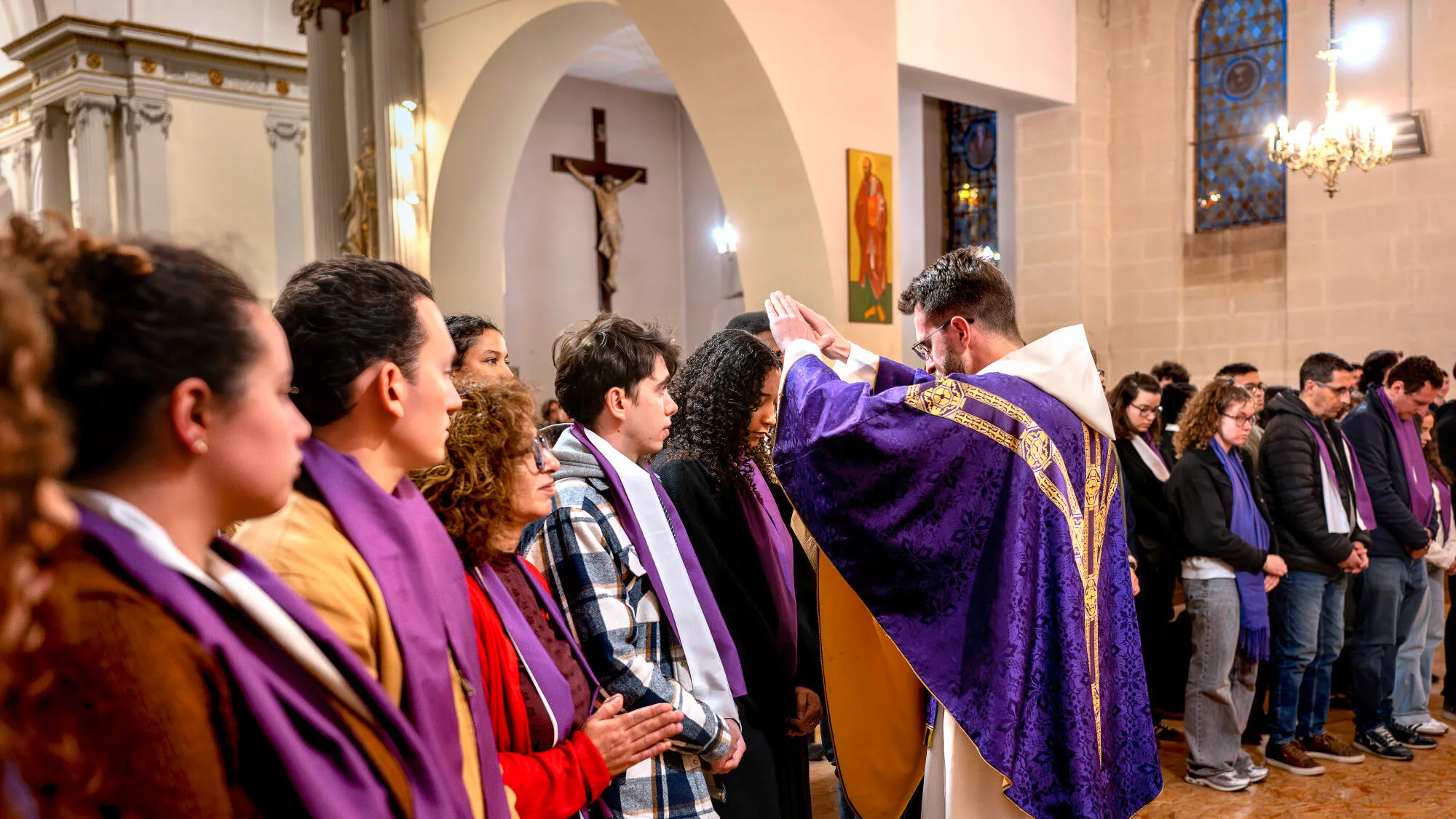
At the Saint-Germain-l’Auxerrois parish in Fontenay-sous-Bois, the catechumens were invited to recount their conversion during Sunday mass, on the occasion of the votes which, during Lent, mark their journey towards Easter. “Many faithful, who are not used to talking about their faith, were touched by the very personal way in which the catechumens speak,” says Vincent Destival, facilitator for the provincial council of Île-de-France.
These testimonies where the future baptized “speak of an encounter, of a call” put at the center the quest for a personal relationship with God and come to reactivate, in certain parishioners, past experiences. “I believe in a rational way,” confides Marie-Pierre Talabot, “but listening to the catechumens talk about their way of feeling God’s love allowed me to remember what I myself had experienced during a retreat, around ten years ago. »
Will this ongoing transformation of Christian communities be enough to permanently anchor catechumens in the life of parishes? From one to the other, their level of practice after baptism can change completely. In Châteauneuf-sur-Loire, no one returns regularly to mass. At Notre-Dame de Nantes, the vast majority remains faithful. “I held on because a year before my baptism, I started helping with reception and I made friends,” says Anaë, baptized at Easter 2025.
“The new ones need to be trained, useful and recognized,” summarizes Arnaud Bouthéon, president of the French Observatory of Catholicism. To meet their expectations, parish communities are regaining a fraternal and friendly dimension which may have faded. In Châteauneuf-sur-Loire, Jeannette Thévard participated in the creation of groups to welcome and support volunteers. “We should have done this work on fraternity before,” she believes.
In Dangé-Saint-Romain (Vienna), Agnès and Clément Chassang try, with the priest, to organize aperitifs with the catechumens at their home. “We didn’t feel warmly welcomed, so we thought that for them it must be worse,” explains this young couple who have just moved in.
Complicated routes
Newcomers also require a strong relational commitment. “I had to practice communication, patience, paying attention to his experiences and his wounds. Transmitting the faith is not so simple!, relates Franck, 24 years old, Djulianne’s confirmation godfather, at the Immaculée-Conception parish in Boulogne-Billancourt (Hauts-de-Seine). I feel responsible for her. »
Support requires caution, because some have had life journeys marked by loneliness, family imbalances or addictions. “Priests understand that they must not overpromise emotionally and not recreate structures of abuse,” underlines Arnaud Bouthéon.
Soon, these converts will form a significant part of the believers, bringing their fresh perspective and their expectations to all parishes. “Priests tell me that in the space of five years, 50% of their parish population can be renewed,” reports Arnaud Bouthéon. Because the wave of catechumens is not ephemeral.
According to the study “Identity, practices and perception of Catholicism in France”, published in March 2025 (French Observatory of Catholicism/Ifop), 8% of unbaptized people in France have already considered requesting baptism for themselves or their children. For Geoffroy de Marsac, in Talence, the challenge now is “to be available, to let oneself be surprised and shaken up, because the work of God is not going to stop”.
I had to pay attention to his experiences, his wounds. Transmitting faith is not that simple!
Franck, confirmation sponsor
How many baptized people in France?
76% of French people are baptized, including 42% of 18-24 year olds.
Source: Ifop 2025/OFC.
How many newly baptized people go to mass at least once a month?
80% of newly baptized people go to mass at least once a month.
Source: CEF 2026.