
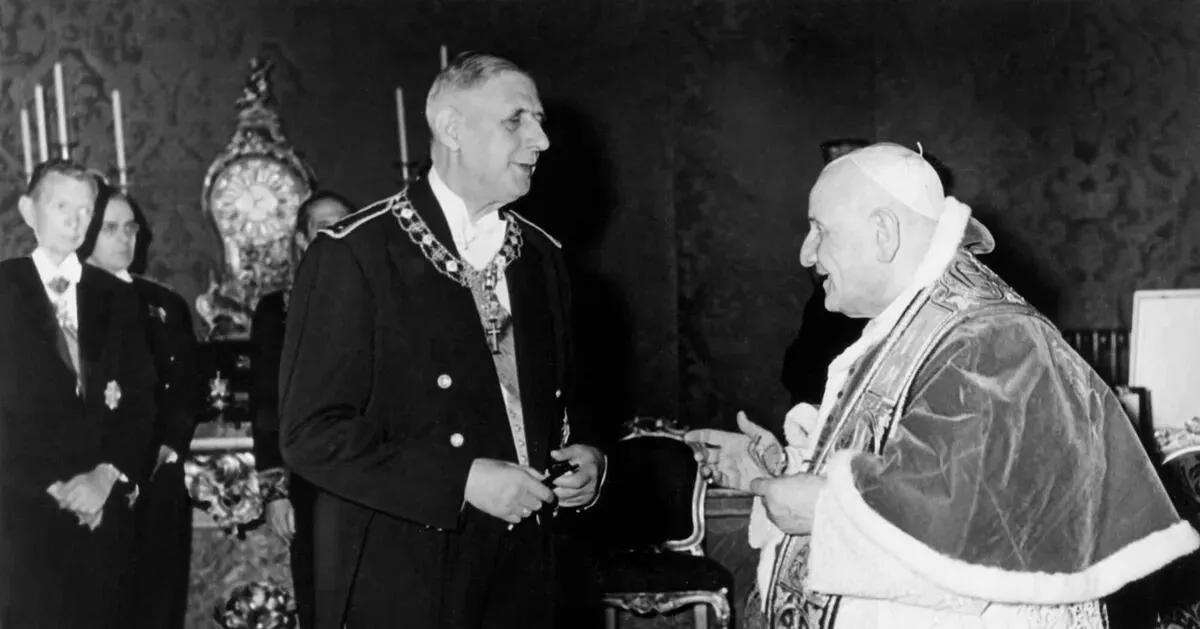
70 years of relations between popes and presidents
Pope Leo XIV will receive Emmanuel Macron for the first time on April 10 at the Vatican. But after several exchanges with Francis, the current tenant of the Élysée is already a regular at papal visits. These were established at the end of the 1950s by General de Gaulle. But not all of the General’s successors displayed the same ease with the Holy See. While François Mitterrand has shown himself to be a supporter of very firm secularism, François Hollande has had to deal with Vatican diplomacy in full adoption of “marriage for all”. Georges Pompidou had simply refused the invitation!
From De Gaulle (1959-1969) to Pompidou (1969-1974): a friendship that breaks down
It was under General de Gaulle’s Fifth Republic that the highly codified rite of the presidential visit to Rome began, in 1959. John XXIII then received the French head of state at the Vatican, accompanied by his wife and the Minister of Foreign Affairs. Cleverly, General de Gaulle maintained these first diplomatic ties by offering the Pope a 16th century Bible on parchment. But the friendship between the Church and the Fifth Republic was quickly nipped in the bud. Elected in 1969, Georges Pompidou was more distant from the Christian religion. It would not be a question of giving the feeling of a return to conservatism, after the movement of May 1968, which had just shaken up society.
Furthermore, De Gaulle and Pompidou have two very different visions of power. The General was a man of symbols, for whom every gesture had to have historical significance. A graduate from Normal University, his successor was more pragmatic and saw no political use in his visit. Will the future prove him wrong? Of all French presidents, Pompidou remains the only one not to have visited the Holy See.
Giscard d’Estaing (1974-1981): a visit then a crime
New strong man of the right at the head of state, Valéry Giscard d’Estaing reconnects with the Vatican upon his election. In December 1975, he met Paul VI during a mysterious one-hour private audience. At the time, the secret conversations of the Holy See did not leak out like they do today! The director of the press room, however, told journalists that the two men spoke about “family stability” and “respect for life”.
Did Pope Paul VI sharply criticize Giscard d’Estaing for the adoption of the Veil law, governing the decriminalization of abortion in France? No one knows. But the president criticizes Gérard Amanrich, his ambassador in Rome, for not having warned him of the subjects that the pontiff intended to discuss. The ambassador was then recalled to Paris and temporarily left without assignment. Before sadly making the headlines: in February 1977, Gérard Amanrich shot his wife, son and daughter to death in their Parisian apartment. Before the police, he claimed to have never recovered from his dismissal after the papal audience.
From Mitterrand (1981-1995) to Chirac (1995-2007): an unexpected connection
According to those who knew him intimately, François Mitterrand had a passion for spiritual discussions. Is this what explains the astonishing alchemy which united him for a moment with John Paul II, in 1982? The president then chose to speak privately with the Polish pope at the Vatican. Whoever forms a government with socialists and communists does not want the visit to be interpreted as a demonstration of Christian faith. But, of all the heads of state of the Fifth Republic, it is he who benefits from the longest audience ever granted: one hour and fifteen minutes. The interview is rich and deep, even if disagreements persist on the future of the Catholic school. The government then considered integrating private schools into a “major public service” – a project ultimately abandoned.
In 1996, Jacques Chirac sought to display greater openness towards religious authorities. He does not request a private audience, but returns to the official visit established by De Gaulle. Accompanied by his wife, Bernadette, he intends to “testify to France’s fidelity to its Christian heritage” and offers John Paul II a sumptuous wooden Virgin from the 16th century.
From Sarkozy (2007-2012) to Hollande (2012-2017): two opposing visions of secularism
Between Nicolas Sarkozy, elected for the Union for a Popular Movement party (UMP, today Les Républicains) and his rival successor, François Hollande, elected for the Socialist Party, two visions of secularism clash. During his first visit to Benedict XVI in 2007, Nicolas Sarkozy defended “positive secularism” by recognizing the place of religions in public life and emphasizing “the Christian roots of France”. His remarks do not fail to arouse criticism from defenders of stricter French-style secularism.
François Hollande is rather part of the latter camp and is not keen to increase direct exchanges with the Holy See when he comes to power. During the head of state’s visit to Pope Francis in 2014, the understanding was not very cordial and there were many points of friction. The Vatican then criticizes the government, after the adoption of the law of marriage for all, of having stigmatized some Catholics during the debates. But these strained relationships soften when tragedy strikes. In 2016, a terrorist attack just cost the life of Father Jacques Hamel, in the small French town of Saint-Étienne-du-Rouvray (Seine-Maritime). Hollande speaks privately with the Pope and thanks him for his comforting words.
The Macron era (2017-2027): a relationship in good shape
Will Emmanuel Macron get along as well with Pope Leo XIV, elected in May 2025, as with his predecessor, Francis? No president of the Fifth Republic has met so often with a sovereign pontiff, as we recount in this article. That is to say six interviews from 2018, including three audiences at the Vatican, regularly concluded with warm hugs. Attended a Jesuit college, Macron undoubtedly found in François a particularly receptive interlocutor. The pope, himself from the Jesuit congregation, was sensitive to the open-mindedness of the head of state regarding the place of religions in society.
Despite deep fundamental disagreements on the end of life and immigration, the two men always exchanged with great familiarity on COP 26 in Glasgow, on the Russian offensive in Ukraine or on the importance of interreligious dialogue. Which did not prevent Pope Francis from declining certain highly symbolic invitations, such as that of the reopening of Notre-Dame de Paris. Will his successor Leo XIV demonstrate the same pontifical firmness?


