
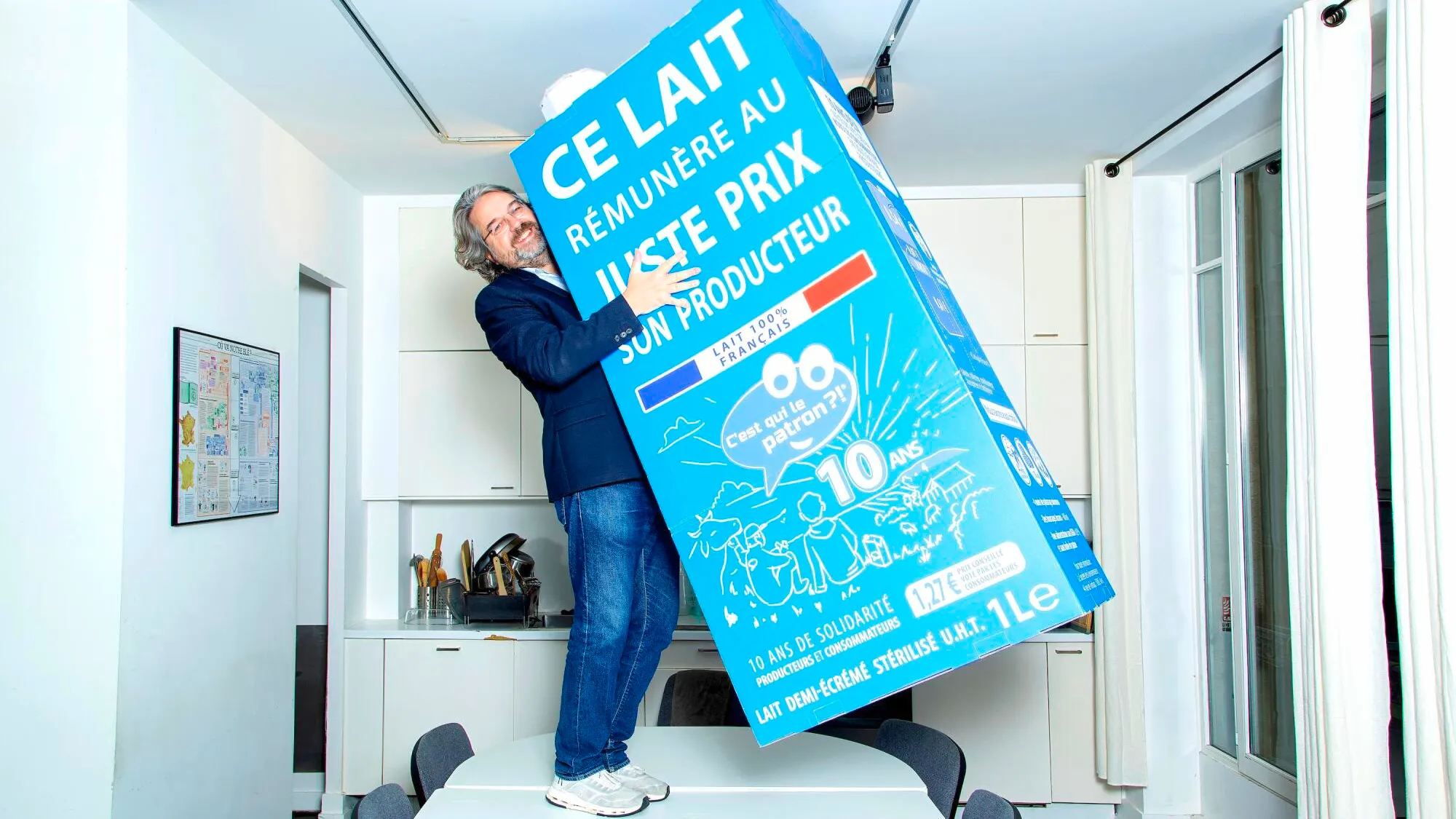
“Giving power back to consumers saves producers” Nicolas Chabanne (Who’s the boss?!)
In 2015, during a report on the milk price crisis, I was taken to the barn of an over-indebted Breton breeder. They told me: “This is where she hanged herself.” » Is it to avoid this type of drama that you launched, a year later, the first carton of milk under the brand “Who’s the boss?!” » ?
Nicolas Chabanne: It’s unreal that those who work to feed us, most often seven days a week, do not earn a living. Your story is the starting point for Who’s the Boss? ! We were tired of hearing the food industry say that consumers want ever lower prices. No. Not if it kills suppliers. Consumers must decide. Thousands of them have joined the cooperative Who’s the boss? ! when they understood that the money was going to go back to the producer and that it was their adventure. They established the specifications. For milk, the buyer pays eight cents more per carton than the usual brands. That’s four euros more per year on average. But for an average farmer who produces 500,000 liters of milk per year, each additional cent brings him 5,000 euros. This changes everything.
Who’s the boss?! has become a very media brand. For what ?
Because the media understood that we were not a company whose sole purpose was to pay dividends to shareholders. In ten years, we have become the best-selling new brand in France. In 2024, we sold the cooperative to a shareholder foundation, to prevent its sale to people who would no longer protect producers. And to avoid making it a family heritage. My three children agreed instantly to renounce this inheritance. One day, Intermarché asked for our accounts, to make sure it was as beautiful as it looked. We provided them with everything because we are transparent. And they agreed to be partners.
Your hyperactive communication may have irritated the rest of the sector…
I was surprised to see that fair trade professionals were not always very fans of our approach, but that worked out. Some mass distribution managers remain angry with us. One day, one of them admitted to me that he didn’t like my personality. But that he recognized that I had a communication capacity superior to his own, he who was only a “little Strasbourg resident”… I understood that the problem was me. This communication that I find so useful, they see something suspicious in it. Putting themselves forward using emotion, they think, goes against the humility and sobriety that they expect from solidarity initiatives. However, I do not earn more at the end of the year if the cooperative makes more sales. It just means more producers supported. At first, I didn’t want to speak in the first person on television but the journalists explained to me that we had to embody our story.
“I had school friends who were sons of farmers. I saw them working on the farm on weekends, I was impressed. »
So the media created your character?
I am ready to do anything if it will help the cause. From the start, I took on a lot of debt to launch the brand. I found out two days ago that we finally paid everything back. We operated without a financial director for the first three years, to tell you the urgency in which we worked.
Where does your heartfelt impulse for farmers come from?
I’m always so moved when I’m interviewed with a producer. A journalist asked me if I was Protestant, because I set up collective initiatives, without personal enrichment. No, I am not Protestant. I lived – and I still live – at the foot of Mont Ventoux (Vaucluse). I had school friends who were sons of farmers; I saw them working with their parents all weekend on the farm. I found it impressive. As a child, I tasted these farmers’ ciflorette strawberries, absolute gems. But they couldn’t sell them and that affected me.
A journalist from Times (British daily, editor’s note), who followed me for an article, didn’t believe me when I explained to him that I wasn’t getting rich. During his report, I visited with him a dairy farmer, Régis. Lactalis released it because it said it could not get by with their purchase prices. Régis then sold his milk to Who’s the boss? ! Regis’ wife arrives, whom I don’t know. Without a word, she hugged me for thirty seconds. Said to me “Thank you. » I look at the journalist and I see that he understands. This is not a marketing strategy. This is real life. That’s the story of our cooperative adventure. Who’s the boss? !
Because of the scorching summer, 30,000 farms out of the country’s 350,000 could disappear this year, according to the FNSEA. Have calls for help exploded?
We have never received so many. This means that the situation is terrible, because producers tend to keep quiet about their difficulties. They draw their greatness from their ability to withstand the harshness of the profession. I wouldn’t like us to wake up one day and ask ourselves: but where are the French producers who feed us? Their disappearance will not benefit anyone. In this dangerous world, we cannot depend on a foreign power for our food.
Who is the enemy? The agri-food industry or lawless globalization?
I’ve been looking for him for ten years. I met the lobbies, all those who have the fate of producers in their hands. I concluded that the enemy is Keyser Söze, from the film Usual Suspects. He’s the mysterious villain who scares everyone but doesn’t exist. No representative of the agri-food industry has the life plan of putting producers to the ground. On the other hand, when it is necessary to make profits, the industry will mechanically push producers to the breaking point.
However, we prove that we can do otherwise. Experts predicted it wouldn’t work; that consumers do not buy at the right price: this is not true. The problem was the lack of products on the shelves ensuring that the money returned to the producers. When we give power back to consumers, it changes everything for farmers. Our success is a glimmer of hope in this endless mess. And there is still a huge margin. Our yogurts are only sold in 11% of stores in France. I also find it crazy that there aren’t five or ten brands like ours! I sometimes see very beautiful adventures, like the Cant’Avey’Lot dairy cooperative (located in Bagnac-sur-Célé, in the Lot, editor’s note). Let’s make them known.
Which farmers touched you the most?
There are so many… Like this retired breeder who burst into tears when he saw the right price printed on his son’s milk bill. He had dreamed of it. He finally felt that his profession was respected. That it made sense. Who’s the boss? ! saved hundreds of lives and allowed young people to settle down. A farmer’s son dreamed of taking over the farm but he gave up and became a nurse. Thanks to our purchase prices, he was able to return to the profession. And he is the happiest in the world. Other farmers managed to take their first vacation, spend time with their children, etc.
Is it only up to the consumer to save our farmers?
It’s not up to him to take care of everything. But the worst would be to wait for politicians to do it, when they have been inactive on the subject for forty years. The Ministry of Agriculture has 36,000 employees; Who’s the boss? ! has 36. We have never received a call from the minister in ten years, even if only to encourage us. Who’s the boss? ! does not cost the State a single euro in subsidies. It is based on the united energy of the 15.3 million citizens who have purchased one of our products. Our purchases transform the world around us. When we realize it, it is no longer an effort, we just feel the happiness of being useful. We will no longer need to make a single appointment with a minister if we continue on this path.
ITS ORGANIC
1969
Birth on July 11, in Moulins (Allier).
1989
Studies modern literature at the Sorbonne.
1996
Launches a network of solidarity washing stations in Auchan car parks.
2009
Responsible for communications for the Carpentras Strawberry Brotherhood.
2012
Creates the Les Gules Brossés collective, to sell “ugly” fruits and vegetables.
2016
Lance Who’s the boss? ! with Laurent Pasquier.
2026
Who’s the boss? ! is approaching one billion solidarity products sold and displays 145 million euros in turnover over the last twelve months.


