
Sexual abuse in the Church: restoring the trust of victims
“Speech is not yet truly free,” says Laurent Martinez, author of Pardon ?an autobiographical play recounting the difficulties of the love life of a man abused as a child by a priest. After a hundred performances, this professional actor confides: “There are bishops who willingly accept that this play be performed in their diocese, but others do not give us the same welcome. » Five years after the report of the Independent Commission of Inquiry into Sexual Abuse of Minors in the Church (Ciase), have the victims really found the promised listening?
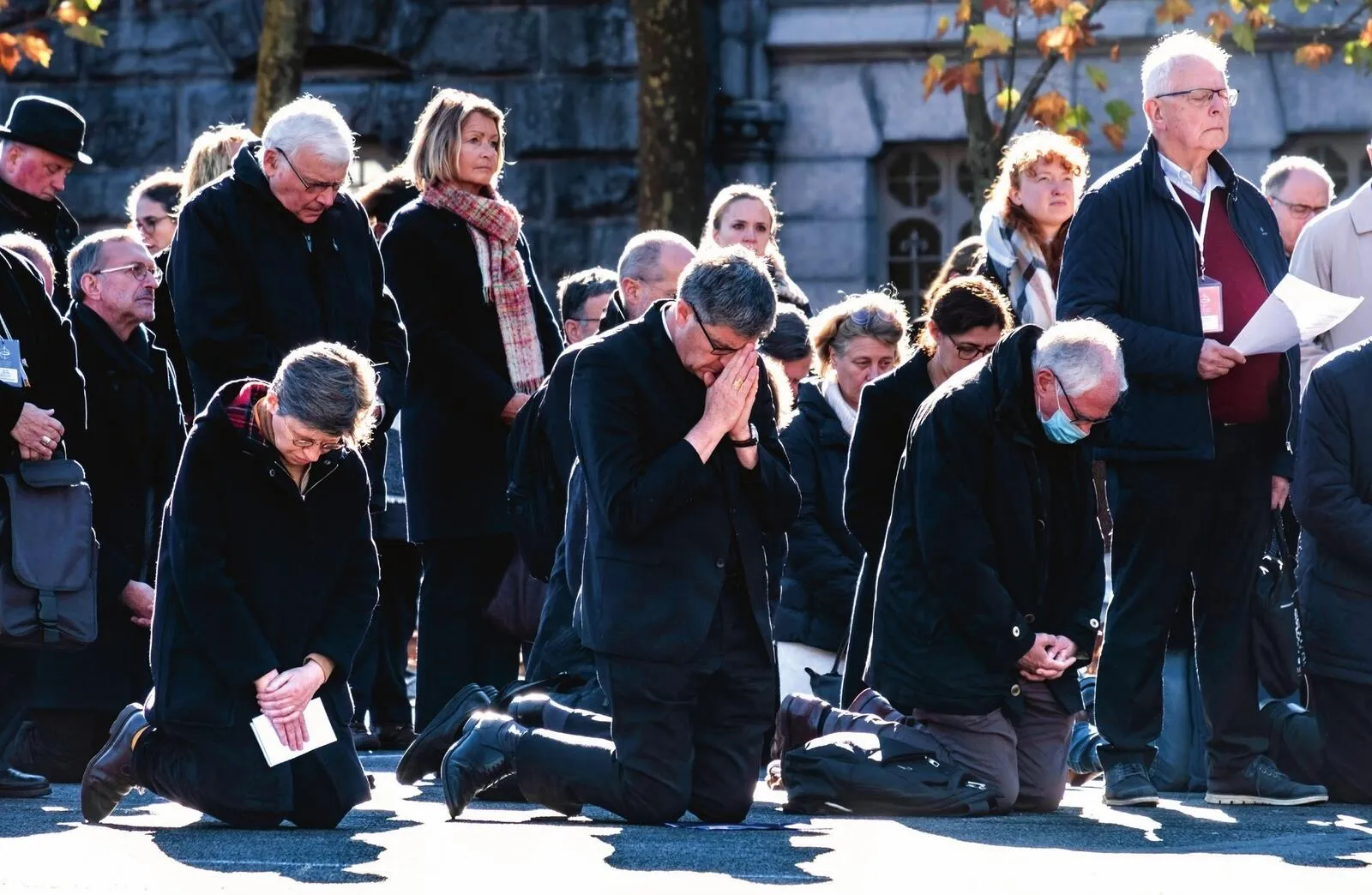
Backtracking. On November 6, 2021, during the fall plenary assembly, Mgr Éric de Moulins-Beaufort, then president of the Conference of Bishops of France (CEF), declared, on his knees, in front of a large red cross: “O God, whom we dare to call “our father”, forgive us. » Behind him, around 120 bishops were praying, often with bowed heads. “Lift up those who are suffering, we beg you on our knees. Grant us to listen to them and do what they ask us,” he continued. This request for forgiveness was addressed to God, because many victims first demanded that profound reforms be implemented before any action was taken against them.
A month earlier, the Sauvé report (named after the president of Ciase) had reported an estimate of 330,000 victims of sexual abuse in the Church of France, between 1950 and 2021, committed by priests, deacons, religious or lay people on ecclesial mission. “I express my shame, my fear, my determination to act with them,” declared Mgr de Moulins-Beaufort. The commitment was made: “listen”, “do what they ask us”, “act with them”.
“180 degree turn”
The first years after the publication of the report, victims are regularly involved and consulted on the work undertaken: active participation in post-Ciase working groups for the implementation of its 47 recommendations, regular consultations within a body dedicated to the CEF, sustained dialogue with the two new recognition and reparation bodies to which victims can turn, the Inirr (Independent National Recognition and Reparation Authority) and the CRR (Recognition and Reparation Commission) – the first for those abused by priests, deacons and lay people on mission and the second for abuses committed by religious.
“After the Sauvé report, the bishops generally got into the habit of consulting us and working with us,” recalls Olivier Savignac, president of the Parler et Revivre collective, a historical and media figure who contributed to breaking the taboo of abuse. “But since the change of presidency at the head of the Conference of Bishops of France, in March 2025, we are witnessing a 180-degree turn,” he denounces.
Two events would reveal the rupture: the meeting organized in Lourdes with Leo XIV and the recent replacement of the Inirr. Regarding the exchange with the Pope, on September 27, if the seven victims, received face to face then together, praised his “deep” listening and said they were “decided” to fight against abuse in the Church, the method aroused profound incomprehension. Many associations and collectives have criticized the lack of consultation and transparency on the chosen format and the criteria for selecting people, which gave the feeling of a unilateral decision.
“We had little time to prepare for the meeting, we had to move quickly and we were in the middle of summer,” explains Mgr Gérard Le Stang, elected in March 2025 president of the CEF’s Council for the Protection of Minors. In fact, among the six people responsible for the organization, there were only two victims, chosen by the bishops.
Another lesser known event: the decision of the bishops, last spring, to replace Inirr with a new structure initially called “Renaissance”. The name was changed, under pressure from victims who considered it injunctive or spiritualizing. This new body, ultimately called the Independent National Support Authority for Victims of Sexual Violence in the Church (Iniave*), began its mission on September 1. “The bishops did not perceive the possible misunderstanding that this change would create,” explains Mgr Le Stang. However, it is a question of remaining in continuity with what has been undertaken: offering victims support adapted to their expectations. »
If the mandate of the president of Inirr, Marie Derain de Vaucresson, former children’s defender, woman with a strong personality, expired on August 31, nothing prevented the existence of the structure from being extended. Victims who have widely praised the work of Inirr point out the risk of starting from scratch and do not understand the lack of explanation for this replacement.
“All this gives us the feeling of being put at a distance, while trust remains fragile and needs to be maintained,” reacts Olivier Mardi, co-founder of the Voix Libérations collective, considered a moderate person and willing to work with the Church. “I could fear that the fight against abuse will lose its place among the priorities of the new presidency of the CEF,” he in turn accuses.
Questioned on this point, Mgr Gérard Le Stang laments: “It is a shame that people are led to believe that the new presidency is less involved. Over the past ten years, thousands of people have been welcomed by the diocesan listening cells and then supported by the CRR or the Inirr. They are often very grateful. » And he adds: “It is undoubtedly because we are no longer in the time of big announcements, but in that of long-term monitoring, which is less visible and audible, in the media. »
Continue efforts
During a conference at the beginning of October, at the Catholic Institute of Paris, Jean-Marc Sauvé himself called for “a move away from a certain masochism”, recalling the “totally innovative and pioneering” character of the reparation bodies created by the Church of France, places allowing “listening, recognition, search for truth, support and compensation, when people wish it”.
However, he also underlined the “limits of the work undertaken”, particularly on the “central” question of governance, recalling that the Ciase report had highlighted “the role of institutional mechanisms in the production of silence or the insufficiency of responses”. And he then insisted on the importance of continuing efforts in favor of “distribution of power” or “collegiality”…
The people interviewed by The Pilgrim welcome the work undertaken and describe a number of bishops who are very active and eager to move forward hand in hand with the victims. Nevertheless, they complain of an episcopal body which has not yet undertaken the expected cultural transformation and would not honor the promise of real co-management of the tragedy of abuse. In December, a day of restitution of the meeting with Leo XIV is planned in the presence of Cardinal Jean-Marc Aveline, president of the Conference of Bishops of France. The opportunity, perhaps, to clear up many misunderstandings.
“Systemic”, the word that causes debate
A few days before the pope’s visit to France, Mgr Pierre-Antoine Bozo, spokesperson for the Conference of Bishops of France (CEF), declared on France Info: “I really think that we have moved beyond the systemic dimension”, causing an outcry from victims of abuse. Coming from the human sciences to designate the overall analysis of systems and organizations, the term was used by Ciase in its report of October 5, 2021. “Sexual violence in the Church highlights a more diffuse responsibility, of an institutional, structural or systemic nature,” the authors wrote.
Two years earlier, Mgr Éric de Moulins-Beaufort, then president of the CEF of France, had already uttered this word during a hearing in the Senate. At the end of the private meeting between Leo XIV and seven victims on September 27 in Lourdes, the latter explained that the pope himself had used it. However, on the plane taking him back to Rome, he seemed to qualify his remarks: “Certain organizations within the Church which have sometimes, so to speak, behaved as a system in an abusive manner.”
1,969 requests for recognition and repair have been presented to Inirr since March 2022. Source: September 2026 report, inirr.fr
1,440 people have contacted the CRR since October 2021. Source: figures as of October 16, 2026, reconnaissancereparation.org


