a demanding “project of hope”
“My comments were interpreted as if I was trying to debate the president (Donald Trump) again, which is absolutely not my intention. » On the plane which took him, on April 18, from Cameroon to Angola, Leo
For the Bishop of Rome, the vociferations of the tenant of the White House against him should not become the issue of his 18,000 km trip to four countries: Algeria, Cameroon, Angola – where he is still at the time of writing these lines – and Equatorial Guinea.
Without ignoring the political significance of his words, he intends to promote a “project of hope” for a world in chaos, carried by a peace which is not an “absence of conflict”, but first of all a “future envisaged with a reconciled spirit”.
To launch this path of “peacemakers”, what better setting than Algeria, which welcomed a pope for the first time? In this country where the memory of the war of independence remains vivid and still scarred by the terrible “black decade” (1992-2002), the Church is rich in the testimony of the 19 martyrs – including the monks of Tibhirine and two Augustinian sisters – “who chose to be alongside this people in their joys and in their sorrows”, as detailed by the Bishop of Rome in the imposing Notre-Dame-d’Afrique basilica.
This peace which inhabited them led them “without pretension and without making noise, with the serenity and firmness of those who do not boast or despair, because they know in whom they have trusted”.
A demanding speech
But Leo XIV did not come to Africa only to honor the saintly figures of the past. Heading towards the center of the continent, he found a Church “alive, young, rich in gifts and enthusiasm, alive in its diversity”.
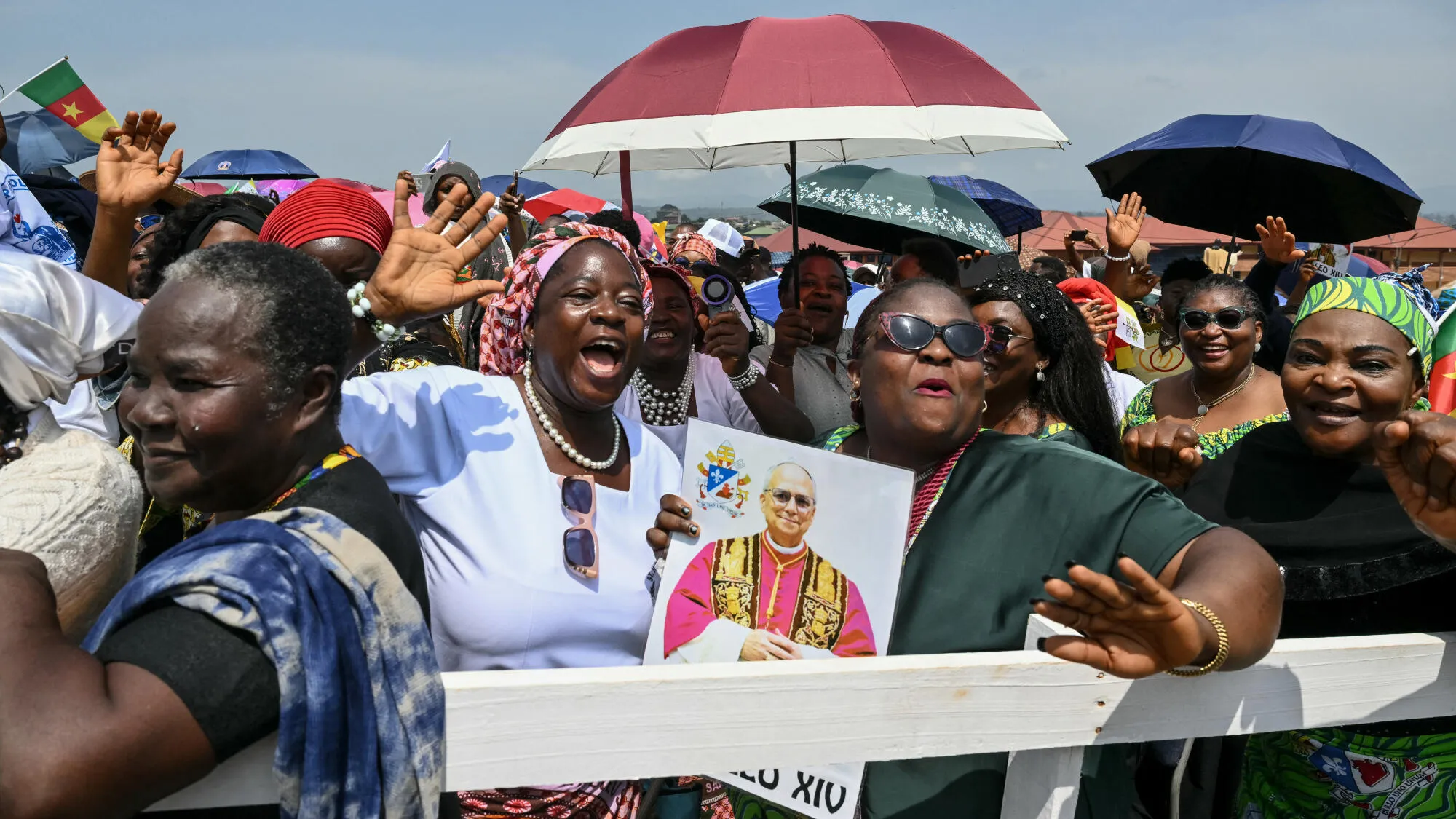
In fact, the crowds gathered along the passage of the popemobile and the great celebrations showed the usual scenes of jubilation of believers for whom it is “wonderful to experience what it means to be a disciple of Jesus Christ and to celebrate our faith together”.
An enthusiasm which did not prevent the Holy Father from being demanding, especially since the host countries are marked by inequalities and serious failings in democracy. In front of the leaders of Cameroon, he had particularly explicit words. “It is time to dare to examine our conscience and make a courageous qualitative leap and to break the chains of corruption which disfigure authority by emptying it of its credibility. »
At his side, the irremovable Paul Biya, in power since 1982, did not blink. Was he thinking of the corruption ranking established each year by the NGO Transparency International, which places Cameroon in 142nd place out of 182 countries?
Leo XIV was just as formal towards those who enjoy power without putting it in the service of peace, especially when he manipulates religion. “Woe to those who hijack religions and the very name of God for their own military, economic and political ends, dragging what is holy into what is most sordid and darkest,” he said in Bamenda, a city ravaged by a separatist conflict.
Between dreams and truces
If the words of the pope, who often visited Africa when he was superior general of the Augustinians, allow themselves to be harsh, perhaps it is because he believes that the continent is rich in exceptional human and spiritual resources, as he affirmed in Angola: “Africa is for the whole world a source of joy and hope because its young people and its poor still dream, still hope, are not satisfied with what already exists, wish to get back up, prepare to take on great responsibilities, personal commitment. »
But are Africa and the world ready to hear Leo XIV’s “project of hope”? During the Algerian leg of the trip, an attempted suicide attack reportedly took place. In Cameroon, the armed groups accepted a truce in fighting, but only for three days, during the visit.
As for Equatorial Guinea, it is approaching half a century with the same man at its head… Like his predecessors, Léon consistently recalls the demands of the Gospel. In his own way: caring, but without compromise.


