
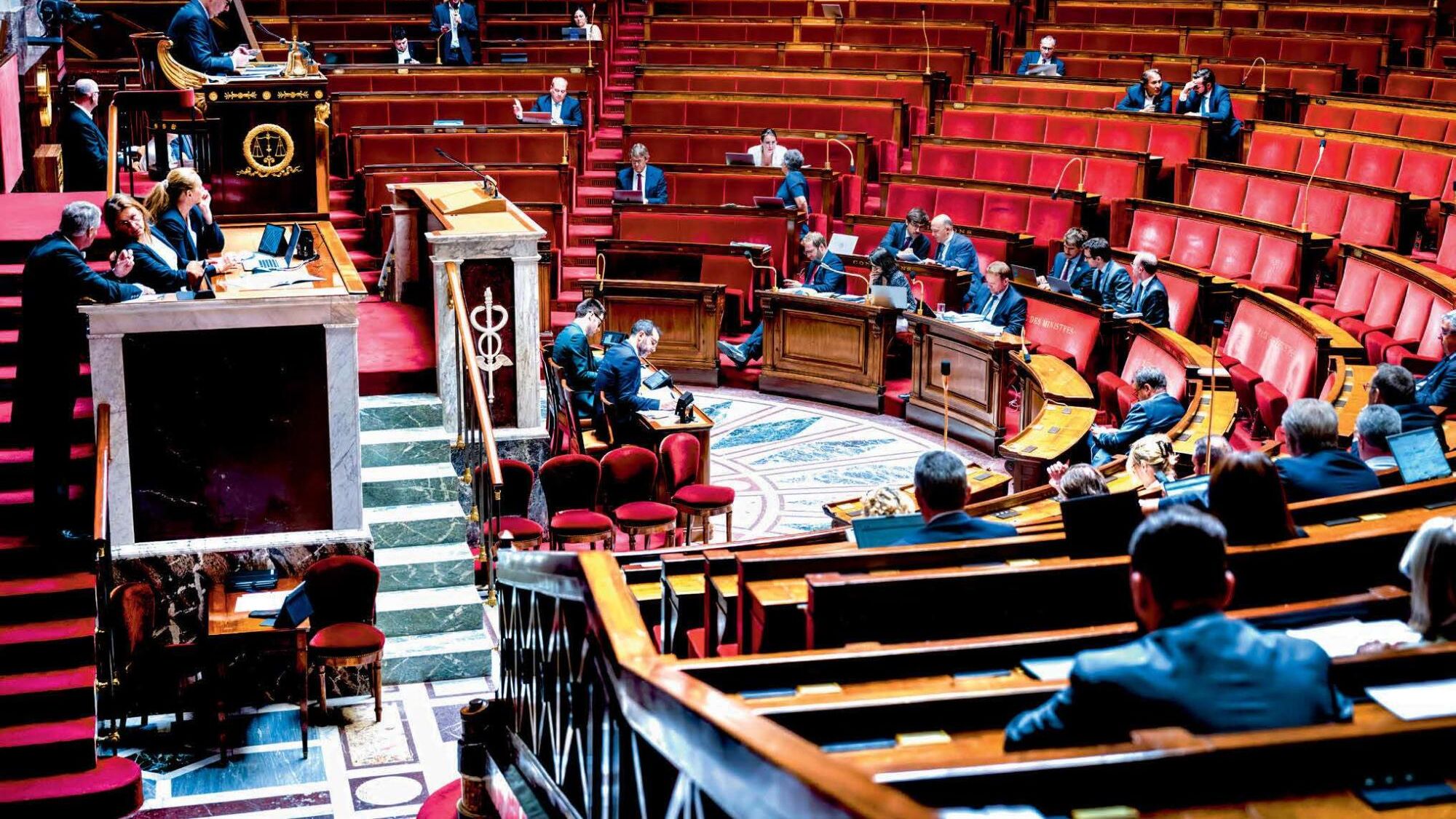
Between a divided National Assembly, transpartisan commissions and builders of agreements of agreements
France will therefore have known three prime ministers in one year: Michel Barnier, François Bayrou and now Sébastien Lecornu. The first fell following the vote of a censure motion by the National Assembly. The second lost the vote of confidence he had requested. The third will have to be creative so as not to undergo the same fate, by giving wages to political groups. The task promises to be difficult.
Because the legislative elections of 2024 fragmented the Assembly into three large antagonistic clans – the left, the presidential block and the extreme right. All against the backdrop of high public debt – which restricts the room for maneuver – and close to the presidential election, which promotes wait -and -see attitude to the supreme posts. To find the path of the compromise, deputies and parties could be inspired by other levels experienced in this practice. They prove that the agreement is not only possible, but also fruitful.
1. In commissions, in the Senate and the Assembly
Contrary to appearances, the National Assembly and the Senate are high places of transpartisan work, because the information missions and the commissions of inquiry must be led by a president and a rapporteur of opposing political groups. Violette Spillebout, macronist deputy, conducted a mission on media education with an RN deputy, Philippe Ballard, and a commission of inquiry into violence in schools with the deputy LFI, Paul Vannier. “It went very well. Philippe was competent and respectful, Paul very hard and rigorous. ”
Very quickly, Paul Vannier and she worked in the same direction because they shared the same indignation. “This commission would never have been so useful if we had not been so opposite,” says Violette Spillebout even. To the point that it wonders if it should not be eliminated in the government, theater of all the vituperations, because they would show a false image of the Assembly. “Because of their appetite for the clash, many media show them more than our committee debates,” she regrets.
“We are not a court”
Senators Laurent Burgoa (LR) and Alexandre Ouizille (PS) also had a positive experience in the Bottle Water Inquiry Commission. They completed during the auditions. “He was the bad cop, me, the kind,” smiles Laurent Burgoa.
As a right -wing man, the senator is more inclined to defend businesses. This did not prevent him from getting angry when Nestlé leaders refused to answer. He accepted that one of them was prosecuted for perjury. But he rejected other proceedings wanted by his co-rapporteur: “I didn’t want us to make the buzz to make the buzz. The strength of a commission is its seriousness. We are not a court. ” At the end of the work, Mr. Ouizille said: “I thought that the designation of Senator Burgoa was aimed at placing me under surveillance. It was nothing. Working with him was a real pleasure. ”
Senator Olivier Rietmann, LR and Liberal, too, of course with the Communist Senator Fabien Gay in the commission of inquiry on public aid to companies. Because they shared the same goal: to better distribute these aids in the interest of the country. Even if it means multiplying compromises so that the report is not buried. Their text was adopted unanimously. How to explain that all these elected officials have collaborated as well? The search for the general interest.
2. Between municipalities, in intercommunality
Many mayors do not carry intercommunalities in their hearts, since they have often been created under pressure from the state. This is the case of Mulhouse Alsace Agglomeration, the intermunicipality of the largest Haut-Rhin city, born in 2010. It brings together 39 municipalities, often on the right, sometimes on the left. Its center president, Fabian Jordan, had to be creative to make them work together, with results. Its territory is cited as an example of governance by the inter -municipal association of France. “The key is to consider the other,” says Fabian Jordan.
To prove to the elected officials that their opinion counts, he set out, he said, to make them participate in commissions or in “project workshops”, in which the future of their territory is decided. He and his team also imagined politicians so that no commune feels neglected. The smallest town halls receive aid. The agglomeration has even established a kind of veto right: if a municipality does not want a project which would touch it directly, it can reject it after a majority vote in the municipal council.
3. In municipal councils
“I pushed a big rant about the site. Then afterwards, we hugged our hand and worked. “That day, the tone rose between Christian Valentinuzzi -elected” of the minority, and not of the opposition “to the municipal council of Domène (Isère), as he says -and” the mayor “, disagreeing on the renovation plan of the municipal swimming pool. The objection of another elected official was more successful: a paddling pool will be well built next to the large basin. First councilor since 2017, Chrystel Bayon wanted to create commissions, a way to include the five elected officials (out of twenty-eight) of the minority. The discussion avoids the misses.
Christian Valentinuzzi, who worked forty-two years in an architectural firm, has the eye to identify faults in urban planning projects. But making the discordant voices heard requires a good mutual will. “I learned to be more diplomat,” confesses the retiree. Finally, the renovation of the swimming pool was voted. Some have abstained, but did not vote against. No need to block the project.
Compromise, a local virtue not found at the national level
The culture of compromise is motivated by the attachment of elected officials to their commune, in which they have sometimes been installed for several decades. “A child in the country”: this is how Pierre Ducout, ex-mayor of Cestas, in the Bordeaux suburbs, from 1972 to May 2025. The man of “Movement Delors” used this asset to bring together the right to the Communists.
Between members of the municipal council, the debates have always been “constructive”, until the departure of the councilor is felt and that new electoral opportunities appear. But the “reality principle” continued to take precedence. Many projects are voted unanimously. Like the enlargement of the church, approved from the right to the Communists, in tribute to an old priest-worker and pillar of the town.
Why does this art of compromise seem impossible at the national level? Heavy issues, more resolved ideological lines and presidential perspective. The fact remains that the French are no longer waiting for clashes. They demand agreements capable of getting the country out of the dead end.


