
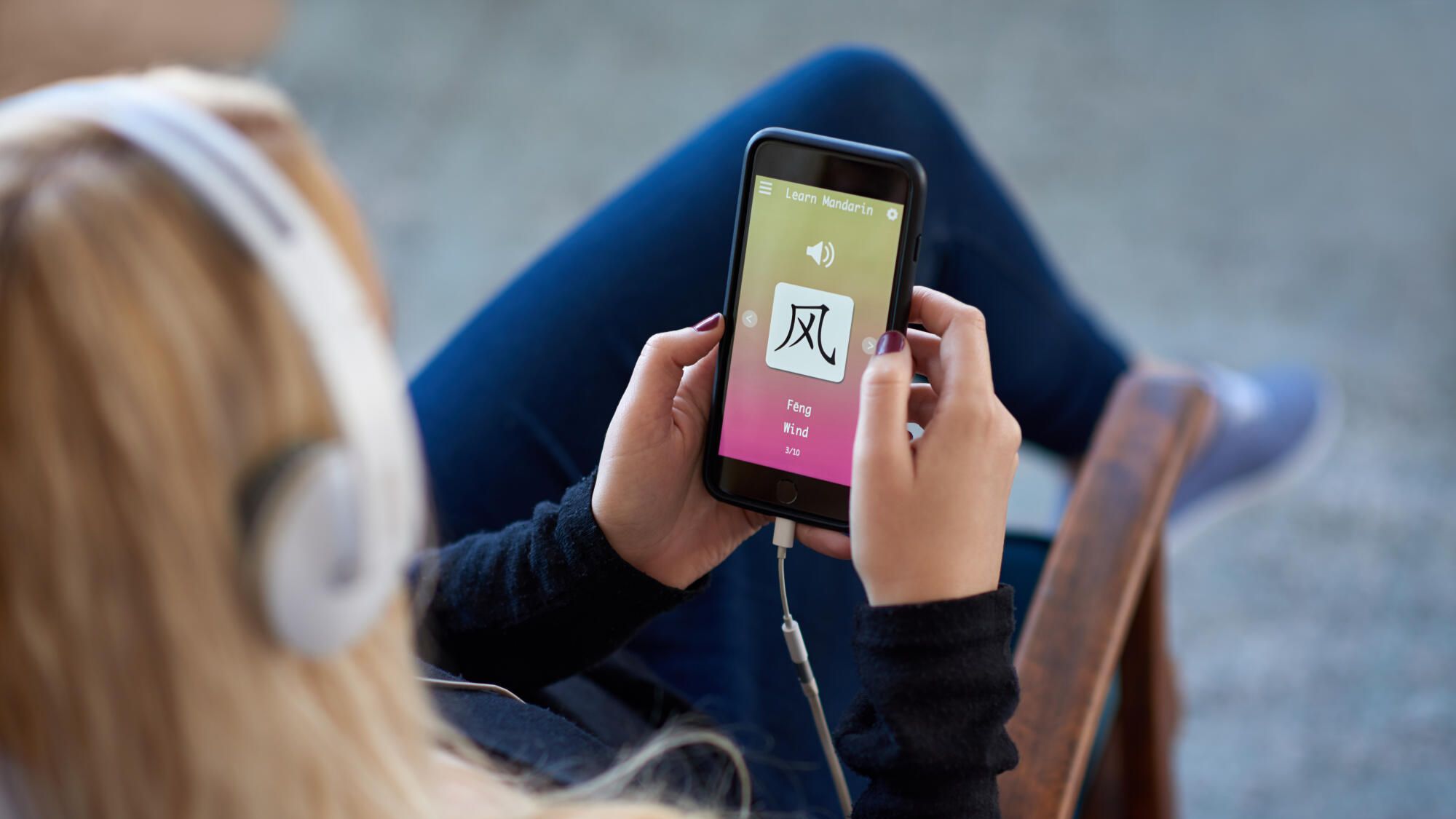
Can we really learn a foreign language thanks to an application on your phone?
With a little twinge in the heart, Bruno remembers his first stay in Italy. We are then in 2015. The young Frenchman celebrates his twenty fanfare: he went to study history for a year at La Sapienza University, in the heart of Rome. On the spot, he marvels from the ancient past of the capital, benefits from the large catalog of cultural exhibitions and establishes links with the Romans “often more open and spontaneous than the French”, according to him. His Italian level?
Rather good, because he studied the language in college, before starting school lessons. But Bruno decides to improve and connect to a digital language application, every day without fault. The platform, available on computer and mobile phone, offers several series of fun lessons to learn foreign languages, step by step.
“After my studies, I worked in the Italian capital for six years for a travel agency,” says Bruno, now 30 years old and returning to his native Haute-Savoie. At the time, I had to contact hotels, restaurants and transport services. So I continued to follow my lessons on the application to enrich my vocabulary, better build my sentences … and I always use it, to keep myself at level. ” Like many learners, Bruno uses Duolingo, the undisputed queen of language applications. Created in 2012 by an American academic, this service was the first to teach languages on digital media.
Illustration of planetary craze, the platform brings together 47 million daily users worldwide. And a myriad of competitors now compete in the market, such as the German Babbel, which gives daily lessons, or the American Busuu, where one can dialogue with natives. Some, more absurd, make us sing in English like Lirica, others converse with a virtual character like talkpal ai. Tandem, HelloTalk, Memrises … The list is infinite due to an ever more unrestrained phenomenon of globalization.
Opening thirst
From the boom in low -budget flights, we travel so easily and so often that our thirst for knowing how to extend. Exposed to new Spanish or Greek films on entertainment platforms like Netflix, accustomed to Korean pop,, We seek to know more foreign cultures. And what could be more effective than learning the language to enter the world of a country and grasp its mentality? Practical, the applications contain a thousand and one words of English or Turkish on a laptop screen.
Since the COVID years, these educational technologies have developed at high speed and compete in ingenuity to make learning fun. “I learned Spanish for two years on Duolingo and I became addicted, pouffle of laughter Pascale, 59 years old and resident of Bourg-en-Bresse (Ain). The application gives points at the end of each lesson. We can therefore compete with other users to access the bronze and then silver division, ruby … Some days, we find ourselves fighting with a mysterious user by the name of Paul258 or Fennec26 to win first place! “
In order to seduce Internet users, Duolingo uses video game codes and shapes a universe as playful as attractive. Users are attached to his mascot – a big green owl – and his characters, like a granny and a grumpy man. Quite intrusive, the owl sends notifications regularly to motivate and congratulate the user all the time. This permanent reward system gives the feeling of finally overcoming Spanish gerund or Chinese ideograms.
But is it really effective? “All the methods are good to take but it has its limits, because it does not offer oral scenario, unlike a course with a teacher and students,” replied Damien Deias, professor of linguistics at the University of Lorraine. However, tame a language is to learn to become clearer than she. When we dialogue with someone and stumble on an expression or a word, we manage to find another way of saying it. ”
“A different language is a different vision of life”
Federico Fellini Italian filmmaker (1920-1993)
Dialogues, notes and immersion
If Duolingo and Babbel do not offer interactions, other applications fill the void. To practice Spanish, Mateo chose the tandem app which makes it possible to dialogue with a native by audio messages or video calls. When he started his apprenticeship, the 22 -year -old lived in the Paris region, regularly spending his vacation in Andalusia (Spain) and dreaming of setting up there, he came into contact, on tandem, with a Hispanophone to whom he had to teach, in turn, the basics of French. “It taught me to be comfortable orally,” he says. And the more comfortable I felt, the more I improve my accent. It allows you to learn much faster. A assiduous student, the boy also took online lessons daily on the Busuu platform. “Despite all these efforts, I think we cannot be satisfied with applications to acquire a good level,” he continues. After each lesson, I had to note everything I had learned about a notebook and revise. Otherwise, I did not hold back. “
Aurore, creator of video content, is of the same opinion. For the past year, this mother of two girls, who has lived in the Var, courageously has followed Japanese lessons on Duolingo. But digital is not enough for her, she plunged back into children’s books at 40, to decipher the Kanji, the Hiraganas and the Katakanas, these mysterious Japanese Scriptures. “The best method in my opinion is to immerse yourself,” says Aurore. Today, I cook Japanese, I listen to songs in Japanese, I watch Japanese films and I put them on pause to be able to better understand an expression. ”
Natural predispositions?
Varoise is not afraid to follow this discipline, because it is fascinated by refined culture and ancestral traditions of the country of the rising sun. But she also obviously has facilities: she already masters German, English and Italian very well.
Do some individuals have natural predispositions? Yes, according to several linguistic studies. The brain of these lucky ones more easily recognizes sounds, retains more words and easily deduces grammar rules. Fortunately, other factors play an essential role, such as our work environment, our exhibition to foreign languages, and above all, our motivation. “I am particularly diligent this year because, in a few months, I go to Japan for the first time,” continues Aurore. It is a dream that is finally realized! ” On site, the content designer intends to chat and order at the restaurant in her favorite language. Her efforts already seem to pay, because she has managed to hold several simple conversations with a Japanese tourist passing through France.
Pascale, the fifties, she now masters Spanish enough to use it with ease during her vacation in the Iberian peninsula, although she does not have all the subtleties. Finally, like many users of dialogue platforms, Mateo had a romantic meeting. He lives today in Andalusia and found the young woman with whom he conversed on Tandem. Because learning a language is also opening up to unexpected horizons.
Asia as a coast
Asian languages have the reputation of being arduous, in particular, for some, because of their tonal character. A poorly accentuated syllable and what you say no longer makes sense! However, the whole world is in mind to learn these idioms today. In 2020, Duolingo revealed that among the languages recorded the strongest growth of users, five were Asian, including the Hindi and Japanese.
In France, the Korean is particularly in vogue. During 2023, the PPPLY learning platform observed a boom of 49 % of learners in France. The Korean is less useful in business, and much less spoken than Chinese, but since the 2010s, South Korea has established itself as a global cultural power. She floods us with her beauty products, her dramas – sentimental TV series – and her k -pop, a musical genre whose young singers have become superstars. So many assets that even shade one of the favorite countries of the French: Japan.
The most studious countries
The only application to provide such precise data, Duolingo establishes a global ranking of its students each year according to their attendance. Understand: countries where users spend the most time to their lesson on the application.
The latest reports indicate that the eastern countries are particularly studious in learning English. Belarus, Czech Republic and Hungary regularly occupy the first three steps of the podium, ahead of Germany or Ukraine. But, in 2024, the title of the most diligent to master the language of Shakespeare was delighted by Japan!